


After beating Connecticut on Saturday, the Wolverines completed one of the best college basketball seasons of all time. Arizona finished third in the final AP poll, behind only the two championship game competitors, despite many declaring in advance that the semifinal game featured the two best teams in the nation. However, clearly the manner of defeat for the Wildcats left room for many voters to change their mind.
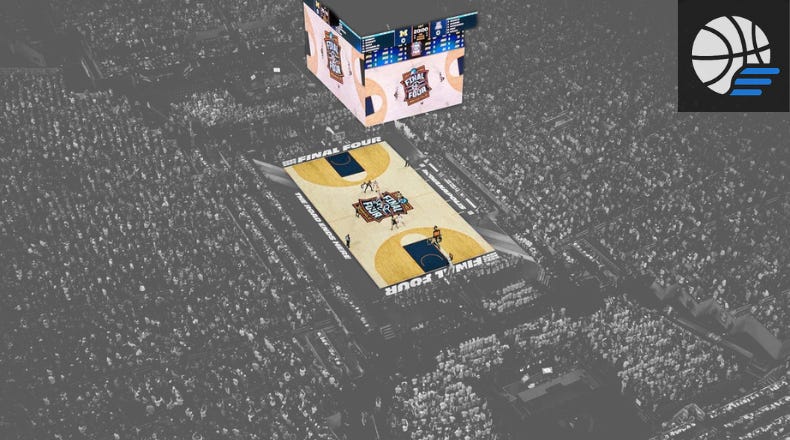
Even without the trophy, this year’s Wildcats make a good case to be the school’s best ever. They were the Big 12 regular season and tournament champions and got Tucson back to the Final Four for the first time since 2001. It was a remarkable season.
In the postgame press conference, Coach Lloyd said, “Obviously [Michigan has] the kryptonite right now. So that’s going to be a fun thing for me to try to figure out this offseason.”
I appreciate that amidst an extremely disappointing moment for himself and his team, Coach Lloyd would evoke the word “fun” in this manner. As a coach, this is all part of getting better by solving the next puzzle in front of them. That’s exactly the winning mindset you want from your program’s leader.
Last week, I wrote that I wish the Michigan matchup was a seven-game series. The Wolverines would certainly be favored, but not by as much as it might seem based on one game. In Tommy’s spirit of having some fun learning from this, and with the benefit of a whole lot of hindsight, let’s take a look at what the Wildcats would re-emphasize and what they might have changed if they had another crack at it.
Michigan Game 2
Adjustment: Make more shots
When a team loses like the Wildcats did, it can be tough to rebuild the confidence of players who looked at least a little shaken. While you can’t BS away some of the issues, you want to convince the team that what happened was an anomaly. So while this is really a fake adjustment, I think it is a good one to start with psychologically.
There’s a fairly empty platitude that basketball games sometimes come down to who makes shots. Coming into the game, Michigan led Arizona in eFG% 58.0 to 55.1. But on Saturday, the Wildcats had an eFG% of only 40.8%, while Michigan’s was 56.5%.
Some of that is due to the defense, but there also may have been shooting luck involved. The question would be, “did we get the shots we wanted and not make them or did we not get the shots we wanted?” Not every shot was wide open, but I think there was a large number of shots that didn’t go down on Saturday that the Arizona players would say they would make more often than they would miss.
It might be tough to watch, but it highlights that part of the reason this game was never close was partially just due to bad shooting. That’s not a big consolation after this one game, but if there was another, it’s a positive because regression to the mean would be on the Wildcats’ side.
In another contest, it’s unlikely that Brayden Burries, a 39% three-shooter, will go 2-10 from three with most of them very open. It’s unlikely Koa Peat, a 54% two-point finisher, would go 5-17 from two.
At 68.1%, the Wildcats even shot under their season free throw percentage of 73.4%, including a crucial point in the game where Mo Krivas missed two followed by Ivan Kharchenkov missing the front end of a 1-and-1 when the score had closed to 30-23.
Emphasize: Get more shots
Arizona actually won the total rebound battle 44-40. That’s hard to do when you miss nine more shots and six more free throws than your opponent. I prefer to look at rebounding percentage broken down by offense vs defense.
When we look season-long, Arizona’s ORB% was 38.0% and Michigan’s DRB% was 75.1%. In this game, Arizona rebounded 38.3% of their own shots, so clearly won this battle.
On the season, Michigan’s ORB% was 34.6% and Arizona’s DRB% was 75.5%. In this game, Michigan got 29.7% of the boards on their misses. So this result fell right in the middle.
Overall, Arizona won the rebounding battle and I think it would be worth emphasizing that they could dominate that factor even more by being aggressive pursuing loose ball rebounds on the defensive end of the floor.
Meanwhile, it felt like the Wildcats turned the ball over a ton, even though they finished with only one more turnover than the Wolverines. But that is a place for improvement. Arizona had averaged a turnover on 15.2% of possessions and turned it over 18.1% of the time in this game.
Michigan gets credit for some of this as well due to its defensive scheme, but I think it would likely be less effective after being seen once. It is one thing to say “pack it in and make Arizona shoot”. Almost every team that the Wildcats have played this year has tried some version of this. But it is another thing entirely to commit to and execute that strategy.
Here is Michigan’s first possession of the championship game versus UConn, annotated by the great Jordan Sperber at HoopVision:
As we discussed last week, the Wolverines use a switch-heavy defensive scheme, 1-4 around the perimeter. But Arizona does not use a lot of guard-guard actions, which, as expected, made the switching a lot less relevant. So what did the Michigan defense look like against Arizona, again credit to Jordan Sperber:
Sperber’s article is worth a read to fully explain how the Wolverines guarded by going under on most screens. Part of the adjustment is already covered in our “make more shots” section. If a team is going to regularly go under screens, the easiest way to punish it is to knock down some shots off the dribble.
But in the cases where a player doesn’t take that shot, they need to know they are driving into a crowd. Arizona would need to emphasize that drivers have a plan before getting into the paint, either to get a shot or to have a pass back out option in mind. Ivan Kharchenkov was the primary, but not only, culprit here.
It’s good to give a look at an example of where the Wildcats had success by not over-dribbling.
Adjustment: Change Location and Angle of Ball Screens
The most common way of attacking “under” ball screen coverage is by re-screening, sometimes called Twist action. Here’s Fran Fraschilla explaining it at a coaches’ clinic and some in-game examples. You’ll see players use this to walk the screen closer to the basket, to give themselves an angle to step back into a three, or even just to make the defense work over and over again.1
Another option, one that Krivas has already used this year and that all of the posts could have used versus Michigan, would be to dribble lower against the sagging defender.
The deeper these dribble handoffs occur, the more difficult it is for the perimeter defender to go under. In the situations where Aday Mara stayed back to cover the rim, there wasn’t a lot of advantage in Koa Peat or Tobe Awaka attacking at him. However, they still could have improved their positioning with a single strong dribble to the free throw line. If a defender still chose to go under, this is an open three-point opportunity off the catch.
Emphasize: Play Through the Posts
If you watched the championship game, UConn posted up Tarris Reed Jr. a lot with mixed results. However, this was a battle that Arizona won, especially with Krivas. Typically, the Wildcats move the ball east-west on the perimeter to set up high-low action between the two posts. But they were most successful just getting the ball to the wing and throwing it into the low (usually left) block.
Adjustment: Improved Rotations
Despite Mara’s career-high 26 points, I would argue that Krivas mostly won the battle with him on that end as well. Here are the baskets that Krivas gave up to Mara:
A lot was made over Elliot Cadeau “intentionally” missing shots off the backboard. The only time I’m confident that occurred was the first play of the game. In the first two clips, Krivas could use a slight adjustment to not help quite as hard on Cadeau and stick with the strategy of making him be a scorer. Krivas certainly should get a hand up on the Mara 15-footer, but that was the only bucket that Mara got on him 1-on-1.
Here are some of Krivas’s defensive highlights from this game2:
Unfortunately, here were the buckets that Mara got when Krivas was not guarding him:
Put simply, no one on Arizona can cover Aday Mara except Mo Krivas. In the 21:02 that Mara and Krivas shared the floor, which included the first few minutes of the game where the Wildcats were in a daze, Arizona was plus 5. Let me say that again: the Wildcats beat the Wolverines in the minutes that Krivas and Mara both played.
In the 8:47 that Mara played and Krivas didn’t, the Wildcats were minus 15.3 In a rematch, Arizona would need to strongly consider making time be 0:00. Matching Krivas’s minutes to Mara’s wouldn’t necessarily mean Krivas would need to play more, but he could have. Krivas, who was clearly Arizona’s best player against Michigan, played only 28 minutes, despite recently playing 32 against Utah State and 35 against Purdue.
The other rotations to look at would involve the three subs, who had the three worst per-minute plus-minus: Awaka minus 16 in 17 minutes, Dell’Orso minus 20 in 18 minutes, and Aristode minus 9 in 10 minutes.
Some of that was necessary because of Jaden Bradley’s foul trouble, which he would need to be more aware of as it looked like Cadeau and others were purposely trying to put fouls on him. And Aristode likely only got into the game because Kharchenkov was struggling so significantly on offense.
However, the starters getting spooked to start the game likely led to the balance between starter and bench minutes to be less than ideal. The bench combined for 50 minutes4, compared to 21 in the Purdue game.
Adjustment: Take Timeouts
One way to settle your starters is to sub them out. Another is to use a timeout. Coach Lloyd took only one timeout during the competitive portion of this game. That timeout came at 14:27 with a 16-5 score. It was the earliest that Arizona has used a timeout this year and many might argue it did not come soon enough.
This has been a topic repeatedly in this newsletter. Coach Lloyd prefers his team to “figure it out”. But in a situation where the team looked not itself, this may have been a spot to zag.
When Arizona went on a 7-0 run from 8:51 to 7:21, Dusty May called his first timeout. The Wildcats got one bucket closer before the Wolverines pulled away again and were back up 12 when Brayden Burries got trapped and called the team’s second timeout. By the time Coach Lloyd took his third timeout, at 12:17 in the second half and facing a 72-45 deficit, the game was over.
As I’ve said all season, it’s reasonable to want to keep two or more timeouts for the end of the game. But if the game is already lost by then, it doesn’t do a whole lot of good. Arizona doesn’t get to carry over its remaining timeout to next year.
Emphasize: Covering Cadeau
This was probably my biggest error in evaluating this game. I thought Arizona’s guards would win their matchups and did not give Cadeau enough credit. However, I think the scout was mostly correct and that the execution left some to be desired.
As discussed above, Arizona could have done a little better to stay home so as to be in better defensive rebounding position. Cadeau shot 5-17 from the floor, but gets a lot of credit for his passing, especially in transition as he finished with 10 assists.
There were two breakdowns that could be addressed. First, Cadeau’s best option as a scorer is to shoot the three coming off the ball screen. Arizona had some trouble getting through screens to challenge that shot.
In the first two clips, Arizona is soft-hedging using a show and recover under. This was not a screen defense I saw much of the Wildcats using this year and Cadeau recognized it and called for a re-screen in clip one before knocking down the three. Clips three and four show Wildcats getting stuck on (or even under) the screener. This could all be cleaned up.
The other breakdown was very uncharacteristic of Arizona and involved allowing Cadeau to reject the ball screen against drop coverage.
As designed, Krivas is aligning himself to protect the driving lane as Cadeau comes off the screen. It is the on-ball defender’s job to push the ball handler into that screen. Once Cadeau is able to reject the screen and get into the paint, the Wildcats were in trouble.
Although, this never led directly to a bucket, Michigan took advantage of Arizona being out of position in three different ways: a kick to a shooter whose defender helped, attacking a switch leading to a foul, and an offensive rebound leading to a three-pointer.
Wrap Up
As fans are inclined to do, there were plenty who were quick to assign blame, either to specific players or to the coaches. I hope the above breakdown is not taken to be that. When a game goes awry like this one did, everyone takes account of what they could have done better. And since I’ve spent all year doing postgame breakdowns, it seemed only right to try to explain some of what happened.5
This was a discouraging ending to an amazing season. The coaching staff and players deserve tons of praise and personally, I couldn’t have picked a better year to give extra attention to this program. On behalf of Tucson, thank you to all the members of this program that took us on a really enjoyable ride.
Where From Here?
And just like that, the 2026-2027 season has begun. Arizona has two incoming freshmen committed. Shooting guard Caleb Holt is ranked by ESPN as the #4 player in the class and swingman Cameron Holmes is a 4-star recruit from Phoenix.
On Tuesday, the transfer portal opened. Whatever models teams use to evaluate both the playing ability and now monetary worth of players need to be developed long before now. With over 1,000 players in the portal in the first day, there is no way to realistically scout all of them.
Estimating the market for a player and backchanneling interest in both directions in commonplace. Building a roster is effectively a high-stakes knapsack problem, but connecting with people in recruiting will never lose its importance.
I would only be repeating reports and rumors about what players Arizona might have interest in, but for the potential returners, it’s worthwhile to walk through their situations. First, a big thank you to the seniors: Jaden Bradley, Tobe Awaka, and Anthony Dell’Orso.6
NBA Rookie Contracts
For players considering making the jump to the NBA, there is a great difference between being picked in the first or the second round. Players who are picked in the first round receive a contract that guarantees two years with team options for years three and four. Those options must be exercised by October of the preceding year. In practice, almost no one gets cut before year three and few get cut before year four.
The NBA is currently projecting a 6.65% increase to the salary cap, which is tied to the rookie scale.7 If that projection holds, here are the contracts that players will be set to sign:
1st pick: four-years, $66.9M
10th pick: four-years, $29.2M
20th pick: four-years, $18.9M
30th pick: four-years, $15.0M
There are very few college basketball players that make more than $3.75M per year, the amount the last pick in the first round of the NBA draft will make on average over the length of his contract. Furthermore, the big money comes in players’ second and third contracts, so there is value in starting the clock on a rookie deal as early as possible.
While there is a second round exception available to teams, they are allowed to sign players to minimum salary contracts, use other exceptions, or use cap space to sign players selected in the second round.
Last year, the 31st pick Rasheer Flemming, signed with the Suns for 4-years, $8.7M with a team-option on the final year that has a deadline of June 28th, making it much easier to decline.8 Picks 32-38 signed for the same amount, as did picks 49 and 56.9
Nearly every other player signed a 1-year, $636,435 two-way contract to split time between the NBA and G-League. Despite being drafted, these players are fighting for their NBA lives from day one.
Brayden Burries
Burries is currently being mocked somewhere between 10-20 with a small chance of jumping into the top 10. If he goes at 15, he will make nearly $5M in his first season. This is a no-brainer, Burries has to go.
Koa Peat
There are a lot of people clamoring for Peat to stay an extra year. Projected as a top-10 prospect out of high school, Peat has fallen to the late teens, early twenties range in most mocks. Next year’s draft class is supposedly much weaker and the argument is that if he can show range out to beyond the arc, he could jump back to the top 10 and maybe top 5 in 2027.
Peat actually finished the year at a respectable 35.0% from three including making his final attempt of the season.
That shot looks a lot better now than it did in November, but Peat only averaged 0.6 three-point attempts per game this season. The comp for this is Derrick Williams, who shot 25.0% on 0.5 attempts as a freshmen and then 59.5% on 1.9 attempts as a sophomore, becoming the #2 overall pick in 2011.
No one would expect Peat to shoot 60% from three next year, but if he could even maintain the 35% on 2-3 attempts per game, NBA teams might be much more sold on him.
However, there is a lot of downside risk here. If he decides to return and isn’t able to show range, he may fall off team’s draft boards entirely. He would make $3.9M in year one if drafted at pick 20 and have a team committed to developing him for multiple years. I think that is too good an option to pass up and therefore, he will almost definitely leave.
Motiejus Krivas
Here’s where it starts to get interesting. Krivas was not on draft boards to start the year but has progressively ascended thanks to his play primarily on the defensive end. Mocks have him anywhere between 20-40, but more often recently in the 20’s.
Going 25th, Krivas would make $3.2M in year one. But this starts to get to a risky spot in the draft where a player could easily slip to the second round. Teams are loathe to give promises to players this deep in the first round as those picks are prime to get swapped on draft night.
If he returns, and avoids injury (always a risk), I find it hard to believe he would be anything other than a first-round pick next year. I could see Krivas having a much more important offensive role for the Wildcats next season, being a go to scorer in the post. And if forced to bet on either on Krivas or Peat to extend range to three, I actually like Krivas’s chances more. He shoots a good ball and is a good free throw shooter for a big man, typically a indicator that a player could one day shoot the three.
Krivas will certainly put his name into the draft pool. He will have all the way until May 27th before he will have to decide to keep his name in or withdraw. If his agent is able to get a consensus among teams that he will go in the early twenties, he is probably gone. I would lean slightly to this outcome.
Ivan Kharchenkov
Similar to Jaden Bradley, who twice entered his name in the draft and then withdrew, Kharchenkov should go seek feedback in the draft process. His strength is clearly on the defensive side of the ball, but his offensive weaknesses were just on full display in the Final Four. He needs work as a creator on the offensive end.
If he were to enter the 2026 draft, he would likely be a mid to late second round pick, but he could intrigue some teams during pre-draft workouts. Unless he moves up significantly, I’m not sure why he would consider that a good option. He could also go back to Europe or transfer to another school if he thought there was a better opportunity, financially or playing-wise.
This will probably be a mess. I could see Kharchenkov entering his name in the draft and the transfer portal, only to end up back at Arizona.
Dwayne Aristode
Unfortunately, I would not expect any decision from Kharchenkov until near that May 27th withdrawal date. And that probably means that the Wildcats will lose Aristode.
Both Aristode and Kharchenkov played small forward this season. If they both came back and wanted to start, could they play the 3 and the 4? Maybe, but that would require the coaching staff to make some pretty drastic changes to the way they like to play.
Caleb Holt will absolutely start and although he has referenced wanting to be like Jaden Bradley, he is not currently a high-major point guard. Perhaps he could play that role in some backup minutes like Burries did this year, but I don’t see Arizona starting Holt/Aristode/Kharchenkov on the perimeter. Like Kharchenkov, Aristode needs reps as an on-ball creator to improve and I’m not sure the Cats can go into the season confident they can both start.
If Aristode is satisfied to take a sixth man role, he would see increased minutes next season. Then the question of how much Arizona can afford to pay a sixth man comes into play, especially when it appears they will need to pay a point guard (or two) and a power forward either from the transfer portal or internationally.10
Aristode should definitely get his name into the portal before the April 21st deadline to do so. There is no deadline for him to sign elsewhere or return so he could ride out Kharchenkov’s draft process until the end of May to make a decision. However, many of the offers he could have between now and then might be gone by that time.
Aristode has a wide range of possibilities. If he doesn’t improve as a dribbler, he might never play a game in the NBA. But his upside is super high. I said earlier this season that if I had to guess which guy on this Arizona team would become an NBA all-star, he would be my choice.11
To the dismay of all Aristodians, my gut tells me that development won’t happen at Arizona.
Arizona had two moving screens in this game. When defenders go under, screeners need to be careful not to roll early.
The last of which should have been offensive basket interference.
For completeness, the combo of Krivas-on/Mara-off was minus 10 in 7:05, and both off was plus 2 in 3:06.
Five were garbage time.
Even if rewatching this game twice was brutal.
An executive order signed last Friday could theoretically open the door for their return, but I consider this to be extremely unlikely.
First round picks can be paid anywhere from 80%-120% of scale but nearly every rookie is paid at 120% of scale.
Either to let a player go or to force them into restricted free-agency.
Maxime Raynaud signed a 3-year version of this contract with the Kings.
That’s assuming that Sidi Gueye can play backup center, which also might be a stretch.
I’d probably switch to Burries at this point after the way he improved throughout the course of the year, but Aristode is still second.