


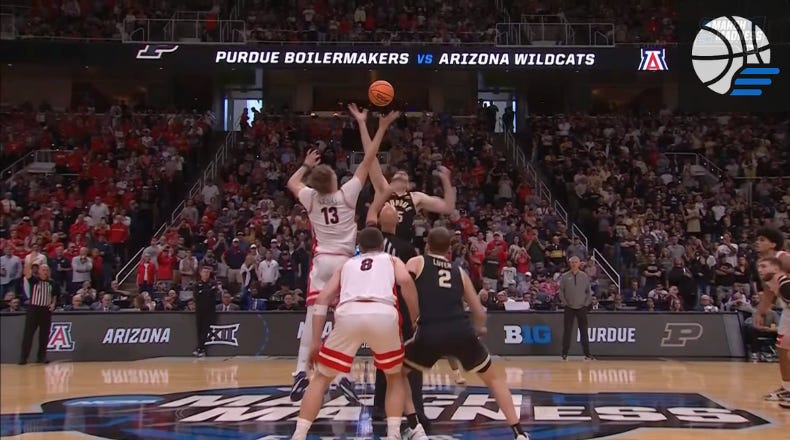
After 25 years, Arizona will play in April. The Wildcats dominated the second half against Purdue, overcoming the Elite Eight hurdle that had previously impeded them five times since 2001. They now prepare for a third-weekend NCAA Tournament clash with Michigan.
Final Four Preview
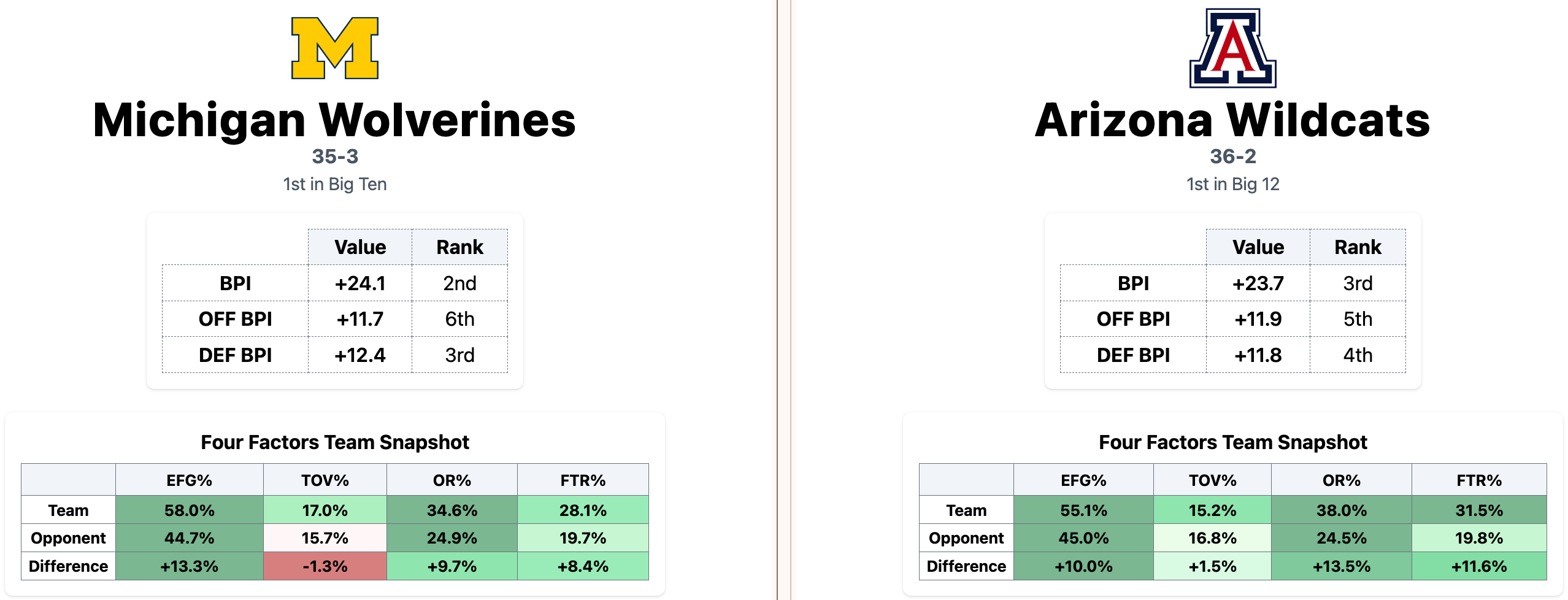
Michigan won the Big Ten regular season championship and lost in the tournament final to Purdue. The Wolverines have played 13 ranked opponents, going 11-2. As far as common opponents, they have played TCU (W), San Diego State (W), Auburn (W), UCLA (W), Purdue (1-1), and Alabama (W).
(Source: ESPN Analytics)
With all due respect to Connecticut and Illinois, either of whom could win a national championship on Monday night, the semifinal matchup between Michigan and Arizona features the best two teams in the country. KenPom1, EvanMiya, and just about anyone using the eye test now rank these teams as the top two in the country and top six on both offense and defense.2
Defensively, these teams are nearly identical. Both have speed on the perimeter and power on the inside. They have the same effective field goal percentage defense, they defensive rebound about the same, and they send opponents to the line at the same rate. Michigan forces slightly fewer turnovers than the Wildcats.
Offensively, Michigan is really a joy to watch. They are incredibly well balanced. Six of the eight players in the Wolverine rotation have usage rates between 18.3% and 21.4%.3 They are an excellent passing team, 99th percentile in assists per game. There will absolutely be a point in this game where it feels like the Arizona defense is chasing Michigan from behind all over the court as the ball swings from Wolverine to Wolverine.
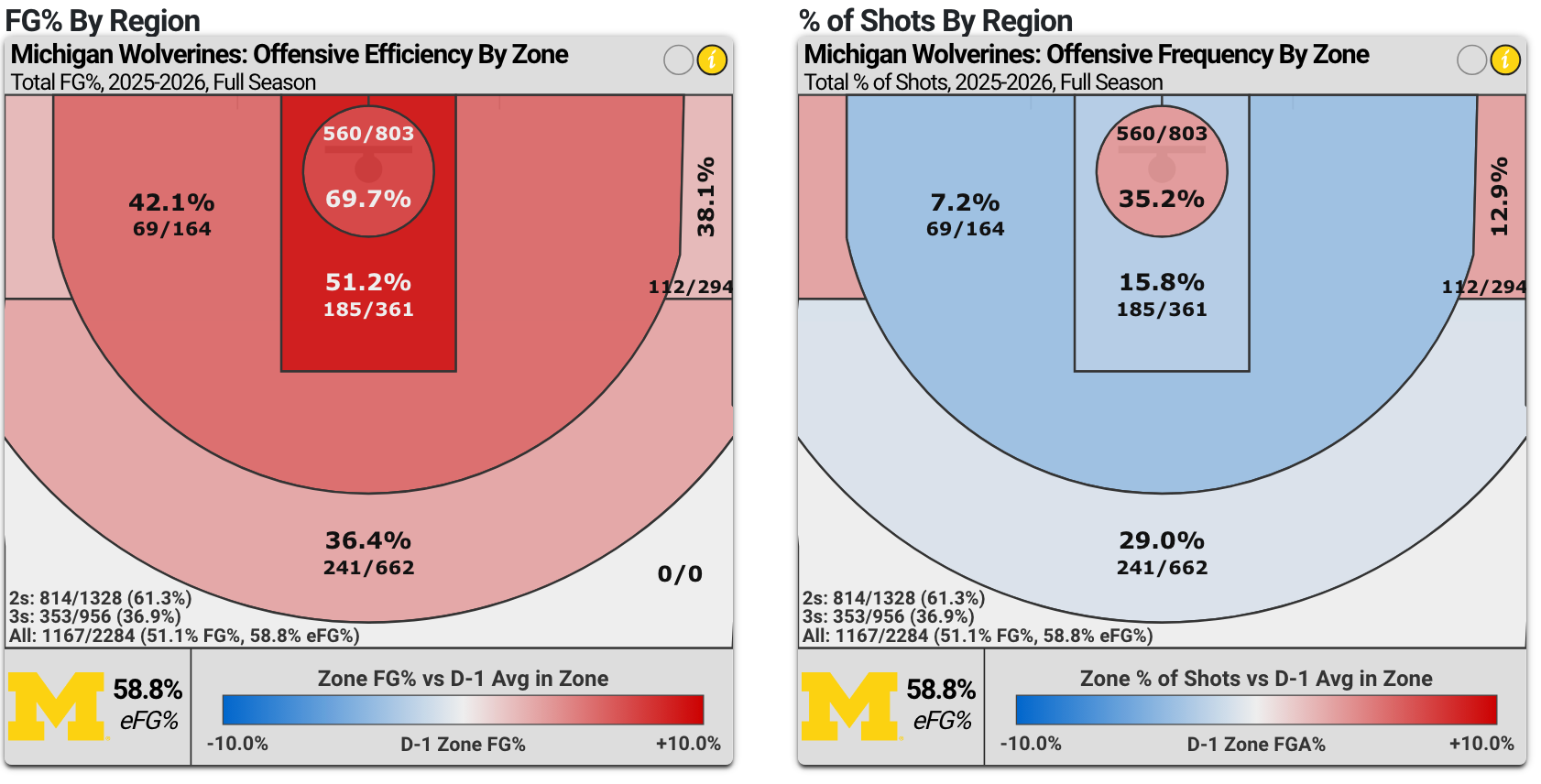
They are also in the 99th percentile in effective field goal percentage and their shot charts are just about analytically perfect.
(Source: CBB Analytics)
They shoot 2.5% fewer paint-non-rim shots than the D1 average and 3.5% fewer midrange shots. All those shots are redistributed to the rim and the corner three. In each area they shoot 3.5% more frequently than the D1 average. And as far as making the shots they take, they are somewhere between above-average and elite from every area on the floor.
However, Arizona has edges in the other three offensive factors, turning the ball over less, offensive rebounding more, and earning more free throw opportunities.
Personnel
Michigan uses an 8-man rotation since backup point guard LJ Cason was lost for the season after suffering an ACL tear at Illinois.4 When breaking a team down offensively, I think using archetypes is a fairly good way to start, and I tend to do that first by evaluating their size and three point shooting.
For context, Jaden Bradley shoots 39% from three, but on only 3.2 attempts per 100 possessions. Brayden Burries shoots 40% on 8.4 attempts. Michigan and Arizona both play at a high but not ultra-high pace of just under 70 possessions per game, with slightly fewer in postseason play.
Point Guard
Elliot Cadeau (3) - 6’1” 180 - 38% on 8.8 - Cadeau is the engine that makes the Michigan offense run. Similar to the last two games against Darius Acuff and Braden Smith, the Wildcats should be happy to go over screens, force Cadeau inside the arc and make him be a scorer.
The difference is Cadeau probably just won’t take the bait. He shoots very few of his shots at the rim or in the midrange and is not very successful when he does. If he drives, he is hoping to get someone to help so he can make the next pass to a teammate who can use that advantage. He will shoot the three if Arizona defenders get stuck on screens.
Wings
Trey McKenney (1) - 6’4” 225 - 38% on 11.1 - McKenney is the best offensive player of this group. He excels beyond the arc, but can also create his own shot. Unlike Cason, McKenney is less of a creator for others, which changes how Michigan looks in the minutes Cadeau goes to the bench. McKenney is an 89% FT shooter, compared to Cadeau’s relatively low 69%.
McKenney is the weakest defender among the Wolverine perimeter players. It would be wise of Arizona to try to put him into some actions and see how he handles it.
Roddy Gayle Jr. (11) - 6’5” 210 - 32% on 4.6 - Gayle is the best defender of this group. His steal rate is decent and his block rate is very high for a guard, plus he contributes on the defensive glass.
He is not nearly as good a three-point shooter, but he will slash and crash the offensive glass. He is also not a great creator for others, primarily because he turns the ball over too much.
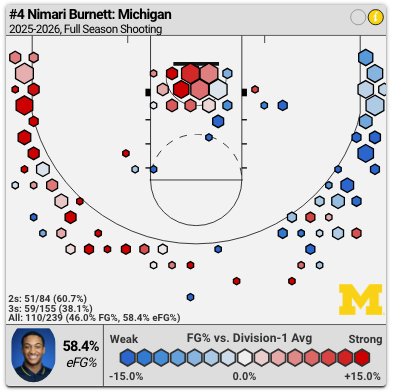
Nimari Burnett (4) - 6’5” 195 - 38% on 11.5 - Burnett gets the start at the two because he is a better shooter than Gayle and a better defender than McKenney. Burnett is also not a primary creator, but rather a spot-up shooter, especially from the left side.
Posts
Morez Johnson Jr. (21) - 6’9” 250 - 36% on 1.9 - Johnson’s game is a hybrid version of Koa Peat’s and Tobe Awaka’s. While he has the size and tenacity of Awaka, he moves around the floor more like Peat. He can shoot the three if left wide open but nearly all of his work is done at the rim.
He is an outstanding defender and rebounder that can and will cover all three of Arizona’s posts at some point.
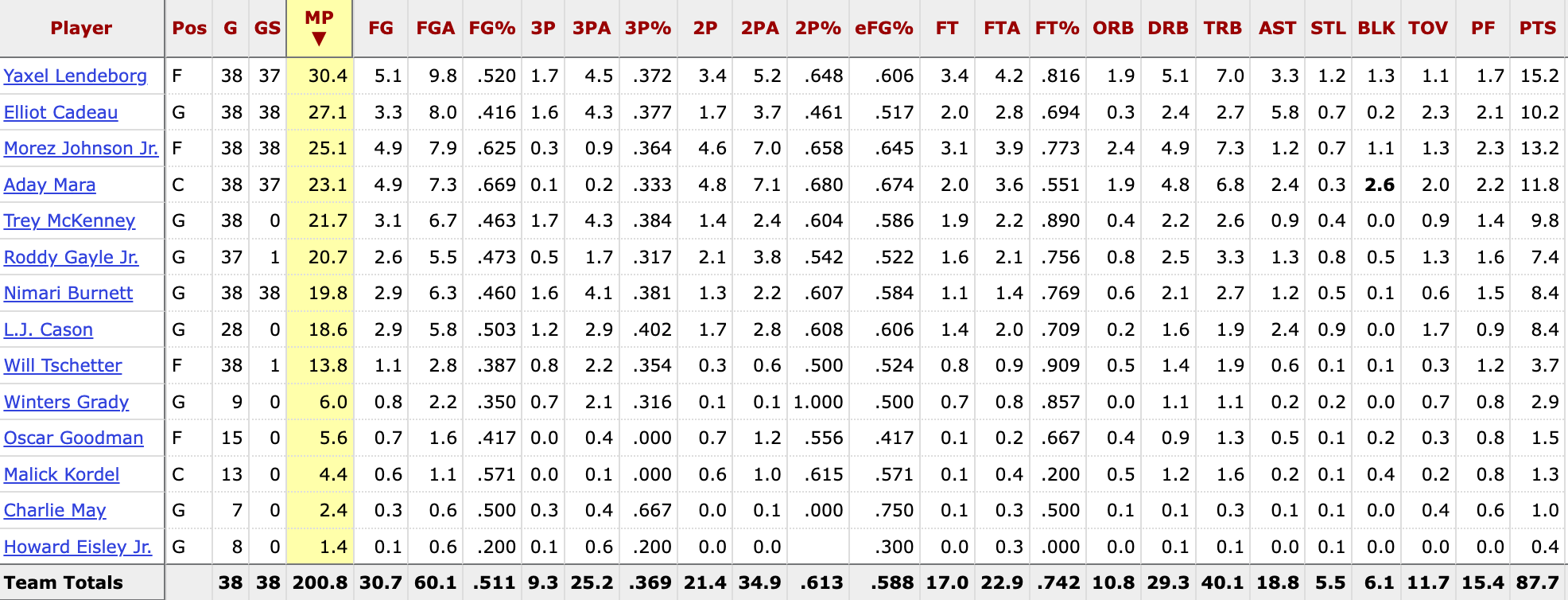
Aday Mara (15) - 7’3” 255 - 33% on 0.6 - Mara is one of the best shot blockers in the country and he alters a lot of attempts. His defensive positioning is not quite as good as Mo Krivas and he has struggled with foul trouble in some games this year.
Offensively, he is a threat as well. He can roll into lobs or post up and finish with either hand. He is also a very good passer for a center. He is a bad free throw shooter, at 55%.
Will Tschetter (42) - 6’8” 230 - 35% on 8.8 - Tschetter changes the game for Michigan because he will defend posts on one end, but spread the floor on the other end. 79% of his shots this season have been three pointers. Michigan’s defense is somehow also better with Tschetter (DRtg: 95.3 on vs. 99.0 off). It is a little surprising to me that he doesn’t play more. Michigan will run after-timeout (ATO) plays for him. Here are two:
Yaxel
Yaxel Lendeborg (23) - 6’9” 240 - 37% on 8.3 - Lendeborg gets a section all to his own because he is Michigan’s best and most versatile player. Despite his size, he is not a post. He is a small forward.
Lendeborg is 23 years old and in his sixth year of college basketball.5 If he were a 19 year old freshmen, he would be in conversations to be a top-five pick in the upcoming draft.
At only 20.5%, Lendeborg has the lowest usage rate among the 15 AP All-Americans. You can compare that to AJ Dybantsa’s 33.9%, for example. He is not what you think of when you think of a star player. He shoots very few bad shots, but rather takes and makes a lot of threes and finishes at the rim. He does not ball stop, does not turn the ball over, and creates a lot of shots for others. His assist to turnover ratio is 3.1, in the 99th percentile in the country.
He is also one of the best Wolverine defenders, able to guard 1-5 against many opponents. His steal and block rates are high and his foul rate is low. He is not quite the rebounder that Johnson and Mara are but he holds his own.
(Source: Basketball Reference)
Optionality
There’s long been an argument for having backups with similar archetypes to the starter that they would replace. It allows a team to run similar offensive and defensive schemes, rather than having to practice multiple. This has recently been replaced by a desire for optionality, a buzzword meaning how flexible a team can be.
As discussed previously, Arizona plays almost all of its possessions with two guards, one small forward, and two posts. They play some with three guards, either with Kharchenkov at the four or out. But that’s about as far as they can adjust.
One advantage that Michigan has is the luxury of playing many different ways, and a lot of that has to do with Yaxel Lendeborg.
Yaxel at the Three
Let’s start with this because it is Lendeborg’s natural position and what the Wolverines will start the game with.

Arizona’s starting lineup has played 28% of its possessions (685 / 2,437). Michigan’s starting lineup has played only 17% (421 / 2,476).6 The numbers indicate that this is a better than average defensive lineup for the Wolverines (primarily because they send opponents to the FT line less), but not quite as good of one offensively as there is less spacing.
Arizona will have to match up pretty much straight down the line. After their Sweet Sixteen win over Alabama, Lendeborg told reporters he felt “disrespected” that the Crimson Tide chose to cover him with a freshman. Well, he is going to get a lot of that on Saturday, because Ivan Kharchenkov is likely to have the assignment.
Very few teams can cover Lendeborg with anyone even close to his size, and when they do, he typically has a major mobility advantage. Kharchenkov gives up 2 inches and 20 pounds, but it would really take Michigan away from their game to have Lendeborg trying to back Kharchenkov down into the post.
Kharchenkov will need to work to keep Lendeborg off the offensive glass and he cannot afford to get into foul trouble. Arizona will not play their three posts together and none of the guards can cover Lendeborg. If Kharchenkov gets fouls, and Michigan stays with their “big” lineup, Dwayne Aristode will have to play. He combined for four minutes of action last weekend and is really a break-in-case-of-emergency option now.
It would not be crazy to say that the Wildcats have the advantage at all four of the other starting spots. Bradley is bigger than Cadeau and just as fast. He is really the perfect type of defender to get narrow through screens and chase Cadeau off/inside the three-point arc. Burries absolutely must win his matchup no matter who is at the other guard spot for the Wolverines.
Johnson is a tough cover for Koa Peat. He is bigger and very aggressive. Peat needs to be ready to go from the tip and battle for every rebound. If there was ever a time for a year of practicing against Tobe Awaka to bear fruit, this is it. My guess is that Mara will outscore Krivas in this game, but Krivas can have a bigger impact if he provides help on Cadeau and Lendeborg and especially if he can out-rebound Mara.
On the defensive end, Lendeborg often is Michigan’s point of attack defender and I would not be surprised to see him start on Jaden Bradley. Cadeau would cover Burries and Burnett on Kharchenkov.
The Wolverine defense has had a ton of success, partially by being extremely switchable on the perimeter. However, that strength is pretty well negated by the fact that Arizona runs very few guard-guard actions to switch.
Arizona does not do a ton to “target” certain matchups, but this would be an opportunity. I specifically think getting Lendeborg switched onto Burries, or onto Anthony Dell’Orso when he is in, would be beneficial for the Wildcats. Their gravity would pull Lendeborg away from help defense and rebounding while other Arizona players attack.
Tschetter In
Lendeborg is bigger than post substitute Will Tschetter, but still plays the smaller position. I would expect Tschetter to cover Koa Peat (or Tobe Awaka). Again, Arizona won’t hunt this matchup, but it would be big for the Wildcats if Peat could take advantage and/or if Awaka can tally some second chance points during these stretches.
When Tschetter replaces either Johnson or Mara, Michigan’s numbers get a lot better on both the offensive and defensive side of the ball. They are best when paired with Johnson, so this is a case where putting fouls on Mara might not be as important as one might think. His on/off numbers are frankly unimpressive.
Depending on how much time Lendeborg spends at the three versus the four, this might be the only time that Arizona can rest Kharchenkov without playing Aristode. Peat will have to spend some time covering Lendeborg, which he is capable of, but will stretch him. The Wildcats could then cover Tschetter, who is really a perimeter player, with Dell’Orso.
As far as the cat and mouse game of matchups, I would give a slight advantage to Michigan. Here’s why: take a look at their rotations for four of their last five games (Howard excluded).

Compare that to Arizona’s charts from last weekend.

Dusty May has normalized short rests and multiple stints for his players. Meanwhile, Tommy Lloyd changes up his lineup much less frequently. Because of Michigan’s optionality, I think May will be able to dictate the flow of the game. For example, Kharchenkov goes to the bench and Michigan goes back to the Lendeborg/Johnson/Mara lineup to force him back in.
This is a underrated strength of this Michigan team. You cannot ever feel like you have gotten comfortable defending them, because at the next dead ball, they are probably going to sub. And the next lineup will probably play a little differently than the current one.
Yaxel at the Four
All of the above combinations cover less than half (933 vs. 1068) of the possessions that Lendeborg spends on the floor. The majority this season have come with him at power forward, in what effectively is a “small-ball” lineup with Lendeborg being the stretch four.
Let’s start with looking at the time with Tschetter in at center first. They have only used this lineup for 45 minutes all season, but that did include six minutes in the Elite Eight game versus Tennessee. If Michigan goes to this lineup, Krivas needs to exit the game, because he has no one to cover.
It would still be a surprise to see the Wolverines play any time without at least one of Johnson or Mara on the floor. Believe it or not, the defensive numbers are slightly better with Johnson, but the offensive numbers are far better with Mara.
I expect that Lendeborg will spend fewer time at the four than normal, just so he doesn’t have to get beaten up inside by Peat or Awaka. But those minutes will provide an interesting choice for Coach Lloyd. Going with the Awaka/Krivas lineup in this situation might cause Michigan some problems. I don’t think Peat going iso on Lendeborg is an advantage for the Cats, but Awaka vs. Lendeborg on the glass is.
But what do you do on the other end though? Notably, Roddy Gayle has been in the game for about 80% of the possessions this year with Lendeborg at the four. Arizona could be sneaky and try Awaka on Gayle while keeping Kharchenkov on Lendeborg. I would even be interested to see Awaka cover Roddy Gayle and let a wing cover Tschetter in some other situations.
While they will change lineups frequently, I think the best combinations for Michigan will be Lendeborg/Tschetter/Johnson and Gayle/Lendeborg/Mara. Arizona will almost definitely close with its starting lineup, but it will be interesting to see how much the Wolverines go back to Lendeborg/Johnson/Mara beyond the start of each half.
I would absolutely love to watch these teams play a seven-game series because the chess match would be incredible.
Other Thoughts
Michigan did show a little bit of 2-3 zone with the wings high versus Michigan State. They didn’t play it particularly well but they are so long that it is imposing. That’s something that has bothered the Wildcats at times this year and I could see it being something that Dusty May sprinkles in to toy with the Cats.
Michigan’s offense typically flows from their secondary fast break, but they do run some defined plays as well. They have some Iverson series sets for side pick-and-roll and they really like going to a Spain slip when they need a bucket. Arizona has three-way switched this action in the past and it is something they should be prepared for.
Final Thought: There is a lot of hype for this game and nothing I have researched leads me to believe this will be anything but one of the best college basketball games ever.
Second Weekend Breakdown
Arizona has won all four of their NCAA Tournament games by double-digits, but Purdue certainly gave them a little bit of a scare, building a seven-point halftime lead. As expected, the Wildcats had Ivan Kharchenkov and Jaden Bradley each take time covering Braden Smith, who hit a lot of shots early, but finished 4-15 from the floor.
Other than a few mistakes, Arizona held the other Boilermaker guards (Cox/Loyer) in check. As a team, Purdue shot 38% on the night. Early on, they got some offensive rebounds and second chance points, but as the game progressed, rebounding ended up about even. The Cats won the turnover battle 11-6 and shot 20-22 from the line, compared to Purdue’s 8-13.
Dunks
Let’s start with a fun one. There were 11 (!) dunks in the Arkansas game and some were crazy.
Downhill
The Wildcats are at their best when they are applying pressure to the defense. That doesn’t mean forcing the issue, but it does mean putting the opponent on their heels by being in attack mode as frequently as possible. Here are two Brayden Burries possessions, with the latter being more representative of Arizona’s winning play.
Ivan Kharchenkov Drive After Drive
Once the offense has gained an initial advantage, it is imperative that the next player either finish the play, or at the very least maintain the advantage. It kills offensive flow to get an advantage and kick out only for that player to stop the ball and let the defense reset. Kharchenkov is the best about making that secondary drive. Also, great screen assist by Jaden Bradley in the first clip.
Mo Krivas Defense
Krivas might be the best defensive center the Wildcats have ever had. He doesn’t do it in as obvious a way as Christian Koloko or Loren Woods did, but I am just loving every moment. His feel and timing of when to be where is unmatched.
Here’s a few things he did against Purdue: contain guards in drop, affect a floater, cause a turnover at the level of the screen, force a long midrange shot, SWITCH ONTO THE FASTEST PLAYER ON THE COURT AND DON’T EVEN LET HIM GET A SHOT OFF, force a post player eight feet off his spot then block his hook shot, cover the point guard and get back to go vertical against a roller, box out a screener on a direct line run to the rim, block said roller’s shot on his following attempt, steal a lob to a 7’4” opponent after making the guard pick up his dribble, STICK WITH ONE OF THE BEST SHOOTERS IN THE COUNTRY ON A GHOST SCREEN, force a post catch at the three-point line and cause a travel, force a shooter inside the line and into a long two by being up-to-touch on a designed handoff looking for a three, show on a pindown then recover to his man on the slip. Whew!
Dell’Orso Dagger
I clipped this play to start at the moment you could see Anthony Dell’Orso was going to hit this three, about 50 feet ahead of time. Right here. The only way to prevent it was Harris to peel to Dell'Orso and let Loyer try to stop Bradley and that was never going to happen.
Final Four Bound
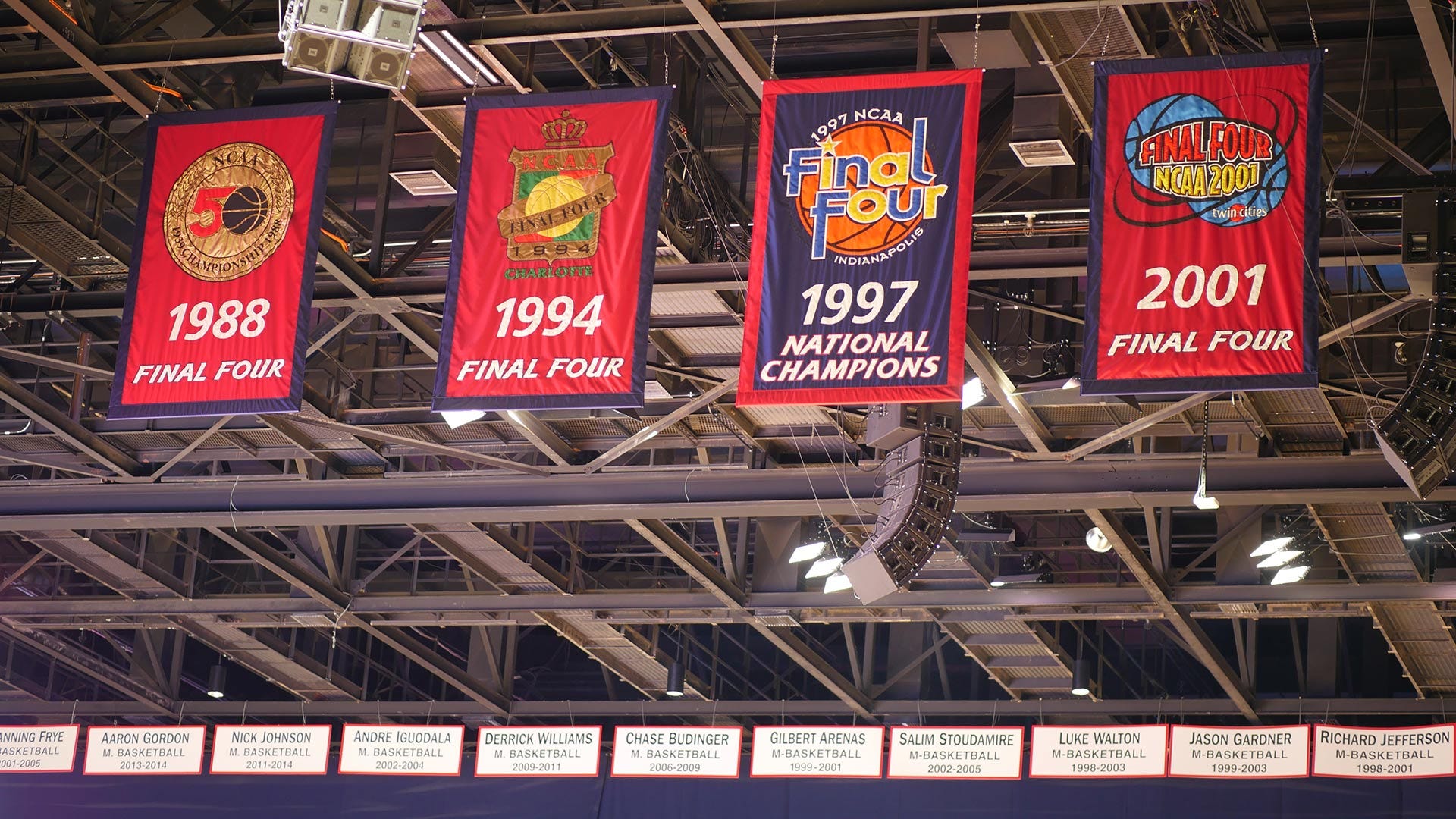
And finally, let’s finish with a couple more plays that will forever be iconic as this 2025-2026 Arizona Wildcats team has officially hung a banner in McKale Center.
All that’s left is to determine which color it will be…
Next Game: vs Michigan on Saturday, April 4th, 5:49PM MST (or later).
KenPom ranks Michigan and Arizona as the 3rd and 4th best teams ever, respectively.
Metrics disagree who is the better offensive team and who is the better defensive team. It is that close.
Aday Mara is at 23.1% and Will Tschetter is at 12.4%.
Cason came back into that game for two minutes following his injury.
Including time spent at Arizona Western Community College.
I’m using all of the lineups that included the eight players currently in the rotation, plus those with Cason.