


Back in October, there were rumors that the NCAA Tournament Committee was considering options to expand to 76 (or more) teams. Like many others, I took the opportunity to make my case for the best way to achieve this. Now that Selection Sunday is behind us, I present what the Utter Hoops expanded bracket would look like for 2026.
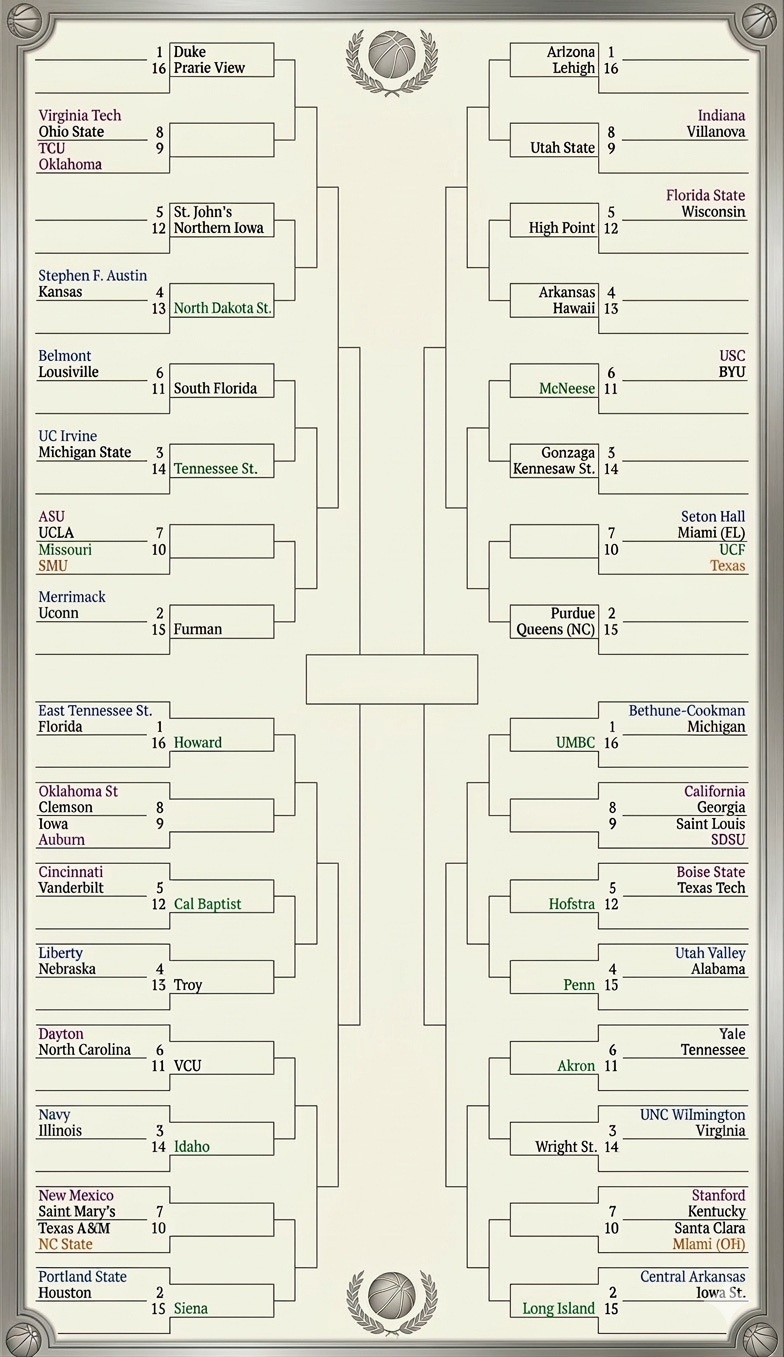
For what it’s worth, my preference would be to axe four teams and go back to a 64-team bracket. But in a world where there are 361 teams1 in Division I, plus more money to be made, I assume that expansion of some kind is inevitable.
The primary goal of the NCAA Tournament is to crown a national champion. I do not think any expansion helps to achieve this goal. Not to mention, most of the games that would come out of an expansion would be not very entertaining, as noted by Kevin Sweeney of Sports Illustrated.
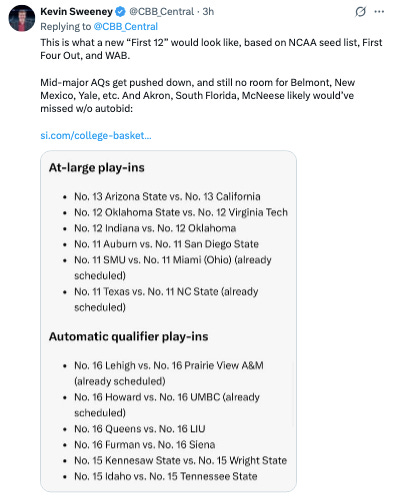
Secondary goals, like rewarding mid- and low-major schools for great seasons, could be improved. However, the 76-team expansion actually makes this worse.
My biggest gripe with the current system is that conference tournament champions have to play in against one another for a 16-seed. They have all earned their chance at a Goliath, plus that’s what the first weekend of the tournament is all about anyway. That’s why people watch!
To review, the core of my proposal is this:
All conference tournament champions are slotted into the round of 64.
All conference regular season champions that did not win their conference tournament receive automatic bids.
A complementary number of at-large teams make up the rest of the field.
All teams from steps 3 and 4 play in opening round games with the winner reaching the round of 64.
Using WAB as the deciding factor of the additional at-large teams, the bracket looks like this:
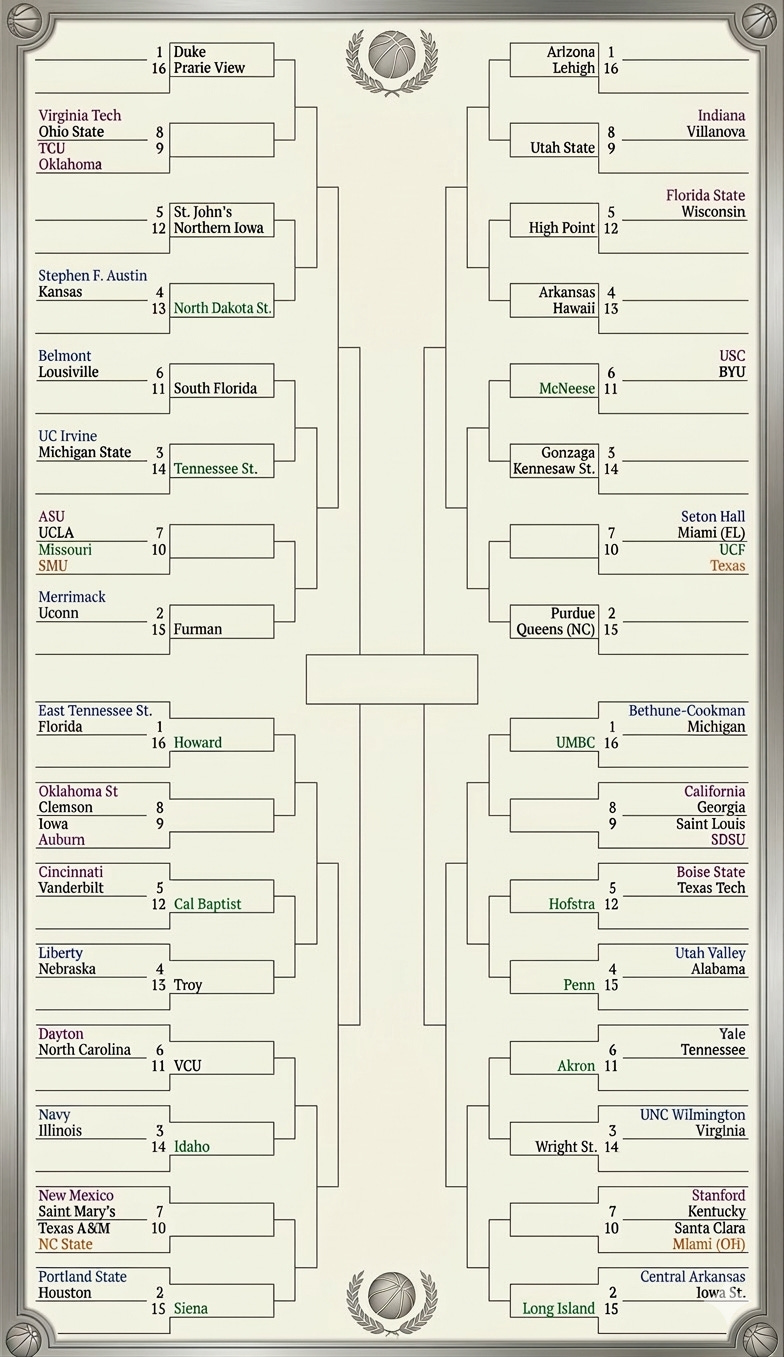
Black = teams that are slotted into the same spots as the real-life bracket2
Green = teams that had to be shifted a seed-line to make space for all conference tournament winners in round of 64
Orange = first four out from real-life bracket
Blue = conference regular season champions that were not conference tournament champions
Purple = new at-large teams using WAB
Top Benefits
Greater reward for conference tournament champions.
More games pitting mid- and low-major teams versus high-major teams.
There would definitely be some obstacles in implementation. I walked through some in my previous article. But if expansion is indeed inevitable, I would much prefer a creative solution to what I’ve seen proposed elsewhere.
Hope you enjoyed!
Plus four teams transitioning to D1 that will be eligible in future years.
TCU should be in black. Louisville is misspelled. Probably other errors. I could only fight with Nano Banana so long.