


On March 13th, 2001, Northwestern State beat Winthrop 71-67 in the opening round game of the NCAA Men’s Basketball Tournament, the first after the field had expanded to 65 teams. The extra team, and therefore the opening game, came to fruition as a side effect of the Mountain West Conference being granted an automatic bid. Ten years later, another three opening round games were added, bringing the total number of teams to 68.
According to reports, including those today by Ross Dellenger of On3, that number is about to go up again. While discussions are still ongoing, it appears that the most likely outcome is an expanded field of 76 beginning in the 2026-2027 season. The 24 teams that would make up the opening round would be half automatic qualifiers and half at-large bid teams. Presumably, the winners of those games would fill in the 11-16 seeds.
Like many, I am not encouraged by these reports. Not because I think the tournament couldn’t benefit from expansion.1 But because it is being done with such a lack of creativity, and at the cost of the smaller conference champions.
The NCAA Tournament’s primary purpose is to name that year’s national champ. But for the small school conference champions, it is their reward for a successful season. I remember feeling bad for Winthrop, champions of the Big South, watching selection Sunday to see if they might play Duke or Michigan State, only to find out they had drawn Northwestern State a play-in game. They never really got the one shining moment they deserved.2 If the new proposal is approved, this will be the case for six conference champions next year.
Hence why I counter with a proposal of my own which would achieve the following:
Additional revenue stream from additional opening round games.
Opportunities for a larger percentage of teams.
Greater reward for conference tournament champions.
More games pitting mid and low-major teams versus high-major teams.
The core of the proposal is this:
All conference tournament champions are slotted into the round of 64.
All conference regular season champions that did not win their conference tournament receive automatic bids.
A complementary number of at-large teams make up the rest of the field.
All teams from steps 3 and 4 play in opening round games with the winner reaching the round of 64.
Let’s walk through what that would look like. For this example, we are using the 2024 tournament as a starting point.3
Here is what that bracket looked like:
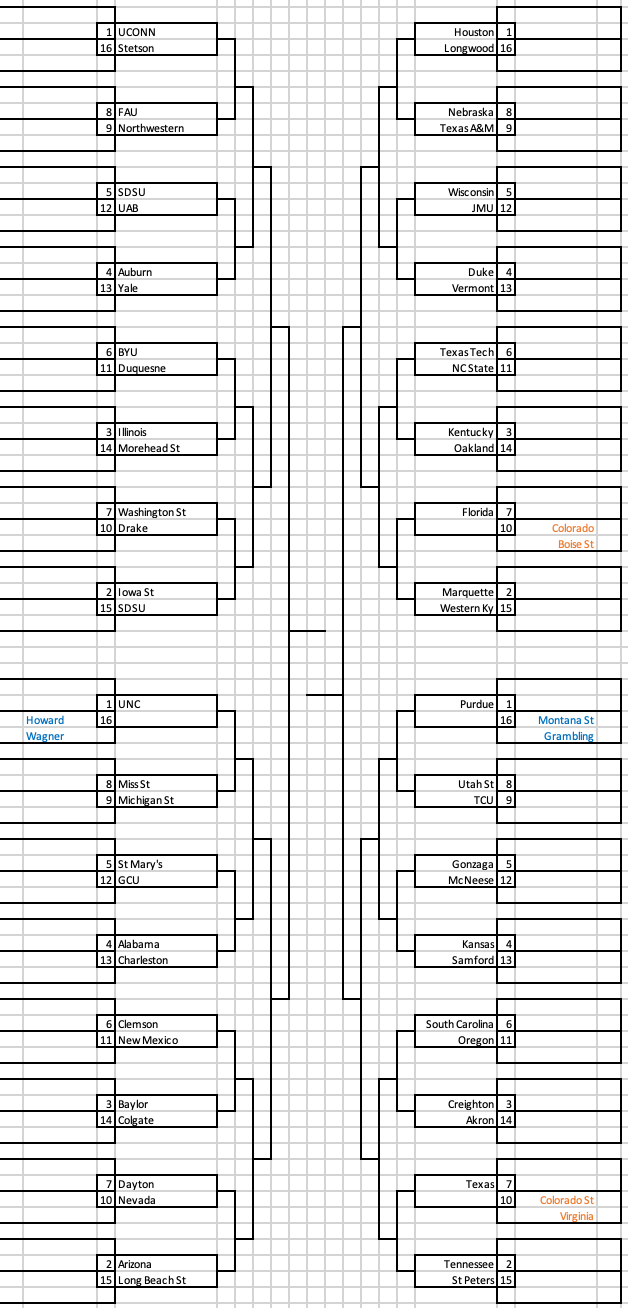
The first step for the committee would be to create a feasible 64-team bracket. In our example, that means dropping the last four at-large teams and shifting the teams around to get all the conference tournament champions into the bracket of 64, but in practice would just mean creating a 64-team bracket like they did before 2001. Here is a hypothetical example of a 64-team bracket. Not all bracketing rules were checked to create this example.
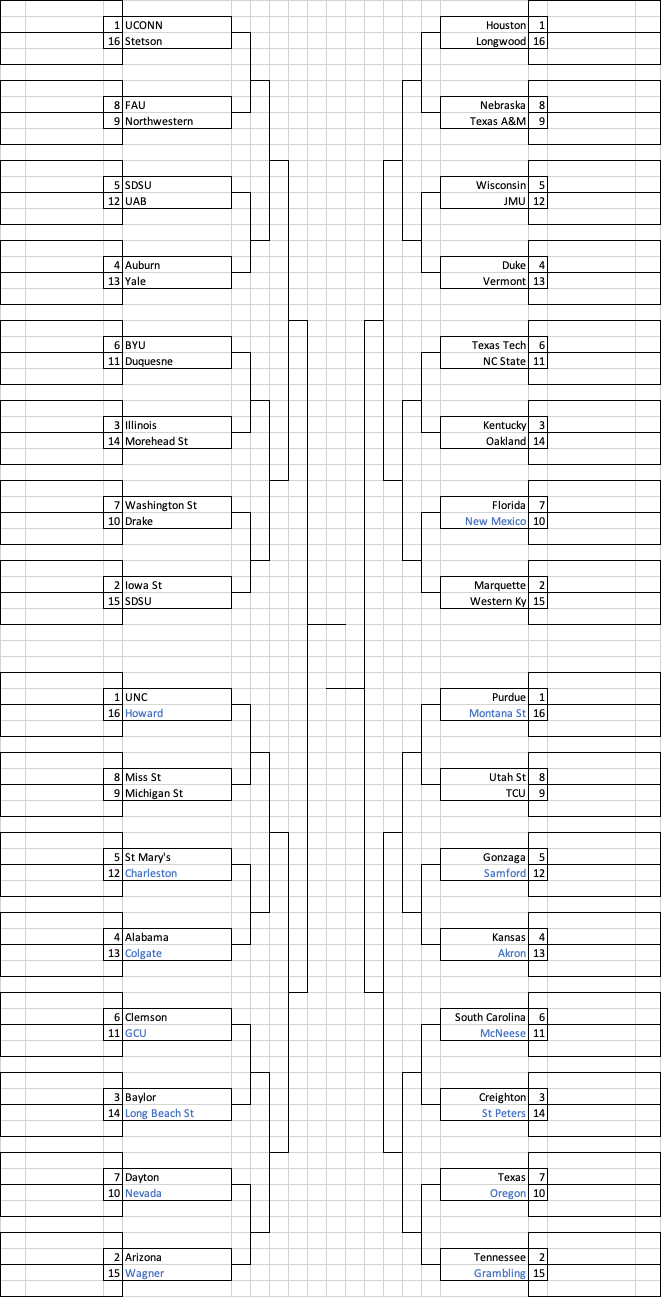
In a traditional bracket where the number of teams is not a power of two (e.g., 16, 32, 64), the top X seeds receive byes and any teams seeded below that are relegated to an opening round. This is effectively what is being proposed in the 76-team expansion concept. In my format, byes are not reserved based on straight seeding, but on having won your respective conference tournament. In this example, three of the four one-seeds did not, and therefore do not receive a bye.
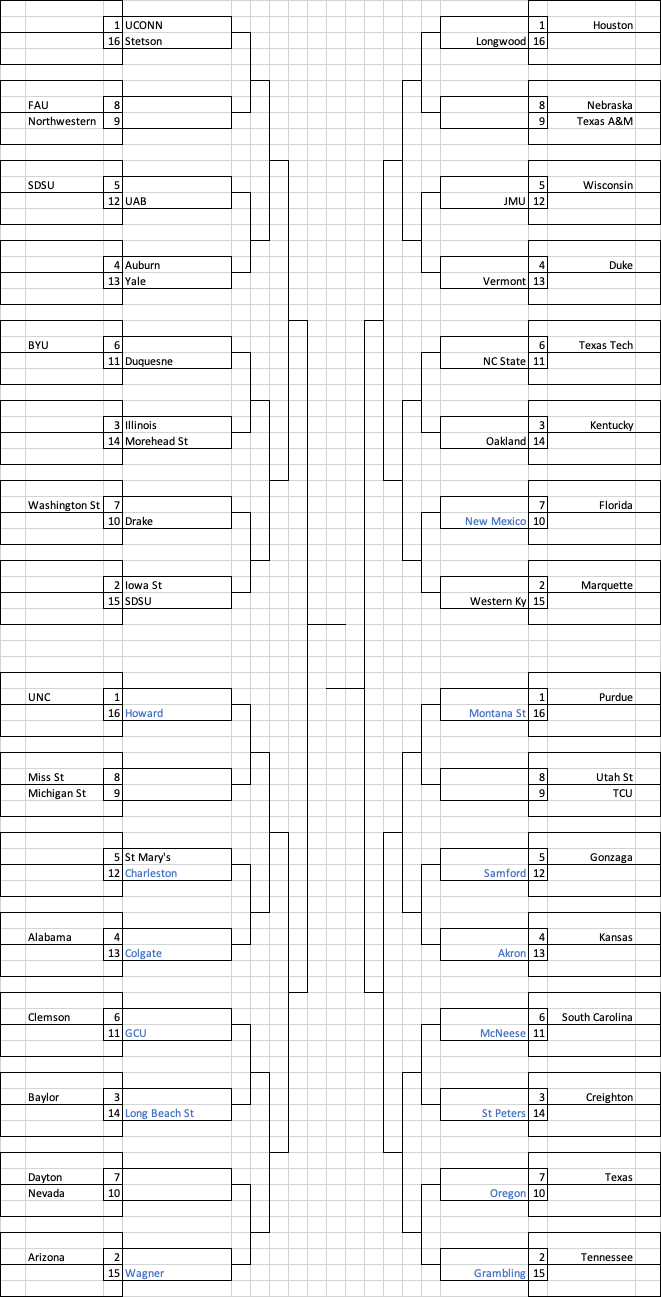
The number of byes would depend on the number of conferences. In 2024, that was 32 teams.4 Subtracting that from 64, another 32 teams did not win their conference, and therefore need someone to play in the opening round.
To select those additional 32 at-large teams, we start by including the conference regular season champions that did not win their conference tournament and were not at-large bids in our original 64 team bracket. In 2024, there were 14 of those teams.5
This leaves another 18 spots for additional at-large teams. Four of those were the teams who made the opening round in 20246, while the other 14 would be extras. In this example, I used the NET rankings to select the top teams that were omitted from the committee’s selection.7
Here are all those teams, ranked by NET, although the committee would use a wider set of evaluation criteria to choose and seed the teams..
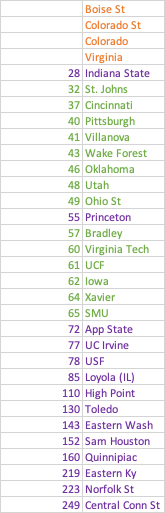
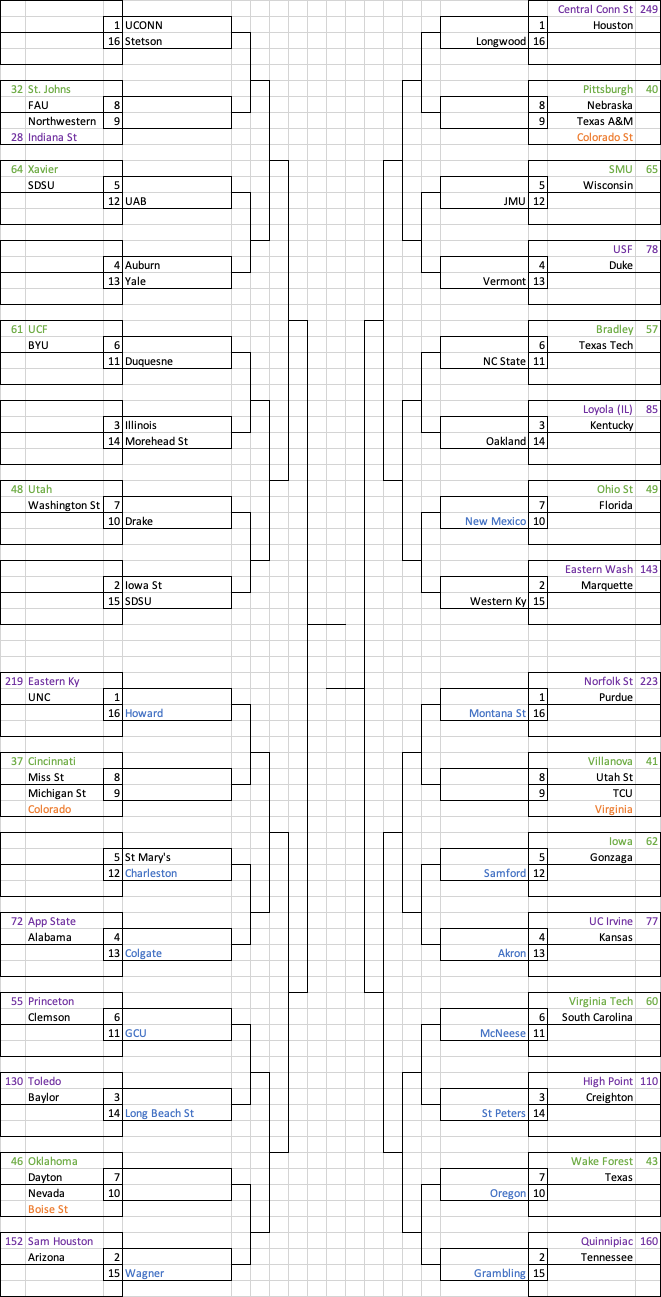
Considering that no team should play any other team from their conference in the opening or first round, along with all other bracketing considerations (not fully considered here in our example), these teams are slotted in to play against the teams already set in the opening round.
This is the final bracket, including 7 rounds, but with all conference tournament champions receiving a bye in the first round and all other conference regular season champions and at-large bid teams in the opening round.
How to Adjust the Schedule
One of the biggest issues I see here is how to adjust the schedule to accommodate these extra games. Rather than using Dayton or another opening round site, I suggest using the same sites from the first and second round for the opening round.
In this example, that would mean Thursday, Friday, Saturday, and Sunday would each have 16 games8. Monday and Tuesday would have 8 games each. I also would suggest moving the second weekend back one day which would give all teams at least 2-days’ rest. The Final Four would remain the same.

Assuming all 13-16 seeds are conference tournament champions, all pods will have at least 1 conference tournament champion and thus no more than 3 opening round games. It could be possible for a pod to have 4 conference tournament champions and thus 0 opening round games but bracketing principles could be added to require each pod have at least one opening round game.
Listed below are the top 16 teams from 2024 in S-curve order along with how many opening games will be in their pod.

Each location must contain either two 2-opening round game pods or one 1-opening round game pod with one 3-opening round game pod. There will be as many 1-opening-game pods as 3-opening-games pods. In 2024, there were four 1/3-opening-game pods.
Shown below is a hypothetical site selection.

In this example, a 2-opening-game pod must go to Brooklyn alongside Connecticut, the number-one overall seed, who had the first priority to be assigned there. A 1-opening-game pod must go to Memphis alongside Houston, the number-two overall seed, who went to Memphis in a 3-opening game pod. As there is an additional constraint being added to the site selection process, the likelihood of the 3 or 4 seeds being able to stay close to home will be slightly reduced.9
Comparison to Proposed 76-Team Format
Additional revenue stream from more opening round games.
Instead of 12 opening round games, you now have 32.
Opportunities for a larger percentage of teams.
Instead of (likely) 8 more bids for power conference teams, you now have 14.10
Greater reward for conference tournament champions.
Instead of relegating them to play-in games, every conference champion makes the round of 64 and gets a crack at the big dogs.
More games pitting mid and low-major teams versus high-major teams.
Instead of SEC Team #12 vs Big 10 Team #11, the conference regular season champions get a chance at an opening round game too.
BONUS: Instead of 8, we get 16 games on the first Saturday and Sunday of the tournament, in addition to the 16 on Thursday and Friday!!!
There are 361 teams in Men’s Basketball Division 1. Currently about 19% make the tournament. Compare that to FBS football where 82/136 (60%) made a bowl game in 2024-2025.
Northwestern State lost to Illinois by 42 but that’s not the point.
Because that’s when I wrote this proposal and sent it to every member of the committee. I got two responses thanking me for caring.
Currently there are 31 automatic bids but we are slated to return to 32 in 2026-2027 with the reintroduction of the Pac-12.
Indiana State, Princeton, Appalachian State, UC Irvine, South Florida, Loyola (IL), High Point, Toledo, Eastern Washington, Sam Houston State, Quinnipiac, Eastern Kentucky, Norfolk State, and Central Connecticut State
Boise State, Colorado State, Colorado, and Virginia
St. Johns, Cincinnati, Pittsburgh, Villanova, Wake Forest, Oklahoma, Utah, Ohio State, Bradley, Virginia Tech, Central Florida, Iowa, Xavier, and SMU
Depending on the number of conference tournament champions, this number will fluctuate. Therefore, this proposal is not necessarily for a 96-team bracket. It only appears that way in this example. If there were 31 conference tournament champions, it would be a 97-team selection, if there were 33 conference tournament champions, it would be a 95-team selection, etc.
Another option would be to drop that constraint, allowing 3, 4, or 5 opening round games at a single site, instead of holding to 4 each. Timewise, it would be possible to play 5 games in a day, but there may be issues with operations, ticket sales, etc. If there were more or fewer than 32 conference tournament champions, and thus more or fewer than 32 opening round games, it would be necessary to have some sites with 3 or 5 opening round games.
In the 2024 example. That number will fluctuate.