


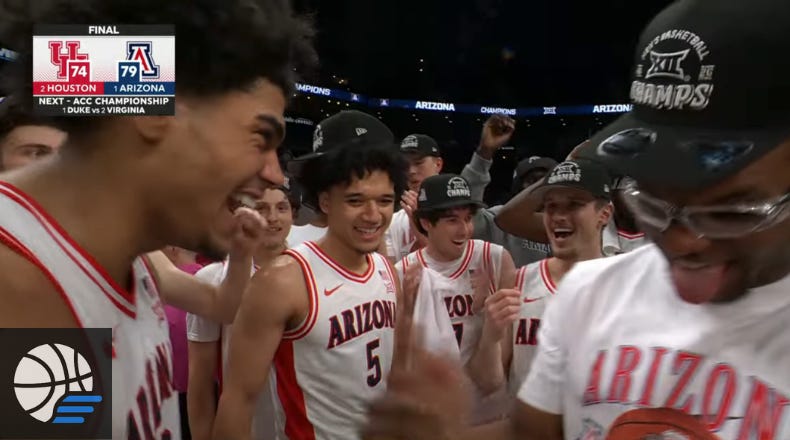
The Wildcats are once again Big 12 Champions, this time claiming the conference tournament title. One year after falling in the finale to Houston, Arizona avenged that loss to the Cougars. Now, only three weekends remain, separating this incredible team from sports immortality.
NCAA Tournament
I was born less than three months after Lute Olson and Sean Elliott took Arizona to its first Final Four in 1988, so I can only imagine what that must have felt like. But I do remember 1994, 1997, and 2001, each better than the last.
I also remember a 1993 tournament that was over before it felt like it even started, a 1998 destiny unfulfilled, and another 1-seed gone to waste in 2000.
By the time Arizona reached the final in Minneapolis, I understood that a deep tournament run wasn’t something that came around every year. While I was disappointed the Cats didn’t hoist the trophy, I was grateful for that Final Four. In my mind, that was something that I would only get to enjoy every 3-6 years.1
So when I sat in the Duck Pond in 2003, watching Kansas fans celebrate around me, I wasn’t despondent because I knew that’s how it went sometimes. I can’t say the same about 2005, which remains the worst sports loss of my life to this day.
And then there were some dark years.2 8-seed, 8-seed, 10-seed, 12-seed, missed tournament (2010). I had never experienced an Arizona-less bracket until I was old enough to drink.
2011 brought renewed hope and 2014 the best Wildcat team of my adult life so far. 2015 felt like the Avengers: Endgame answer to Infinity War, right up until it didn’t.3
And honestly, that’s when I started to detach somewhat. Sure, I thought that the 2017 team had a chance and the Tommy Lloyd teams of the past four years could have found a way to make a run. But there wasn’t one that I really believed was going to do it.
Who could blame me? There’s a whole lot of heartbreak to sort through in the last 25 years.
None of that is fair to put on this year’s group. If they lose on Friday to LIU, it will still have been an incredible feat to finish 32-3, especially considering the gauntlet of a schedule they have navigated. The Big 12 regular and tournament championships are theirs forever.
Memories of a gutsy, grueling win at Houston, or of one of the highest level college finishes I’ve ever seen against Iowa State will stick with me. And those are only two of Arizona’s twelve ranked wins on the season.
Even for a 1-seed, the path to a Final Four is not ever an easy one. By the round of 16, everyone left is good and on the right (or wrong) day, everyone could win or lose. Even the most generous prediction models give the Wildcats about a coin-flip chance of making it to Indy.
When Selection Sunday concludes every year, a common question is “Seeing the bracket, what scares you?” It’s a pretty reasonable question for a fanbase that has learned to keep their guard up.
This year it could be a Purdue or Arkansas team that is peaking at the right time or a potential master/pupil matchup with Gonzaga. It definitely could be ghosts of tournaments past (2000/2014/2015).
But it wasn’t until I sat down to write this article, on the eve of yet another NCAA Tournament, that I was willing to admit to myself that I am feeling pretty scared. Not of any of the teams in the path. I am convinced by this point that Arizona is the best team in the country.
I’m scared because, for the first time in a long time, this team has me believing.
Round of 64 Preview
LIU dominated the Northeast Conference this year, winning the regular season title by three games with a record of 15-3. They played two high-major teams that are in the NCAA Tournament, losing at Illinois by 40 and at Georgia by 15. The only other tournament team they played was Lehigh, who they beat by five.
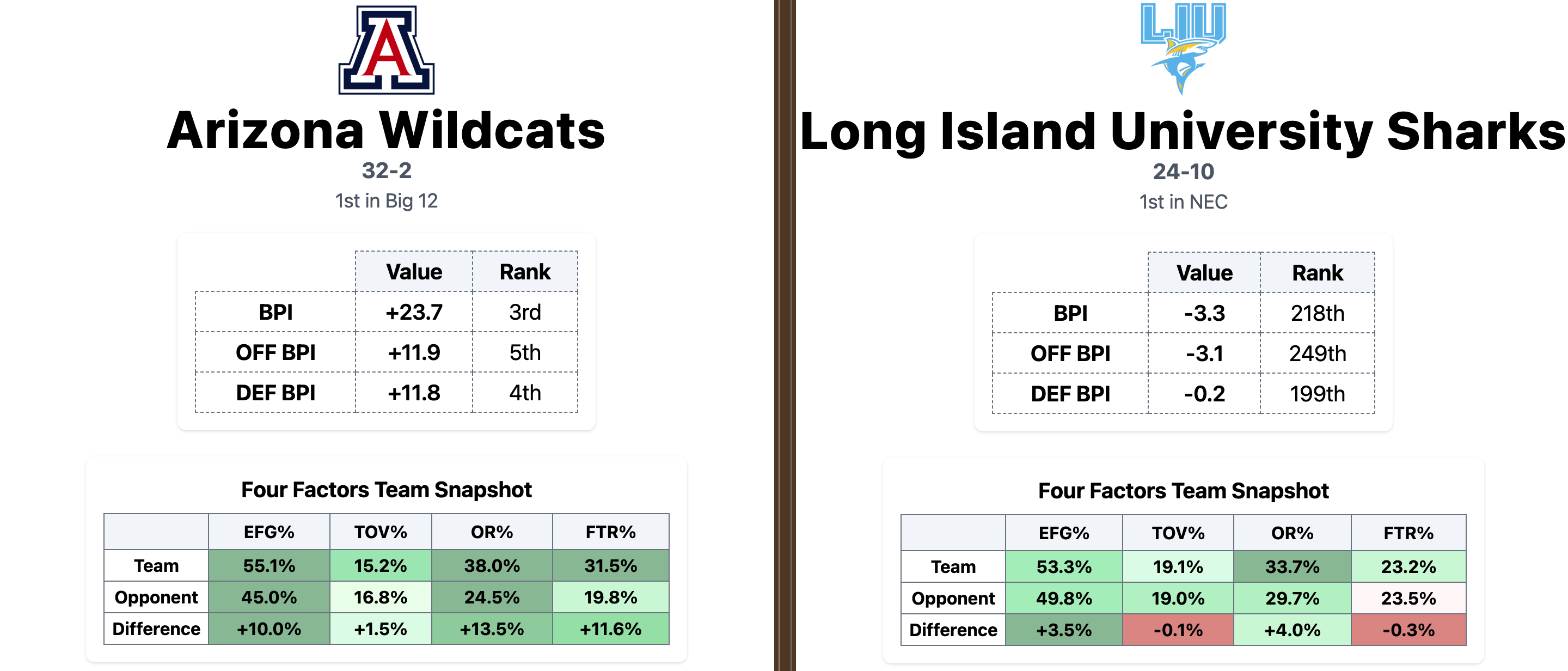
Despite a much weaker schedule, LIU is worse in seven of the eight factors.4 (source: ESPN Analytics)
This is a dream draw for the Wildcats as LIU shoots nearly as few three-pointers as Arizona (16.5 per game vs 16.3) at nearly the exact same percentage (36%). The Sharks have succeeded playing a game very similar to the Cats but with far less size.

LIU will be giving up an average of 30 pounds at each starting lineup spot, which doesn’t even consider the 255 that Tobe Awaka brings off the bench. The Wildcats’ offensive rebounding and ability to get to the free throw line are expected to be major factors in this matchup.
The Wildcats have sneakily become a fast team, playing in the 90th percentile of pace on the season while the Sharks have played right at the median on the year but in the 15th percentile in their last five games. This is a dilemma for LIU as almost 20% of their points come from fast breaks (97th percentile).
Since I think their chances of getting out and pestering the Arizona guards is low, I fully expect them to try to slow it down and reduce possessions. Conversely, the Cats should be looking to apply pressure as LIU turns the ball over frequently (85th percentile turnover rate).
The game plan for the upset is pretty well understood. As other coaches suggest (while heavily touting the Wildcats as tournament favorites), “Let them take and make as many 3s as possible.” Easier said than done as anyone who has faced Arizona this season would tell you.

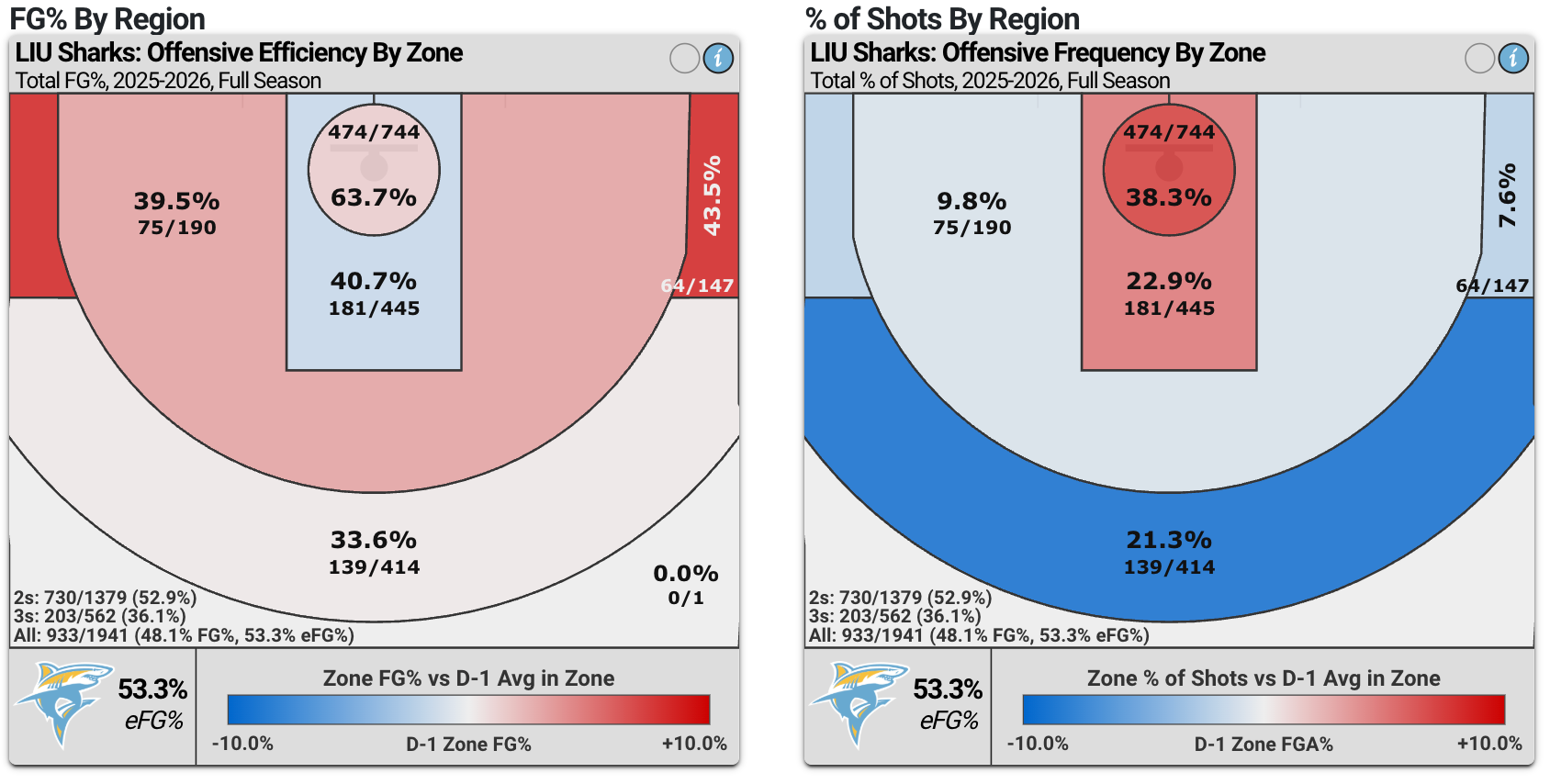
(Source: Basketball Reference and CBB Analytics)
Big 12 Tournament Notes
Elite Competition
The Big 12 had six teams that were head and shoulders above the rest this season but in addition to Arizona, Houston and Iowa State are the cream of the crop.5 When Arizona’s offensive rating gets discussed, I think it’s good to remember that four of those games came against the Cougar and Cyclone defenses that are college basketball S-Tier.
ASU excluded, I tend to cheer for conference rivals when it comes to the tournament. It had been a while since the Pac-12 had three legitimate contenders for the crown and I’m hoping all three of these teams are playing into April. As far as my bracket picks, I have both making the Elite Eight, but only one advancing.6
Evolving Plays
As the season goes along, the playbook continues to grow. Arizona’s offense and inbounds (discussed below) have certainly done so but defensively this team has been rock solid in their man-to-man defense all year. While there may have been some minor adjustments in things like ball-screen coverage, Arizona has opted to stick with what is working for the most part.
But it was neat to see Arizona reintroduce their three-quarter court trap after an extended absence. My last record of its use was in the 12th game of the year versus Bethune-Cookman.
Even if they don’t plan on bringing it out in any major way in the NCAA Tournament, it just gives an opponent that watched the last few games of film another thing to have to think about in prepping their scouting report.
Free Throw Hitch
Okay, here’s a weird one. Something much more frequent that I would definitely want to note on a scouting report is to not fall into the paint when Koa Peat is at the line.
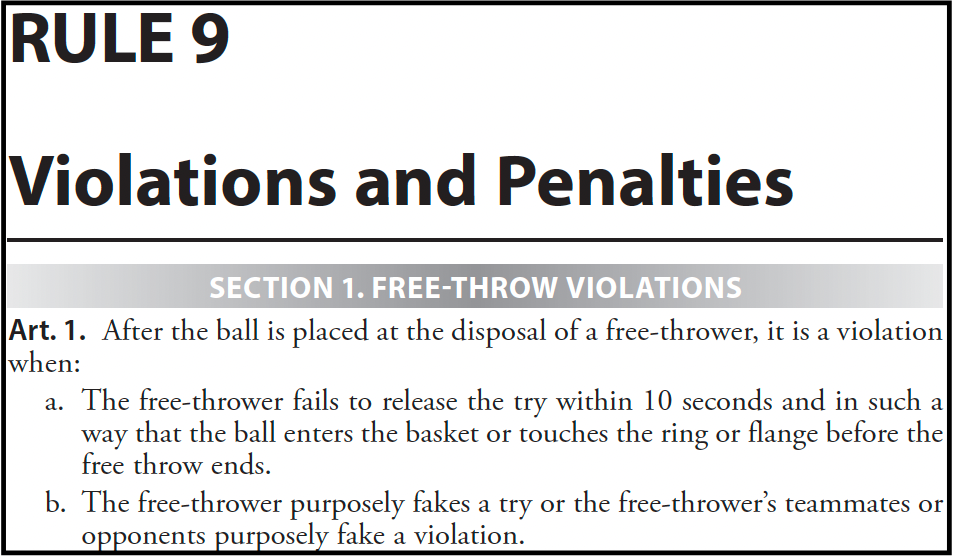
Peat has drawn numerous free throw violations this year.7 And as a 60% free throw shooter, it can be really nice to get multiple chances.
I don’t think Peat is intentionally hitching, which is illegal (see below), but the frequency with which he is drawing violations (officials with a fist held out in the clips) is increasing, including three of the last six games.
One of the reasons I don’t think he is purposely hitching is that this form goes back to at least December, when his unusual mechanics caught their first victim, Dwayne Aristode.
Closing Halves
Thanks to Brayden Burries coming alive in the final few minutes, Arizona closed the first half of their game against Houston on a 11-3 run that culminated in Houston making an ill-advised challenge on a basket interference call with 3 seconds left that cost them their second timeout of the game.8
However, Arizona’s previous two first halves didn’t end on such a high note. Against UCF, Burries took a three-pointer with more time left than would be ideal. Neither he nor any other Wildcat got back on defense on the shot, leading to a breakout and-one.
Even that was better than their atrocious close against Iowa State. I have pointed out Arizona’s use of (or lack of) the two-for-one to end halves, so was pleasantly surprised to see Jaden Bradley in attack mode with 45 seconds left. But with two Cats ending up on the floor, Milan Momcilovic ended up with a transition three-pointer.
This isn’t too bad considering the Wildcats got the ball back for what should have been the last possession. Coach Lloyd called his first half timeout and then chaos ensued.
Just like the start of the game, Arizona seemed caught off guard when Iowa State brought two to the ball to trap, despite this being their preferred defense. The Wildcats using their typical sideline out-of-bounds (SLOB) handoff was a rough call as there is never a better time to trap than when the offensive team will likely not take advantage of breaking it as they are holding the ball for the last shot.9
Tobe Awaka had a chance to save a weak pass but got alligator arms, leading to another Momcilovic three in transition, followed by an Anthony Dell’Orso travel with 2.8 seconds left. Arizona mentally checked out at this point and rather than getting up to pressure, allowed Momcilovic an easy path up the floor into a third three.
I don’t think I have ever seen a team go two-for-one and lose out 9-0 on it. While the Wildcats were not harmed in the end by these first half closes, it’s something to improve moving forward.
Timeout Watch
Coach Lloyd said in the postgame that the above mentioned timeout put the Wildcats in a bad spot.10 As we have discussed previously, it has been the tendency of this team to not take their first timeout until one of the last possessions of the half.
12 of Arizona’s 21 use-it-or-lose-it (UIOLI) timeouts have occurred with under a minute to go. The 8 timeouts followed by a Wildcat offensive possession have resulted in a total of only 5 Arizona points (0.63 PPP).

Coach Lloyd mentioned that he and staff emphasize a culture of FIO (Figure It Out). The Wildcats have done that many times this season and I think it plays into why Arizona even had their UIOLI timeout remaining after they trailed Iowa State 14-2 in this game.
But if you believe in your team to FIO, maybe the late first half timeout advantages the defense more than the offense. While I am not a fan of forfeiting a timeout, I’m also not a fan of using one just so you can say you didn’t let it go to waste.
Speaking of timeouts, Arizona used all of its timeouts for only the fourth time all year in the finale vs Houston. The only other occurrences: the losses to Kansas and Texas Tech, and the win at BYU.
Inbounds
As you know, I have an obsession with inbounds plays. I think it is because coaches have relatively low impact on the play on the floor once the ball is live in basketball.11
But inbounds plays are static and more akin to a football offensive coordinator making a play call. This means it is one area coaches can have a relatively high impact. A great inbounds play that scores a basket can make a coach feel they had a real influence, at least on a fraction of the points gained.
As I mentioned above, I thought the SLOB at the end of the half versus Iowa State was dangerous from the start. However, in the 43 clips I’ve got from this year, they nearly all start with that same action of a screen away at the elbows then an option for a hand off back to the inbounder. There is a reason there isn’t an Utter Hoops SLOB video for this season yet.12
However, I did want to point out that Arizona has recently added a slight adjustment, allowing the wings to come off of pindowns after the initial action which I think is a nice addition. If and when this evolves to floppy and Dell’Orso turns back to come off the double screen to the inbounds side just in time to nail a big three, it will make all 43 of those handoffs into drag screens worth it.
Sometimes though, vanilla is the best. And I would say most of Arizona’s BLOB plays are pretty vanilla as well. Nothing is more vanilla than the elementary school screens across which I only started to see two weeks ago, but worked like a charm here versus Colorado.
And last but not least, a tip of the cap to Iowa State’s TJ Otzelberger. Here is one of their first half inbounds, where the Wildcats easily rematch after the ball comes in.
Point guard Tamin Lipsey is the inbounder here, as he was for every other inbound right up until the end of the game. But with 1:19 left, the Cyclones switched to have Momcilovic be the trigger man.
Because Arizona covers the inbounds with Krivas, he’s the primary cover as Momcilovic sprints to the arc immediately after release of the ball. A minor adjustment but so valuable at this crucial time in the game. Give Coach Otz a fraction of a point there or at least an imaginary assist.
Next Game: vs Long Island on Friday, March 20th, 10:35AM MST.
Oh, to be 12 again.
Which just so happened to overlap with my time as a student at the U of A unfortunately.
Those movies didn’t come out until 2018/2019 so that wasn’t my reference in the moment, but fits nicely in hindsight. Heroes lose, miraculously come back to face the same villain again.
Defensively, they have turned opponents over more often than the Wildcats have.
Texas Tech was near that level before losing JT Toppin.
It’s Iowa State, who I think is extremely difficult to prepare for. Michigan should be starting now.
I actually don’t know how many violations because game logs are inconsistent about recording them on a miss and they never are recorded on a make.
Houston also blew their second timeout the first time these teams met this year.
I did like Nate Heise’s delay to let Koa Peat cut away before coming to trap. Very smart.
In response to a question about not taking a timeout on the play that led to Jaden Bradley’s buzzer beater.
Of course, practices influence play and coaches do choose who is on the floor and make other decisions that have downstream effects.