


James Nnaji made his college basketball debut on Saturday, scoring 5 points and securing 4 rebounds in Baylor’s loss to TCU. For those who are unaware of this situation, it is of note because Nnaji was drafted in 2023 by the New York Knicks.
Pro Players in College
Who is eligible to play college basketball is a question that is becoming increasingly murky. With the advent of NIL, high school age players that had been paid to play in leagues like Overtime Elite, were now able to join college programs.
Another league (or team) of interest around that time was G League Ignite, a professional developmental team created by the NBA in 2020 to give elite prospects a college alternative. It was a slippery slope from there to ask how come other G League players couldn’t join an NCAA team; however, until now, they had all gone undrafted.
After being drafted by the Knicks, Nnaji returned to Spain in 2024 to play for FC Barcelona. Of course, nothing about that would make him ineligible; see Ivan Kharchenkov, formerly of FC Bayern Munich. Nnaji was a contender for a roster spot with the Knicks this season, but after a poor performance at NBA Summer League, he remained unsigned.
That is the distinction the NCAA is now drawing with NCAA president Charlie Baker stating that “The NCAA has not and will not grant eligibility to any prospective or returning student-athletes who have signed an NBA contract (including a two-way contract)”, in response to reports that Trentyn Flowers was drawing interest from college teams.
Flowers is currently on a two-way contract with the Chicago Bulls, and has appeared in 8 NBA games. A two-way pays him half the rookie minimum, around $636,435, which may be less than some NCAA programs would provide.
But why? Why draw the line there? What is different about an NBA contract from a G League Contract or a European Contract? The NCAA has tried to put it’s foot down before and usually ended up losing in court. My guess would be if Flowers were to sue, he would win.
The next line in the sand would be players that had already played in college and left for the draft. The NCAA is on better footing here as there are additional rules about when players must declare or withdraw their name from a draft in order to maintain eligibility.
Plus, to challenge that rule in court, a player would have to leave college, go to the draft, give up their eligibility, and then sue to get it back.1 That’s a big risk for a lot of college players who could just stay in college in the first place and earn good money. You would need a player that thought they were a surefire first round pick, slipped, and somehow went unsigned.
So for now, only players who have never played college basketball are the ones to watch. However, there is one of those that has a pretty strong connection to the Arizona Men’s Basketball Program.
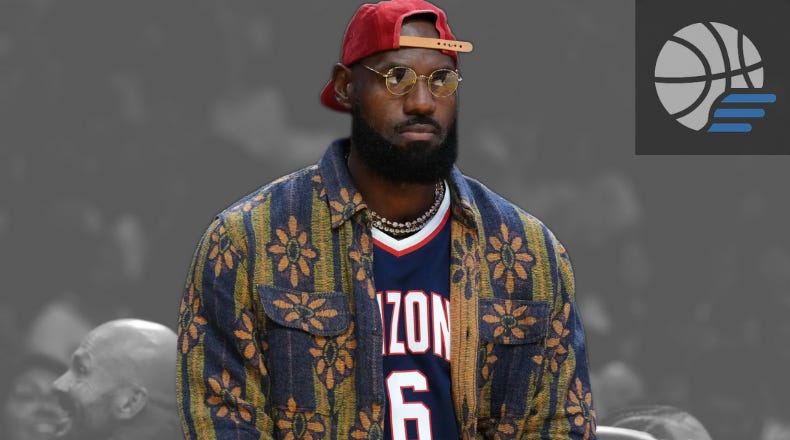
We now live in a world where it is not inconceivable that LeBron James plays for the University of Arizona.
As James nears the end of his NBA career, we know how important it was for him to play with Bronny. The only thing standing in the way of him playing alongside Bryce is one Trentyn Flowers lawsuit. Or heck, maybe one from James himself.
For what it’s worth, Tommy Lloyd was asked about this whole mess last week (not the LeBron part). YouTube Link.
On the ever changing world of college basketball2: “It’s so crazy right now, you know? The only thing that I would say is frustrating is you just don’t know what direction things are coming from. You just try to coach your team. It’s not a compliance issue. Why doesn’t everybody know what’s going to be allowed and what’s not going to be allowed. Why are we surprised by things? Maybe that’s my fault for having my head in the sand and not being on social media. I could admit that it could be my fault. I think it should be a little more obvious what is going to be allowed and not allowed. If you’re talking about a real level playing field, let’s start with that. A couple years ago they said double transfers weren’t going to be eligible. So we literally had a guy in the NCAA office sit in my office tell us, don’t recruit double transfers. This is in the summer. They’re not going to be eligible. They’re going to deny all the waivers. Okay, we didn’t recruit double transfers. Well, that January, all the double transfers got eligible everywhere. So, like, there’s just literally no credibility, and it sucks. But you know what? I’m excited about Arizona basketball. I’m excited about playing at Utah on Saturday, and I’m not going to be a spokesperson for any of this stuff. So I’m done talking about it. I want to be a quote on Arizona basketball, and what we have going right now. Let’s stay locked into the main thing, Arizona basketball, and Arizona football winning the Holiday Bowl. That’s as good as deep as I can go in my rolodex right now.”
Offensive Adjustment Incoming?
Arizona used seven possessions late versus Utah to essentially practice new offense, specifically a 1-3 pick and roll. While the Wildcats typically run offense through their four and five man, they spent five minutes having Ivan Kharchenkov sprint into rush-out screens, to varying levels of success.
With the center (Krivas or Awaka), in the opposite slot or wing, this functioned similarly to the double drag they use with Burries or more-often Dell’Orso as the first screener. The Cats always ran this left to right, towards the ball handler’s (Bradley or Burries) dominant hand.
The adjustment that Utah didn’t make would have been to move the defender covering Koa Peat into more help. Perhaps, that would allow a direct pass to him in a stampede to the rim, but I think you could prevent both.
The adjustment to the adjustment would be to run this in a three guard lineup and let Dell’Orso be the man the defense has to help off of. Of course, then it’s no longer a 1-3 PnR.
Arizona Rotation Contingencies
Arizona has played a set of eight guys through the competitive portions of the 14 games played so far. Point guard, Evan Nelson, and center, Sidi Gueye, have been numbers nine and ten, but neither have gotten more than ten minutes in a game yet this year, even amongst this streak of blowouts. Here’s how each player’s minutes have broken down so far:
Guards
Jaden Bradley (28.1 MPG - 100% PG)
Brayden Burries (27.1 MPG - 30% PG, 70% SG)
Anthony Dell’Orso (23.1 MPG - 82% SG, 18% SF)
Wings
Dwayne Aristode (16.9 MPG - 2% SG, 94% SF, 4% PF)
Ivan Kharchenkov (24.4 MPG - 77% SF, 23% PF)
Bigs
Koa Peat (27.1 MPG - 99% PF, 1% C)
Tobe Awaka (20.3 MPG - 31% PF, 69% C)
Motiejus Krivas (23.0 MPG - 100% C)
I’m not much of a believer in jinxes but if you are, this may be the time to stop reading.
With this tight of a rotation, it’s good to review the level of replication at each position. The Wildcats have mostly stayed injury free so far,3 but let’s look at what a backup plan might look like for each player, from most to least replaceable.
Anthony Dell’Orso (23.1 MPG - 82% SG, 18% SF)
Dell’Orso was integral to the Wildcats first five wins, showing improved defensive chops, and providing much needed outside shooting. But he has gone colder since, and is only shooting 32.8% from three on the season.
The minutes played at SF, and even some at SG, could be absorbed by Aristode. The Wildcats could also use Evan Nelson at PG in the non-Bradley stints, keeping Brayden Burries at SG.
Estimate: Nelson +8min, Bradley +4min, Burries +4min, Aristode +7min
Tobe Awaka (20.3 MPG - 31% PF, 69% C)
It seems sacrilegious to put the best rebounder in the country this high on the list, but there is just more positional depth here to cover his absence than there are at other spots. Not to mention that Krivas, Kharchenkov, and recently Burries are showing out as plus rebounders for their positions.
The PF minutes would go to Kharchenkov and Aristode, in more small-ball lineups, likely with Krivas at center, who would need to up his minutes some as well. When Krivas goes to the bench, the Cats would be looking at a mix of Sidi Gueye and Koa Peat at center.
Arizona has not experimented much with the latter, but it might be worth trying some here in January.
Estimate: Gueye +8min, Krivas +4min, Kharchenkov +2min, Aristode +6min
Dwayne Aristode (16.9 MPG - 2% SG, 94% SF, 4% PF)
Aristode plays the least minutes of the eight rotation players but the small forward position is where the Wildcats have the least options. The triple big lineup has combined for 17 seconds of action so far, so that’s probably not going to be an option.
The triple guard lineup could be though. Bradley, Burries, and Dell’Orso have shared the floor for just over 51 minutes so far, and are +36 in that time.
Estimate: Nelson +5min, Bradley +2min, Burries +2min, Dell’Orso +4min, Kharchenkov +4min
Koa Peat (27.1 MPG - 99% PF, 1% C)
I know. Hear me out. How could the leading scorer and second leading minutes getter be the most replaceable starter?
Again, it’s back to positional scarcity. Peat plays nearly all of his minutes at power forward, a role that could be backfilled by three of the remaining seven players.
This would be a “by committee” type effort and would give a plethora of options to explore. It’s possible you would see all seven players minutes go up, plus possible room for Nelson and Gueye, who could stagger a single stint each in the first half
Estimate: Nelson +4min, Dell’Orso +2min, Kharchenkov +2min, Aristode +7min, Awaka +6min, Krivas +2min, Gueye +4min
Brayden Burries (27.1 MPG - 30% PG, 70% SG)
This starts to get into the land of real trouble. Burries has been red hot lately and losing that momentum would be a huge hit.
However, the Cats could cover the SG minutes with three different guys and slide Nelson in for a stint early in each half. Would badly need Dell’Orso to return to form and Aristode to take a step forward.
Estimate: Nelson +8min, Bradley +4min, Dell’Orso +4min, Kharchenkov +4min, Aristode +7min
Ivan Kharchenkov (24.4 MPG - 77% SF, 23% PF)
Other than Aristode, Kharchenkov is the only other Wildcat not scoring in double figures. The Cats would feel his loss more on the defensive end, where he has become their premier perimeter defender.
And like I said in the Aristode section above, small forward is the least replaceable position on this roster. Even if Aristode pops with this opportunity, he likely only covers a third to half of the gap created by a Kharchenkov absence.4
Estimate: Nelson +8min, Bradley +2min, Burries +2min, Dell’Orso +4min, Aristode +8min
Jaden Bradley (28.1 MPG - 100% PG)
Bradley is the heart and soul of this team, so certainly there are some intangible effects to not having him out there, not to mention that he leads the Wildcats in three point field goal percentage, free throws made, and assists.
I think you would see a shift downward here. Burries plays Bradley’s role, Nelson picks up the Burries backup point guard minutes, Dell’Orso and Aristode play more at shooting guard, and hold on for dear life.
Estimate: Nelson +8min, Burries +4min, Dell’Orso +4min, Aristode +8min, Kharchenkov +4min
Motiejus Krivas (23.0 MPG - 100% C)
This would be a “you didn’t know what you had until it’s gone” situation. Krivas’s defensive rating of 83.5 points per 40 minutes is better than any team in the country.
Bradley also ranks extremely highly in defensive metrics, but I have some faith that Burries could rise to the occasion. Meanwhile, the Peat/Awaka minutes continue to show some cracks defensively, with a defensive rating of 106.2 points per 40 minutes.
Sidi Gueye would definitely get some run here. If he could provide any semblance of the rim protection that Krivas does, it would be a huge success. Coach Lloyd was quoted telling Gueye that he expected him to be ready to play in big games by January.
You would also be looking at something like 14 minutes of Koa Peat at center per game, where he has played a total of 3 minutes so far this season. In this scenario, Arizona would have to fundamentally change some of how they play.
Estimate: Gueye +8min, Awaka +4min, Peat +2min, Kharchenkov +2min, Aristode +7min
Next up: Home versus Kansas State on Wednesday, January 7th, 7:00PM MST.
There’s been some speculation that a player might benefit from doing that after their freshmen year to try to go undrafted so they could enter the NBA at a later time and not be subject to the rookie scale. I find this unlikely for now.
Credit Juan Serrano for transcription.
One Kharchenkov ankle roll, wrapped Bradley and Krivas hands, and no games missed so far. (Knock on wood)
You know when a left tackle goes out, so you move your right tackle, but then you are kinda weak all over. It would be kinda like that.