


Happy start of the season!
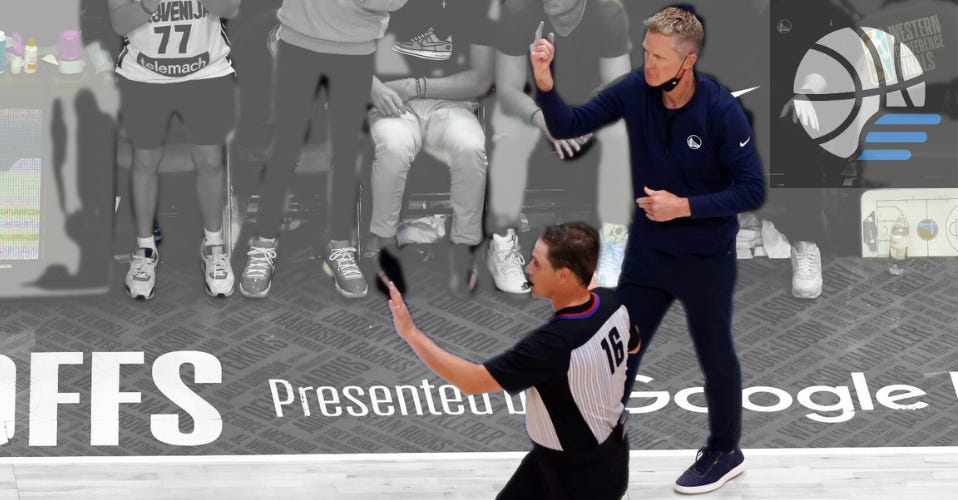
Evaluating coaching is an extremely difficult thing to do. Some of the most important things a coach does, building relationships with players, running practices, scouting and preparing for opponents, developing players, etc. happen behind the scenes for most of us. We rely on insider reports or sometimes just infer based on record.
But there are a few things that can be seen during a game, even beyond the X’s and O’s of offensive sets or defensive schemes. The first would be rotations; who is on the floor with each other and against who from the other team. NBA coaches are also faced with decision points in every games: timeouts and challenges.
Timeout rules in the NBA are complicated, which actually gives more opportunity for a coach to gain an advantage if they use them well. Coaches are forced to take timeouts in certain situations and also stand to forfeit timeouts if a minimum amount have not been used by specific time marks. Smart teams use timeouts in cases where they can cut opponent runs, set up after time-out (ATO) plays, or challenge plays before they are forced to take or lose them.
NBA challenges are an opportunity assessment. Coaches must consider both the likelihood and reward of winning the challenge. A foul called on a three-point shot has a much larger reward when a ruling is overturned than an out of bounds call. Coaches must also consider the cost of a lost opportunity for a future challenge, which is often a harsher penalty for losing a challenge than the lost timeout. For that reason, a call in the first quarter may not be worth the risk to challenge and potentially be without for the rest of the game. Even if correct both times, a team has a maximum of two challenges a game.
Let’s take a deeper look at some basic strategy of each…
Timeouts
Each team starts the game with seven (7) timeouts. They may not have more than four (4) timeouts at the end of the 3rd quarter and no more than two (2) timeouts in the last three minutes1. Therefore, there are two milestones in the game where teams stand to lose timeouts if they haven’t been used.
I see this sometimes by the winning team in blowouts, which can be understandable, but as an example, on 2024-05-25, Indiana (Rick Carlisle) lost a timeout at both milestones in an Eastern Conference Finals game that they lost by three.2
In college basketball, mandatory (TV) timeouts occur at 16/12/8/4 minutes left in each half, but they are not charged to either team. In the NBA, there are two mandatory timeouts per quarter and they occur at 7 and 3 minutes left; however, they are charged to teams. Specifically, the first mandatory timeout is charged to the home team and the second to the away team.
But there is an exception. If a timeout has already been taken, the mandatory timeout does not occur. Assuming only one timeout was taken before the 3:00 mark, that mandatory timeout is charged to whichever team did not take the first timeout. If two timeouts are already taken, then the second mandatory timeout does not occur either. In practice, what this means is that teams typically take a timeout before they are forced to, either to break an opponent run or when on offense to design an after-timeout (ATO) play.
In the Western Conference Finals on 2024-05-26, the Mavericks (Jason Kidd) were forced to take timeouts just below the seven minute mark in the first, third, and fourth quarters. While they had the ball in the first two instances, a Dallas non-shooting foul at 6:56 in the final quarter forced a Dallas timeout which Minnesota used to draw up a play for a wide-open Naz Reid three-pointer. Coaches are playing with fire anytime they allow themselves to be in the situation where the next whistle will assign them a timeout.
Challenges
Perhaps the Mavs were only saved from four forced timeouts in that game by losing a challenge in the second quarter at the 11:45 mark. That lost challenge cost them a timeout, but it counted as their mandatory for the quarter. If they had already been charged a timeout in the quarter, this would be a second charged timeout.
But what if they had won that challenge? My previous understanding was that no timeout would be charged. That is actually not true. If the mandatory timeouts for the quarter have not been taken, that challenge timeout, even when the ruling is overturned, counts as the mandatory timeout.
While it is a minor factor in the decision of whether to challenge a call or not, losing a challenge late in a quarter is more punitive than early in a quarter as it costs a second timeout to be charged to the team for the quarter. Conversely, winning a challenge late in a quarter is preferable as it means teams are able to use their mandatory timeout for other benefits.
Another thought when deciding to challenge is the time in the game. Perhaps the biggest downside of an unsuccessful challenge is the loss of future opportunity to challenge, which is why coaches are wary of wasting it early. Teams are allowed one challenge per game and if they win it, they get one additional challenge, but no more than two total even if they win both.
The major factors to consider when choosing a challenge strategy are the reward of overturning a call and the likelihood of it. Teams are only allowed to challenge three things: fouls, goaltending, and out-of-bounds. More specifically, only calls that were made on the floor (not no-calls). In the 2023-2024 season, teams averaged 114.7 points on an average of 99.8 possessions per game, so a good analysis for the reward of an overturned challenge can start with an estimation that a possession is worth 1.15 points. However, this includes transition possessions which are of higher value. For simplicity (and because it’s pretty close to accurate), let’s say a half-court possession is worth 1.00 points.
Out-of-bounds
This is likely the easiest of the challenge options to consider. If a team wins a challenge, it gains one possession (or takes one possession away from the other team), so the reward is 1 point, unless there are other factors to consider, like a low shot clock, in which case the possession is worth less.
These are also the most likely to be overturned, with 2023-2024 challenge data showing that of the 375 out-of-bounds calls that were challenged, 79.2% ended up being changed.
Usually, teams have an assistant coach on the bench with a tablet that can quickly watch replays and communicate to the head coach if it is a challenge that they can win. Out-of-bounds calls are the easiest to quickly identify as wrong (even if the minutes-long delay to review says otherwise).
Goaltending
The next easiest decision is goaltending, which must be challenged by the defense.3 The reward is the number of points that would be scored, usually 2 points, minus the amount stemming from the resumption of play on an overturn, which is typically a jump ball.4
Again for simplicity, let’s say both teams have an equal chance to win the jump ball, where the offensive team would still have approximately a value of 0.5 points on the possession even in the case of an overturn, leaving 1.5 points as the reward of winning the challenge.
The stats for 2023-2024 had 67.5% of these calls overturned but on by far the fewest challenges, only 40.
Fouls
The most complex case, and the one that was challenged by far the most, 1029 times, are fouls. While I don’t have a breakdown by cases, 52.9% of all foul challenges were overturned, the least of the three categories.
Before starting a dive into the different cases, let’s consider the additional rewards for overturning a foul that is not as easily decomposed into points for the possession: a personal foul, which if on a star player with foul trouble could be meaningful, and a team foul, which could lead to a team to more free throw attempts in the bonus.
These are not negligible but are not significant enough that a coach should consider challenging a non-shooting non-bonus foul. An exception might be a loose ball foul that determines possession, in which case the reward is in line with the out-of-bounds analysis.
However, a non-shooting foul when the opponent is already in the bonus would be the same as a missed two-point attempt foul. For our analysis, we will use 80% as the average free throw percentage, although it is dependent on position and player. So these cases would have a reward of 1.1 points (after subtracting the 0.5 for resumption of play from 1.6).
A foul on a missed three point shot would be worth 1.9 points to overturn. Understandably, these fouls on three-point shooters are some of the most common you see challenged.
Cases where the foul might be switched to the the opponent are even more valuable. Although, offensive fouls don’t count towards the bonus in the NBA and the block/charge is an extremely difficult case to get overturned.
The cases that I believe are the most enticing to challenge are leg kicks by three point shooters or illegal screens pushing defenders into shooters, especially three point shooters. Consider these as having a reward of 2.4 points, plus switching a foul from your player to an opponent.
These cases, where the foul could be switched, are even further increased on a made basket and challenge against the and-one, which in the above three-point scenarios would have a reward of a whopping 3.8 points. A coach would only need to win 21% of these challenges to equal the value of an average out-of-bounds challenge.
Of course, if it were an and-one case where the challenge were only hoping to remove the foul rather than reassign it to the offense, the reward for an overturned challenge would only be 0.8 points.
Coaching staffs likely have a quick reference chart similar to below5. A coach could slightly increase or decrease the projected value based on the players involved or the confidence in the likelihood of the call being overturned.
*Likelihood values based on scenario. Breakdown of foul cases estimated.
The latter of three minutes and the second mandatory timeout of the fourth quarter, technically.
I think Carlisle is a really good coach FWIW.
Goaltending is automatically reviewed in the last two minutes of a game rather than challengeable.
If a team has secured the ball before the whistle, they would get possession instead of a jump ball.
Hopefully with more accurate numbers than my rough ones here.