


I am back home after more than a week in Las Vegas, primarily spent at NBA Summer League. I love the energy buzzing around and the access that fans get is really unlike anywhere else. Summer league is pretty much a hybrid of NBA games and AAU tournaments.
I exchanged a “Bear Down” and got a big smile from Mike Bibby when we passed in an empty hallway. Jordan Ott and I shared the annoyance of a long line at Southwest Airlines bag drop on Sunday morning. But the presence of all of the coaches and front office executives in the same place is both necessary and unique. Everyone comes in, handles their business, and gets out.
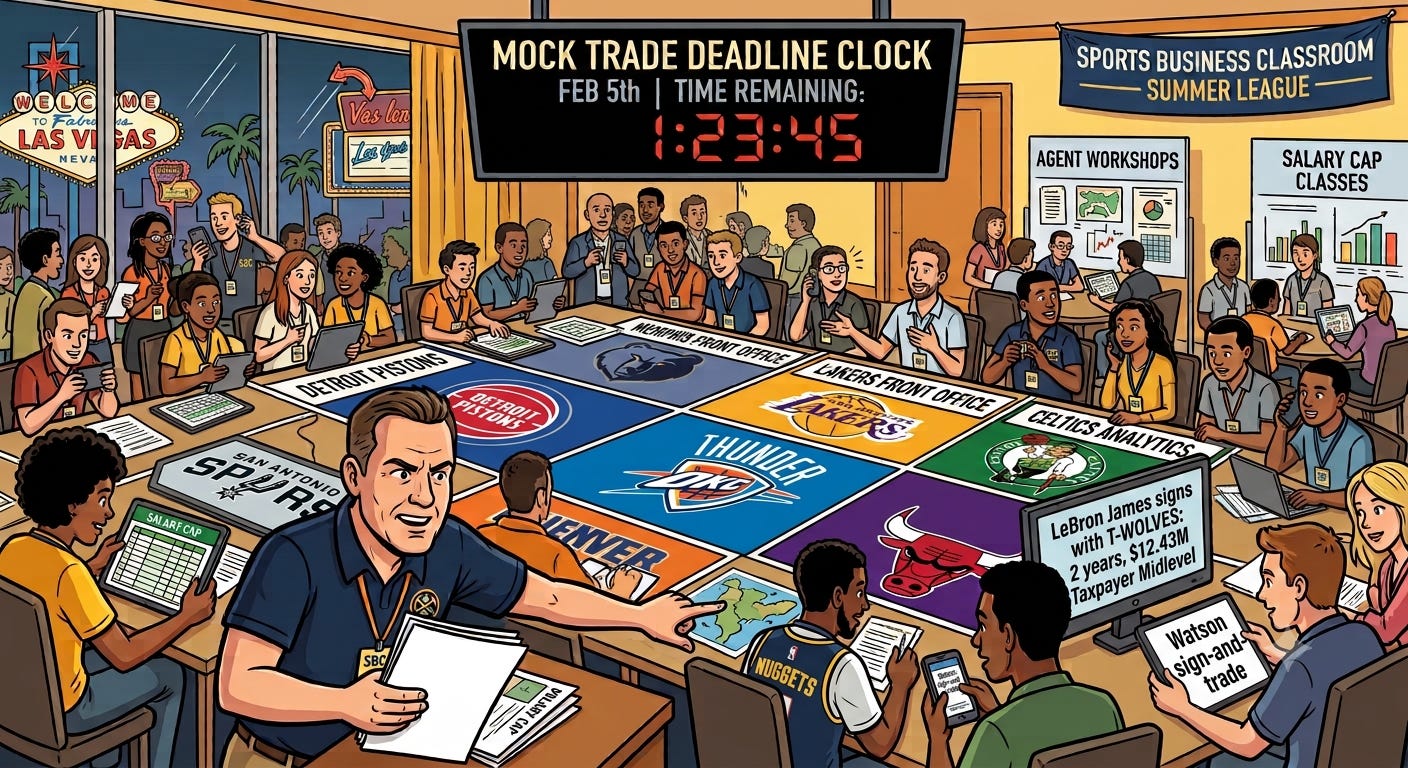
Around that, actual basketball is being played. You can watch parts of a dozen games in a day for the price of a single NBA regular season ticket.1 Players, coaches, and referees are all fighting for their careers. Less visible is the scratching and clawing of those trying to get a foot in the door of NBA, WNBA, G-League or college front offices, and that’s where Sports Business Classroom comes in.
Last year, I had the opportunity to take part in SBC, a program designed for those interested in working in those positions. I detailed my experience in one of my first YouTube videos. This time, I returned as an alumnus, supporting the current batch of students.
In addition to taking in the wisdom of several high-profile speakers and networking with as many people as I could, my role was to participate in the mock GM exercise, where 20 teams are made up of students in the salary cap, scouting, and analytics majors, and the final 10 are run by alumni.2
The mock gives the students the chance to apply their learnings from the week to evaluate players and make moves with the franchise they are assigned. While the days are spent in the classroom setting, hearing from some of the best in the business, the nights back at the hotel are spent working on deals with other teams and agents. I spent Tuesday-Thursday coaching students who asked for help in preparation for the four-hour transaction window on Friday morning.
SBC Mock Results
This is the third full-scale mock exercise I have been a part of (two SBC and one at ASU’s Mock Trade Deadline event that I helped with). One of the things I have learned is that very smart people can have very different opinions about moves. While it’s tempting to name a winner and loser (team vs team in trade or team vs agent in signing or extension), I wanted to instead highlight the moves I thought were a win-win for both parties and thus could potentially see happening.
The mock exercise covered everything from July 14th, when the mock diverged from real life, to February 5th, the trade deadline. And if we look at the signings made in the “offseason”, I thought all of the major name free agents ended up in pretty reasonable spots.
Restricted free agent Jalen Duren returned to Detroit on a deal starting at less than 25% of the salary cap after the big man’s leverage was diminished and fellow RFA (and Wildcat) Bennedict Mathurin did the same with the Clippers just above the midlevel. Denver’s negotiations with their two RFA (Peyton Watson and Spencer Jones) effectively stretched later into the summer so I’ll hold on that for the moment (Spoiler: I was assigned to be the Denver GM).
Draymond Green and James Harden signed back with their current teams as well after LeBron James and his agent chose Minnesota for the taxpayer midlevel (2 years, $12.43 million with a player option).
Signings
Once you get past that level, it gets to be pretty slim pickings, but there were a couple of moves around the edges that made sense to me in terms of filling out benches.
Bruce Brown (Golden State Warriors) - 1 year, $4,500,000 via the taxpayer midlevel.
With only 11 players currently on roster3 and a nearly $36 million gap to their second apron hard cap, the Warriors definitely have work to do.
It could be as simple as signing two minimums and giving the rest of the money to Green, but in this case they opted to use a portion of their midlevel to secure Brown, a veteran wing that seems like a natural fit for Golden State.
I think he could be had for a minimum, but if this is what it took (and Green is willing to take a little less to get one of the few rotation caliber free agents left on the market), maybe paying a little extra made sense.
Nic Batum (San Antonio Spurs) - 1 year, $3,876,529 via the vet minimum exception, counting as $2,449,421 against cap, tax, and aprons.
I actually had to go check and make sure Batum hadn’t played for San Antonio before. He hasn’t, but I can already clearly picture him in a Spurs jersey.
Last year, San Antonio had Kelly Olynyk, Mason Plumlee, and Bismack Biyombo as veterans, but could really use one that could actually play. Batum certainly isn’t what he once was, but was still good enough last year to get on the floor. It only seems natural he continues the Spurs’ long-standing French connection.
The Spurs currently will have one open roster spot once Jordan McLaughlin signs and project to be $2.1 million under the luxury tax, which they almost assuredly will finish the year under to delay the start of their repeater tax clock. However, the $300k could be made up via an in-season trade (most likely Harrison Barnes’s $8 million expiring or McLaughlin).
Perhaps this would require Batum agreeing to a partial guarantee around $3 million just in case the Spurs don’t want to make a trade and need to cut a player before the January 10th guarantee date. That would proportionally get their tax hit under the threshold. They could then re-sign him near the end of the year to be on their playoff roster.
Bradley Beal (Orlando Magic) - 1 year, $3,876,529 via the vet minimum exception, counting as $2,449,421 against cap, tax, and aprons.
I wrote about Beal’s financial situation last year in response to his buyout with the Phoenix Suns, saying then that I found it unlikely he would sign for more than the $15 million non-taxpayer midlevel for 2026-2027. We are far past that now.
Beal declined his $5.6 million player option at the end of June and could re-sign with the Clippers using non-bird rights for up to 2 years, $13.2 million.4 This is the most likely option, and Los Angeles may have had a handshake agreement with Beal dating back to his signing last year that they would take care of him this offseason.5
With the Clippers rebuilding, and especially if they do retain Mathurin, there might be better options basketball wise for Beal. If he wanted to join a team that could really use his help to try to jump up into contention, Orlando is a prime candidate, as they are in desperate need of more shooting.
The Magic currently have one open roster spot along with the highest payroll in the league. Even a minimum contract would leave them only $50k in space below the second apron. Alternatively, they could waive Jamal Cain, whose contract is non-guaranteed, to offer Beal $5 million out of their taxpayer midlevel. This would hard cap them at the second apron, which reduces future flexibility, but I can’t really see them going over anyway.
Extensions
While July is made for free agency, August-October is the season of extensions in the NBA. First round draft picks entering their fourth year (draft class of 2023), as well as players on 3- or 4-year contracts starting on the second anniversary of the most recent signing or extension, or 5- or 6-year contracts starting on the third anniversary, are eligible for extension.
Anthony Black (Orlando Magic) - 5 years, $130,000,000 starting at $26,000,000 in 2027-2028.
Let’s stay in Orlando where the Magic will try to come to terms with former 6th overall pick, Anthony Black. As I said above, Orlando has a very expensive roster and that is true beyond this season as well.
For the second SBC in a row, the Magic GM opted not to “solve” the Paulo and Franz “problem”, but instead moved on from Jalen Suggs, taking back Fred VanVleet’s expiring salary among other things. That makes some sense if they think that Black can move into a starting role.
The mock Magic and Black’s agent agreed to a five-year $130 million extension that would put him under contract all the way through the 2031-2032 season, structured as $26 million in each year.
I think the real Magic might choose to start at a lower number for the same average annual value (AAV) since they are already facing financial constraints, but the flat structure would be a way to get Black a little bit more money earlier and hedge your bets in the long run if you’re the Magic.
Amen Thompson (Houston Rockets) - 4 years (PO), $156,630,600 starting at $39,157,650 in 2027-2028.
Thompson looked like a sure thing to get the 25% max only a year ago, but his offensive game has still yet to come around. The number there in the first year looks a little bit awkward, but it’s equal to 22.5% of the projected salary cap for next season. This seems like a good compromise for the Rockets to save a little money in the near term while also structuring this contract with no raises.
Thompson, meanwhile, receives a player option on only a four-year extension, which will set him up to be eligible to begin his next contract with seven years of service. If he does turn the corner offensively, he could demand the 30 percent max at that time.
Jordan Walsh (Boston Celtics) - 3 years (PO), $10,000,000 starting at $3,086,420 in 2027-2028.
Walsh’s salary for the upcoming season just became fully guaranteed. He is playing on the last year of a four-year contract for the minimum using the second-round pick exception. Walsh has made about $7.6 million in his career, so turning down a $10 million extension might be quite difficult, especially with a player option attached should he pop.
On the Celtics’ side, locking in a player that has proven to be a serviceable defensive rotation guy at just above the minimum seems like good business. Walsh would be an unrestricted free agent next summer so I like the idea of getting an extension done rather than letting him walk, but this can be done anytime during the season so no pressure.
An extension at this level would also make Walsh potentially tradable alongside another player on a minimum contract if needed to make a bigger move at a future trade deadline. Stacking multiple minimum salaries to make the financials of a trade work is no longer allowed during the season.
After I wrote this section but before I sent it out, Walsh and the Celtics agreed to a 3 year, $15 million deal ending in a team option. A little more money, but a flip of who holds the option compared to how it went down at SBC. All in all, very close.
Restricted Free Agency
In real life and mock offseason, RFA is a complicated and unfortunately antagonistic situation. Last summer, four high-profile players entered RFA after failing to come to terms with their team on an extension.
Chicago’s Josh Giddey came out the best, agreeing to a 4-year, $100 million offer with no raises or options. Jonathan Kuminga ultimately signed back with Golden State, albeit on a 2-year deal with a team option. He made $23.8 million last year, but is still searching for a home this offseason after being traded to Atlanta midseason. While I’m sure the Hawks would be happy to facilitate a sign-and-trade, they are now the second team seemingly willing to move on from Kuminga.
Quentin Grimes used the only leverage a RFA has and took the qualifying offer (QO) with Philadelphia, betting on himself for only $8.7 million. He has followed it up with some long-term security in the form of a 4 year, $60 million contract with the Los Angeles Lakers. Cam Thomas also took the QO and made $6 million but is now in danger of being out of the league.
This season Walker Kessler and the Jazz both agreed to a sign-and-trade to the Lakers. Meanwhile, Jalen Duren seems destined to go back to Detroit. If he takes a long-term deal, it will probably be at an amount less than he wants. Obviously, his other option is the more risky route of taking a qualifying offer of less than $10 million.
Denver
Along with Bennedict Mathurin, the two most important restricted free agency situations remaining both exist in Denver: Peyton Watson and Spencer Jones.6 As I hinted at earlier, I was the Nuggets’ mock GM for this exercise.
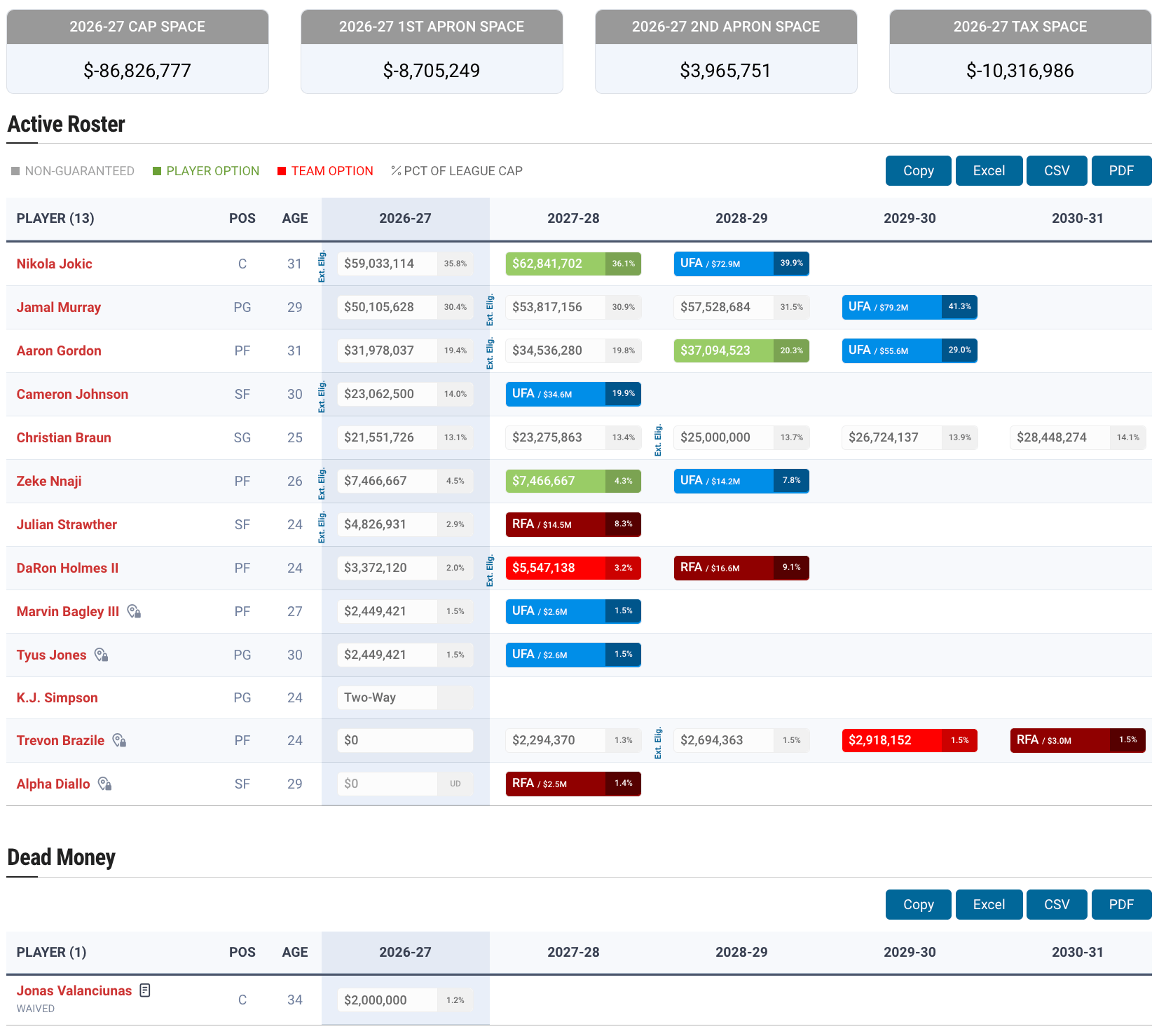
Denver is also expensive and with an ownership group that is not known as the most willing to spend money. The Nuggets were over the luxury tax in the three seasons previous to last. If the Nuggets are payers this year, they will do so at the “repeater” rate, a higher cost than non-repeater teams.
But Denver is already above the tax threshold by $10 million and below the second apron by only $4 million even before re-signing either Watson or Jones. They cannot easily fill out their final two required roster spots without tipping over.7
An aside on the second apron. The players union has been making statements about their dislike of the aprons, setting the foundation for their next set of CBA negotiations, with changes likely to take effect in the 2029-2030 season.
We have seen four teams already end the year above the second apron, so it is not a hard cap as much as people want to call it that. What does seem like a line that teams won’t cross is finishing above the second apron three times and getting their frozen pick dropped to the bottom of the first round.
Therefore, teams are more hesitant to start their second apron clock. We just saw OKC duck the second apron this season, at least partially because they will have to be in it in the future.
I think a compromise could be made that keeps the aprons, but removes the penalties related to frozen/dropped draft picks in future years. Then there would be no concept of a second apron clock. Teams would be free to enter the second apron in a given year, subject to all of the other restrictions preventing them from adding players, but not from keeping their own.
A much more significant change. While the union has said that players losing their bird rights is a concern because of second apron concerns, that is really about the mid-tier players that teams are fearful of investing in. 35% max players (e.g., Jaylen Brown) getting traded retain said rights.
But the system is paying guys that supermax right after they have peaked, which is not ideal. Currently players with six or fewer years of service can earn the 25% max, those with 7-9, 30%, and 10 or more, 35%.
Then there are rules based on awards voting, minimum game requirements (that are seemingly arbitrarily administered), and other factors (Luka didn’t qualify after getting traded) that allow players to get bumped up to a higher tier. But potentially the best player in the world (Wemby) just declined said escalators and took the 25% max outright.
This is far too complex a system. I would love to see under six years, 25% max and seven years or more, 30% max. Period. It would keep more teams together and redistribute salary and security to the NBA middle class.
It seemed like the Nuggets had some decisions to make this offseason and would even take the temperature of the market for Jamal Murray and Aaron Gordon. I know I tried to in the mock exercise, especially with the former, but his $50 million contract wasn’t something teams were willing to build around.
In real life, Denver has done very little this offseason, signing only veteran minimums. The most important business of the offseason, signing the best player in their history, Nikola Jokic, to an extension, failed. Jokic opted not to sign an extension, and will have the chance to decline his player option at the end of next June, becoming an unrestricted free agent.
So there is a lot of pressure on the Nuggets to perform. However, I’m not sure that bringing back Watson and Jones to run it back for another year will end in any better result. The Nuggets were arguably a top four team in the west last season and might be again, but are certainly not in the top tier of contenders.
In my opinion, it is pretty unlikely that Denver wins the title this season no matter what they do, so one of the ways I looked at this was with a goal of having the best opportunity moving forward from the summer of 2027 to effectively pitch Jokic on that vision.
I did not think having large amounts of money committed to Murray, Gordon, Braun, and Watson was going to be a good foundation for that vision. With that in mind, I set out to try to find the best sign-and-trade deal that I could for Peyton Watson.
Sign-and-trades are inherently difficult because of base year compensation (BYC). Essentially, whatever value Watson was to agree to (call it, $30 million) would count as $30 million for the receiving team’s salary in the trade, but would only count as $15 million for the Nuggets sending money for salary matching purposes. That is why you almost always see sign-and-trade deals include a third team who can take on the extra salary.
The most interested party early on was the Milwaukee Bucks, who were trying to send back a mix of players and what little draft capital they have left. Part of the value Milwaukee wanted to send out in the trade was the contract of Tyler Herro, which I neither wanted nor could the Nuggets take on financially. At that point, both Milwaukee and I agreed to look for a third trade partner. I told them that I’d be looking for either a power forward that could play alongside Jokic or a shooting guard, preferably if one or both was defensively minded.
We discussed that if Detroit had not previously traded Isaiah Stewart, they would be a natural fit to take in Herro. However, I walked away from that discussion and urged Watson’s agent, who was working with me to find his client a team that would pay him, to have a chat with Memphis. A day later, they had agreed in principle to a deal starting at $25 million, given that terms could be agreed to on a sign and trade.
I researched what a trade might look like. Stewart has two years remaining at $15 million each, with the second a team option. It is really a great contract and I would be quite interested to see him play alongside Jokic. Unfortunately, there was no way to make the trade straight up Watson for Stewart because of BYC issues.
I approached the Grizzlies with the suggestion that they take both Watson and Braun, the latter of which most agreed was on a neutral value contract, but one that Denver could not afford. Because of an additional move that Memphis had made, they were far below the tax and could use their $28 million traded player exception (TPE) from the Jaren Jackson Jr. deal to take in one of the contracts.
I paid Chicago two second round picks to take Zeke Nnaji into their room midlevel which set up my ability to complete the sign-and-trade that would hard cap Denver at the second apron.
Denver receives: $110,000
Chicago receives: Zeke Nnaji via RMLE, 2028 MIN SRP, 2031 SAC SRP
Denver receives: Isaiah Stewart, Ty Jerome, and GG Jackson8
Memphis receives: Peyton Watson via sign-and-trade, and Christian Braun via TPE9
Peyton Watson (Memphis Grizzlies) - 4 years (PO), $107,500,000 starting at $25,000,000 in 2026-2027.
These moves left the Nuggets about $5.3 million under the second apron, which they were now hard capped at. I had previously offered Spencer Jones’s agent a deal for 3 years, $13 million. They wanted 2 years, $12 million, which I thought was above what they could get from another team so I invited them to try to go find that deal. Golden State was willing to use their biannual exception to sign Jones to an offer sheet of 2 years at $5,477,000 each, which was unfortunately more than Denver could currently afford.
The extended calendar aspect of the mock would have allowed me to stretch Jonas Valanciunas’s $2 million cap hit over three years, opening another $1.33 million in headroom for this season to match the Jones offer sheet. In real life, that decision will be interesting for Denver, who must make that call by the end of August, perhaps before they are certain how these RFA situations will unravel.
In hindsight, I wish I had worked more with Jones’s agent to come to an agreement. Denver could have paid the same money over two years but including an 8% raise, which would have negated their need to stretch the dead cap hit.
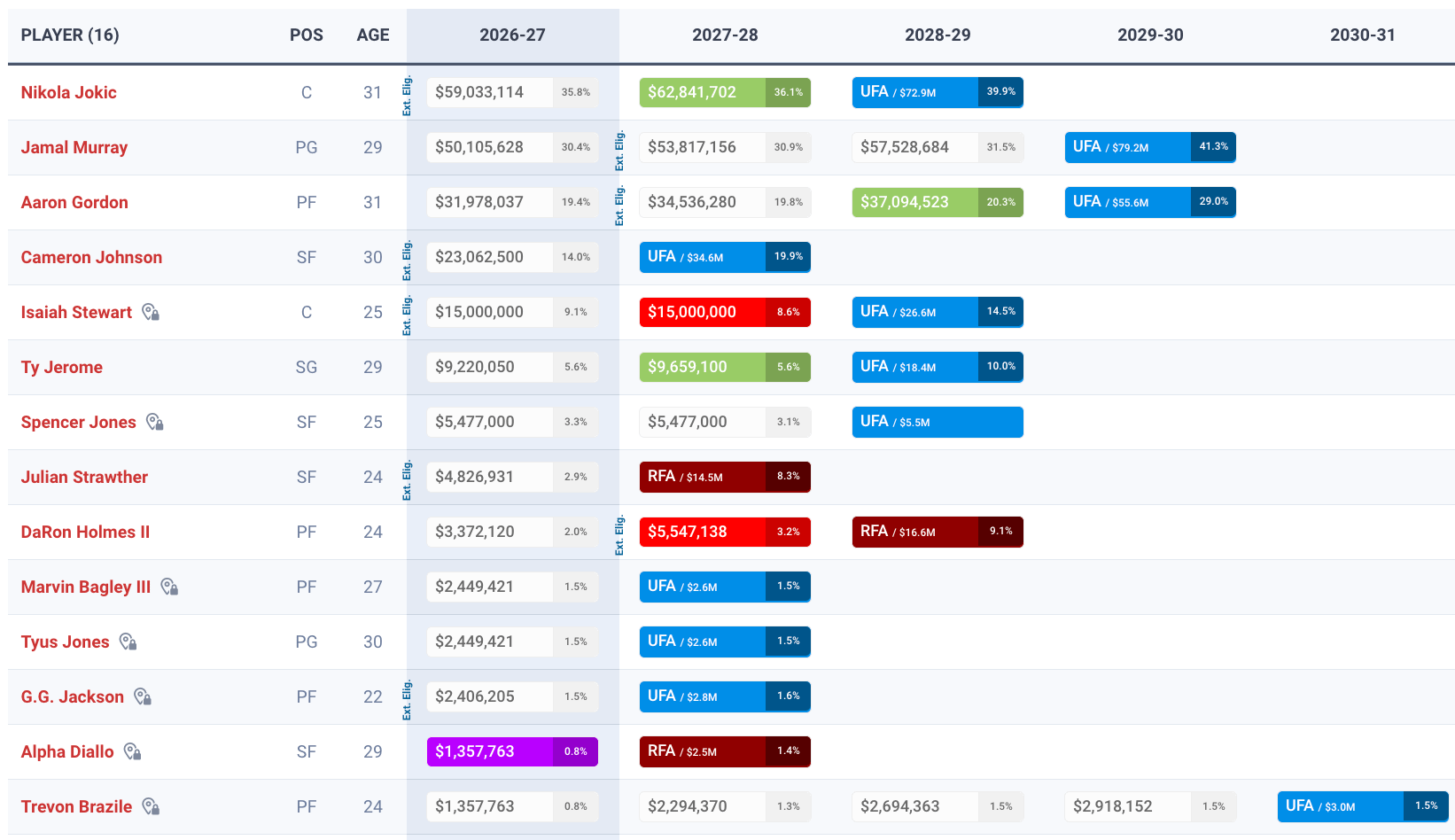
In the end, Denver picks up a physical, defensive-minded big man that can play alongside Jokic or in backup center minutes, along with more shooting on the perimeter. More importantly, they clear out their cap sheet.
Stewart will have a team option and Jerome a player option that he could possibly decline and sign back for multiple years starting at a lower number if it helps. The other salaries on the books are small except for the big three. The Nuggets get to try a different mix and remain competitive for 2026-2027 and kick the can down the road to next summer on any big changes.
By staying under the second apron, their 2034 pick will be tradable next offseason, perhaps along with Murray or Gordon, who would each have two years remaining under contract. It’s not a perfect plan to retain Jokic, but it at least gives the Nuggets a little more flexibility and time to find said plan.
Trades
Making a truly balanced trade is pretty difficult. Finding a potential partner who is willing to give up the things you want and whose goals match up with what you are offering is hard alone. Dealing with all of the rules and negotiating draft capital makes any trade lucky to get across the finish line.
One trade that intrigued me, but ultimately didn’t get done involved the Lakers, who out of all 30 teams, probably had the most controversial mock, after being saddled with a Walker Kessler move that was not thought highly of by most at SBC. Their attempts to build a contender got mixed reviews, but they did at least explore another path.
Los Angeles reportedly declined an offer of Brandon Miller (who had signed a 5 year $192 million contract extension), Naz Reid, Moussa Diabate, and three unprotected first round picks for Luka Doncic.
Doncic will almost assuredly decline his player option in 2028-2029 so he can re-sign at the 35% maximum with his 10 years of service. That means the Lakers have two years remaining to prove to him that he should stay. I don’t see this year’s team being a beacon of hope, which would mean next summer would be very tenuous with only one season remaining and no first rounders to send out to try to improve further.
We are seeing this play out in Denver with Jokic and we just ended this saga in Milwaukee with Giannis. Waiting until the final year allowed Giannis to exert control on the trade process by letting teams know where he would be willing to sign an extension. That suppressed the value the Bucks were able to get in return. Meanwhile, Jokic may walk for nothing.
I do not subscribe to the theory that any player is untradeable.10 The Charlotte package is far stronger than any that Milwaukee received for Giannis. Miller starting his extension at 20% of the salary cap and under contract for six seasons along with Reid’s three years plus an option totally resets the Lakers’ clock while refilling some of their depleted draft pick inventory.
For Charlotte, this is the way to get a number one guy to pair with the young, cheap talent they already have on roster. Perhaps they are just as well off waiting another season though and seeing what they have with this group, improving incrementally and trying to make the playoffs. Next summer, they might be able to swing a similar deal for far less.
Charlotte receives: Kel’el Ware
Milwaukee receives: Ryan Kalkbrenner, 2027 CHA FRP, 2027 MEM SRP
The Hornets did get this deal done, upgrading their frontcourt with a player on the same timeline as Miller and Knueppel.
Ware, the number 15 overall pick in 2024, will be extension eligible next offseason. I’m always skeptical of paying a guy at market value long before you have your star in house. The Bucks are just at the beginning of a rebuild that will take some time.
In this trade, they pick up a first round pick from Charlotte, who has not made the playoffs yet with this group. With the new lottery odds coming into effect, that pick could be valuable if the Hornets somehow slip into the lottery again. The Memphis second rounder is likely to be a good one, even more so if they end up in the relegation zone.11
Sacramento receives: Jakob Poeltl, Ja’Kobe Walter, 2028 TOR FRP, $1,000,000
Toronto receives: Keegan Murray, Dae’Qwon Plowden
If the Kings are realistic about their outlook, taking on negative value contracts with assets is a good way to go. Poeltl is about as distressed an asset as there is out there. As Sacramento, I would have tried to get the Raptors’ 2029 pick unprotected just because it is one year later, and their 2027 which will be the worst of four teams, but still good to have. Plus, they get a second draft guy in Walter to try out.
Toronto turns Poeltl into a wing that can play for them in the playoffs for the price of one first round pick that they hope will be in the 20s.
Wrap-up
There were plenty of other trades in the mock, both moves around the edges, and full-blown blockbusters, but usually ones I had an opinion on one way or the other. Every time I partake in one of these exercises, I learn something new. Plus, they are a ton of fun.
If you want to learn more, a great place to start is Bobby Marks’s transaction tracker, where he explains each move that is made from a salary cap perspective, or Yossi Gozlan’s Third Apron substack and podcast. And the best source of salary information and best trade machine live at Spotrac.com, home of my friend Keith Smith.
These are three of the most knowledgeable people in the world in this area and they are also instructors at Sports Business Classroom. I’ve been very lucky to hang out with and learn from these guys the last two years.
A tip: Cox Pavilion games are a better watch than those in the arena. You can get much closer to the floor and hear the coaches and players.
This is partially a logistical move. Each student franchise (and the six agencies) gets time to present their strategy on Wednesday and their results on Saturday. Having all thirty teams present would be tough. Plus, it’s nice to have more people on hand to help.
Teams are allowed to have 21 players on roster during the summer, but must cut down to 15 (not including their 2-3 two way contracts) by the start of the season. Teams must have at least 14 players on standard contracts throughout the season, with an exception to drop as low as 12 for up to 28 total days, but no more than 14 consecutive.
The Clippers’ whole situation is in limbo with the Kawhi Leonard deal held up; however, SBC processed it as if the Raptors had gone through with the trade.
That would have happened before Pablo Torre released information related to the Clippers and Aspiration. LA may be a little wary, but paying Beal $6 million is not as obvious as the Bucks paying Gary Trent Jr. $15 million.
Guys like Jaylen Clark, Jordan Miller, Tari Eason, Mohamed Diawara, and Mark Williams signed back on team-friendly deals. Quinten Post signed with Memphis via an unmatched offer sheet.
I did a search for which second rounders had not signed yet to consider acquiring their draft rights, which don’t carry a tax variance to the 2-years-of-service minimum.
I may have been able to push harder to get a pick included but for the sake of the exercise and getting something done for the students representing Watson and the Grizzlies, this was good enough.
This trade would have to wait until September 8th, the two-month anniversary of Stewart being traded to the Grizzlies, since it is required for his salary to be aggregated in this deal.
I’m actually a fan of Dallas’s progressive decision to move on from Luka when they did. Their execution after making that decision was terrible.
Relegation zone → less likely for great first round pick → better chance at high second round pick.