


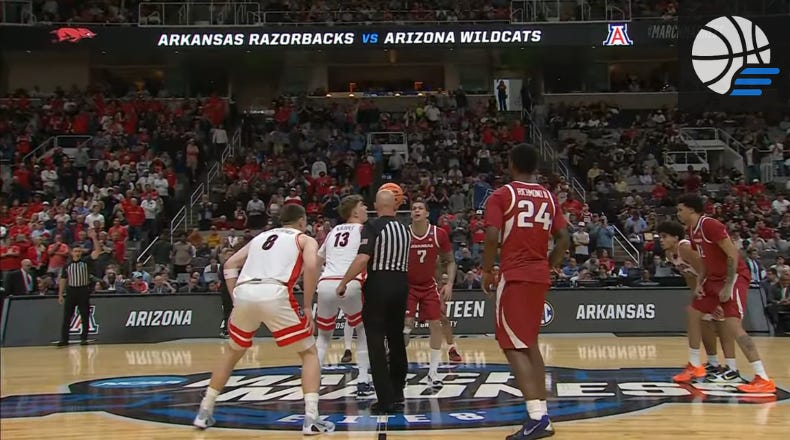
Arizona handled its business in the Sweet Sixteen, scoring 109 points en route to a victory over Arkansas and earning a matchup with Purdue in the Elite Eight.
Elite Eight Preview
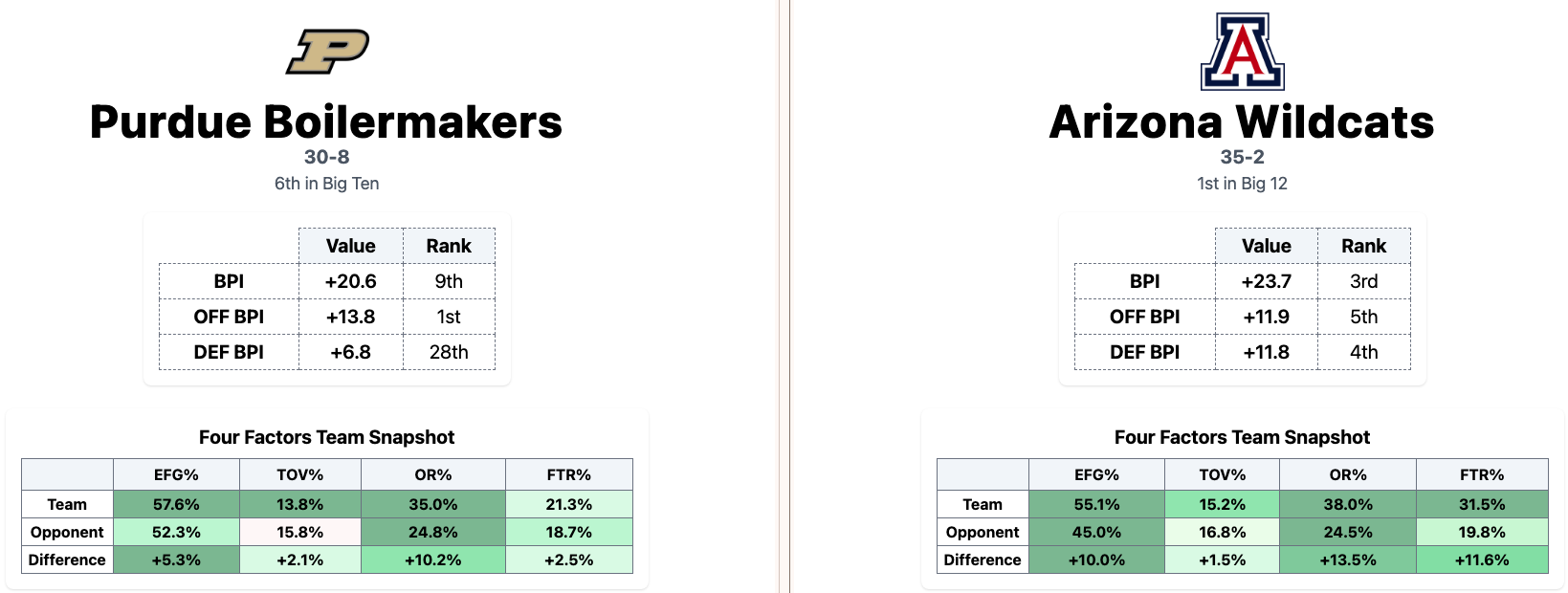
Purdue finished seventh in the Big Ten regular season and won the tournament championship. The Boilermakers have played 11 ranked opponents, going 7-4. As far as common opponents, they have played Alabama (W), Texas Tech (W), Iowa State (L), Auburn (W), and UCLA (1-1).
(Source: ESPN Analytics)
Purdue Offense
Similar to the Razorbacks, the Boilermakers are stronger on the offensive side of the ball. BPI, KenPom, and EvanMiya all rate Purdue as the best offensive team in the country.
They run a lot of set plays, but almost all to move pieces on the chessboard for Braden Smith to work as the handler in ball screens. Smith’s box creation is 14.2, higher than Christian Anderson, Kingston Flemings, and every other guard the Wildcats have played this year except Darius Acuff (14.4).
For more insight into Purdue’s offense, watch this video:
Similar to how the Wildcats covered Acuff, I think the strategy will be to force Smith to be a scorer. Smith can finish from all three levels and is an elite mid-range shooter but what you don’t want against Purdue is for everyone else to get going.
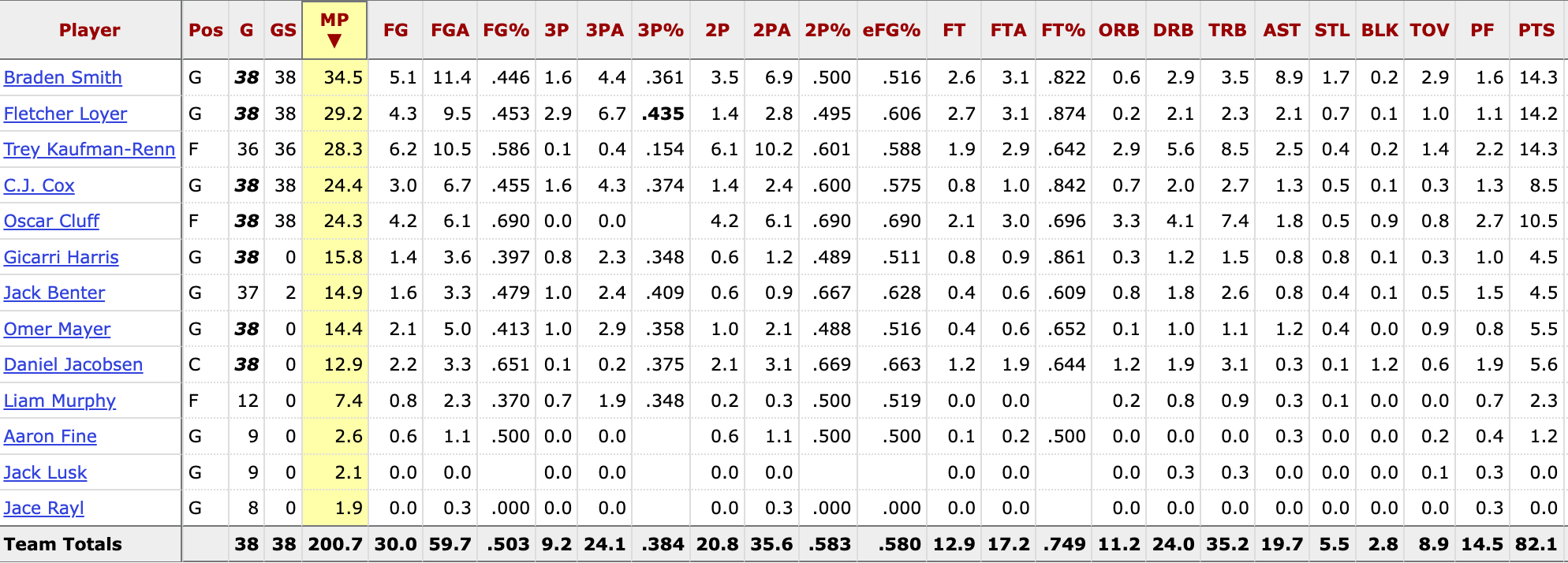
Other perimeter players’ three-point rates (3p% on 3PAr) are: Cox (37% on 0.64), Loyer (44% on 0.71), Harris (35% on 0.64), and Meyer (36% on 0.58). Even post sub Jack Benter shoots 41% from three at a 3PAr of 0.71. More than half of each of their shots are threes. All of these guys’ jobs are to be ready to shoot it if Smith throws them the ball.
The last two starters, Trey Kaufman-Renn (TKR) and Oscar Cluff are not three-point shooters. For the first time in the tournament, Arizona will face a team that can put significant girth on the floor to match Arizona. However, while Arizona goes to Tobe Awaka, Purdue goes to Benter at 6’6” 215 and essentially plays only one big. They do have Daniel Jacobsen at 7’4” 250, but as of late, his minutes have dwindled to near nonexistent.
The Boilermakers are efficient at shooting, nearly as good as Arizona on the glass, and, with Smith handling the ball most of the time, a very low turnover team. They play at one of the slowest paces in the nation, about 62 possessions per game.1
Purdue does not get to the free throw line very well, which could help Arizona keep its posts on the floor. If the game happens to be officiated tightly, Arizona has the advantage of having three big men compared to Purdue’s two.
Matchups

Most likely Jaden Bradley will start on Smith. However, when Bradley is out, and maybe even some of the time he is in, I would consider covering him with Kharchenkov. While I think Bradley may be a little better at getting over the screen, Kharchenkov’s size might be more to think about in rear-view pursuit should Smith try to beat the Wildcats pulling up for jumpers.
By far, Anthony Dell’Orso’s best matchup is Gicarri Harris, who is typically the first guard sub, replacing CJ Cox. That seems to typically happen at the 12-minute timeout so we will see if Coach Lloyd delays his first guard rotation to get that matchup.
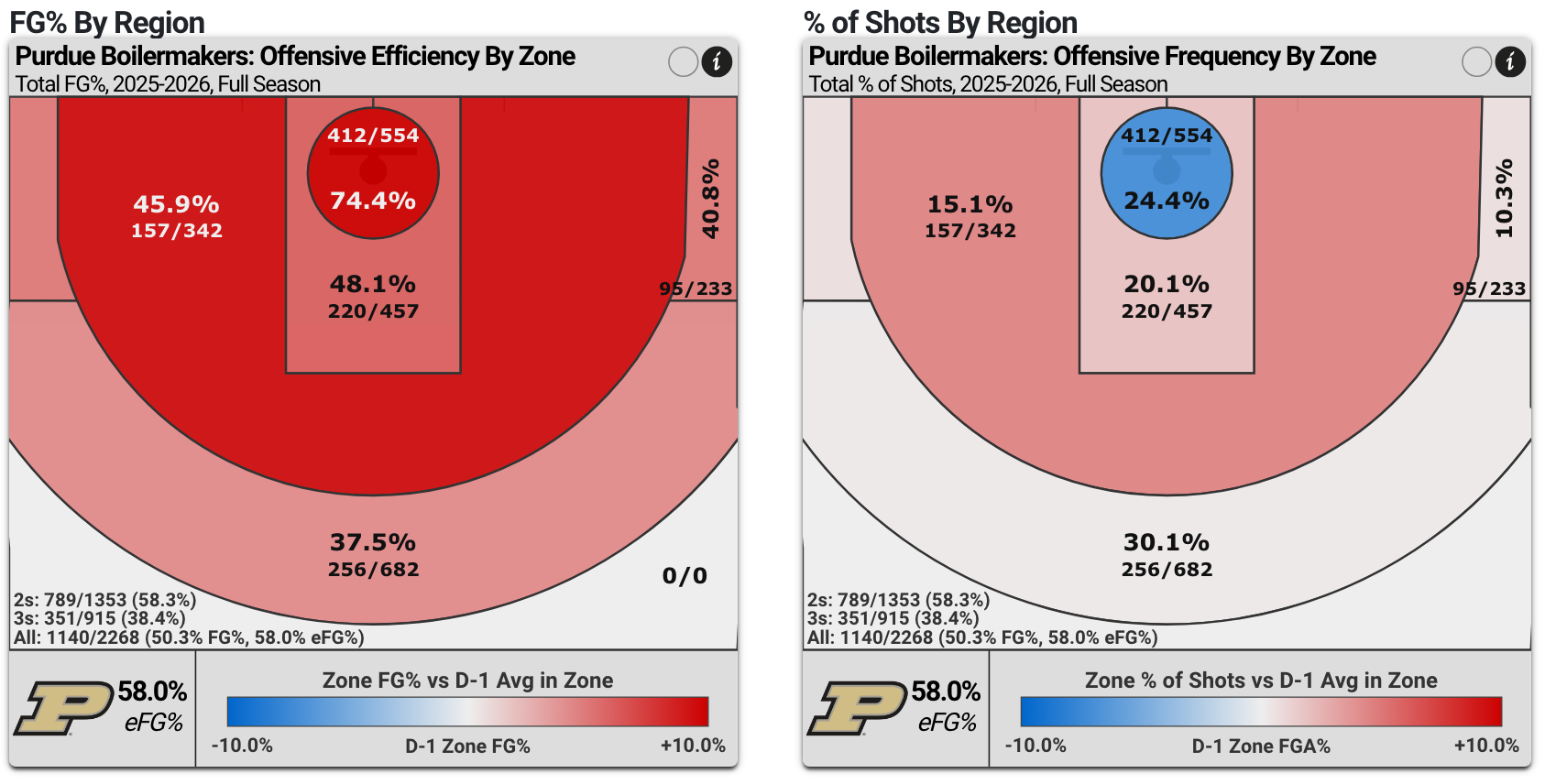
Purdue does not attempt a ton at the rim and should not have their normal level of success there, as the Wildcat posts are strong deterrents. TKR may do more damage in the short roll, something I pointed out as a potential spot to attack after ASU had some success in their first matchup.
However, unlike Massamba Diop attacking Krivas’s drop coverage center-on-center, TKR plays the majority of his time at power forward. He will be far less successful if Krivas stays on Cluff, who will not be able to draw him away from protecting the rim.
For that reason, I expect the best offensive lineups that Purdue can put on the floor to include Benter instead of Cluff. Arizona will have to decide if they are better off matching Krivas’s rest with Cluff’s. Especially if Kharchenkov covered Smith, that would make the Cats very switchable. I wouldn’t even mind Krivas switching onto Smith under ten on the shot clock.
In general, I think it will be important for the Wildcats to switch up some coverages and give Purdue different looks. The Boilermakers are good enough that they can figure defenses out if a team lets them.
(Source: Basketball Reference and CBB Analytics)
Purdue Defense
Defensively, the Boilermakers are small and unathletic, especially compared to Arkansas. However, they play very hard, which can make up for a lot. They do not generate a ton of turnovers (or score much in transition), but instead stay disciplined and try to force opponents into low-value shots.
Loyer may cover Burries, trying to generate cross-matches in transition. If that were the case, I would leave Burries on Loyer on the other end. There’s no real size advantage for Loyer, who plays as Purdue’s small forward, despite a guard body. Smith probably has to cover Bradley, who needs to attack him the same way he did Acuff, if for no other reason than to make him work.
The question will be: how does Purdue cover the posts of Arizona, especially with Benter on the floor? It asks a lot of TKR and Cluff to hold down that end, much less without the other.
Arizona will try to go inside of course, but I think it is also important that Koa Peat attacks the rim from catches in the mid-post. If TKR were to get into foul trouble, Purdue would have a much tougher time on both ends of the floor.
Next Game: vs Purdue on Saturday, March 28th, 5:49PM MST.
There were 79 possessions in the game vs. Arkansas.