


The Wildcats returned from Birmingham with another W in their pocket after one of their most difficult tests so far this season.
Are the Crimson Tide the best team the Cats have played? Probably, not. But the contrasting styles the two teams play meant there was more room for variability.
Through a half of basketball, all of the questions that permeated the pregame discourse seemed relevant. And then, very quickly in the second half, they could all be brushed off.
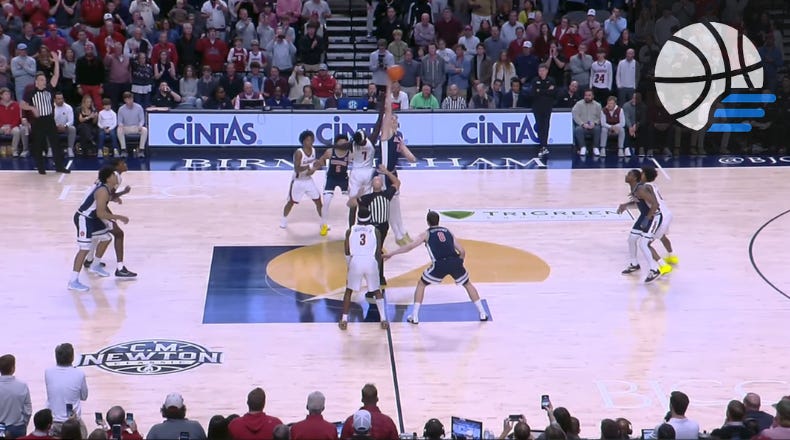
First Half (Alabama 41 Arizona 39)
In press conferences leading up to this game, both Coach Lloyd and Anthony Dell’Orso were asked if there would be pressure on the Cats to match Alabama from behind the arc.1 Both essentially said absolutely not and that Arizona would play it’s typical style.
Then Arizona shot 17 three pointers in the first half, the same as Alabama.
Similar to how UCLA guarded Arizona earlier in the year, Alabama packed the paint and dared the Wildcats to beat them from long range. Brayden Burries said after the game that he was surprised that defenders kept closing out short on him.
So, were the Wildcats forcing or taking what the defense was giving them? Judge for yourself in this supercut of all first half attempts, without seeing make or miss.
Other than Dell’Orso’s last second shot at the end of the half, I struggle to find any that are terrible forces and I would call nine of the attempts “you have to take that” opportunities. For the record, here are the five that went in.2
Arizona’s 5-17 3FG was equivalent to 0.88 points per shot. While not lighting the world on fire, it was better than the 0.72 points they got per two-point shot (9-25).
Arizona should expect to see more teams throw this type of defense at them, especially when they appear to be at a disadvantage inside. I intend to have a breakdown of the Wildcat’s shot profile in the next article.
Second Half (Arizona 57 Alabama 34)
At 16:58 with Arizona leading by four, Jaden Bradley picked up his third foul, joining Koa Peat, who also had three personals, on the bench. Those two returned at 10:41 with Arizona leading 67-51.
Alabama coach Nate Oats was asked postgame why he chose not to take a timeout during that stretch and said he didn’t have anything to tell his team other than to play harder.3 Much of the focus was on the rebound differential (28-13 in the second half) but I think both of these topics start with Alabama’s offense.
Unlike the first half, the Crimson Tide offense looked stagnant and resorted to a lot of isolation, leading to contested shots, and balls that are difficult to offensively rebound since all defenders are more lined up in iso than against a lot of off-ball movement.
They tallied only 4 assists compared to 9 turnovers, 7 of which were live ball turnovers, allowing the Wildcats to get out and run and everything just flowed much more smoothly, leading to good looks.
It also helped that Brayden Burries got hot as the sun for a stretch.
Fun Bonus
Two Ivan Kharchenkov saves by poking the ball back into open space for his teammates to push in transition.
Motiejus Krivas Love
A lot has been made of Koa Peat hitting the ground running as a freshmen or of Jaden Bradley’s improvement as a scorer to compliment his steady point guard play. Braden Burries is finding his rhythm after Anthony Dell’Orso carried some of the wing scoring through the first five games. I have happily pointed out the little things that Ivan Kharchenkov does that matter to a winning team and Tobe Awaka may be the best rebounder in college basketball.
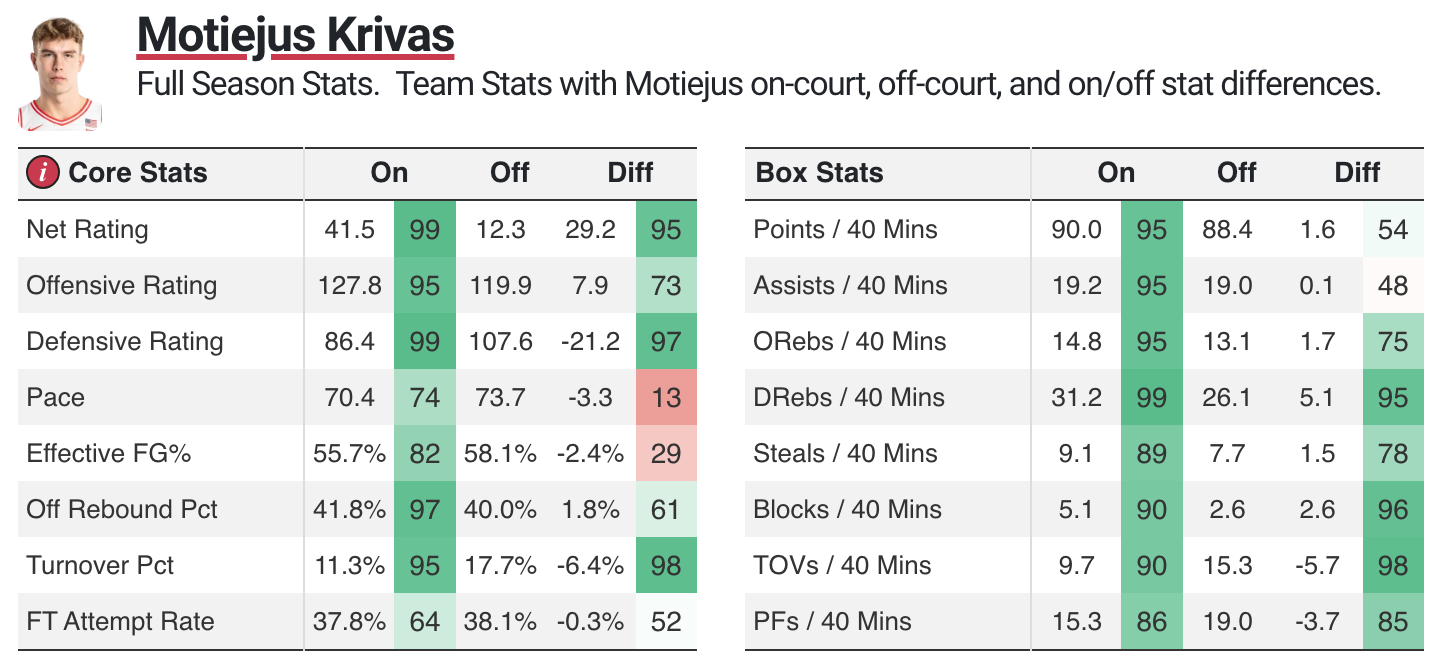
Motiejus Krivas is the most important player on this team.
Krivas recorded his first career double-double in this game, finishing with 14 points and 14 rebounds. Some would say he should do that every night. When you are 7’2”, sometimes the expectations are unfair. Here are seven of those rebounds that could have gone either way, had Krivas not given extra effort to track a rebound from a distance or to outmuscle an opponent.
The Wildcats are better at nearly everything, some things substantially, when Krivas is on the floor. His defensive rating4 is 86.4. The best team defensive rating in the country is 87.3. His net rating is 41.5. The best team net rating in the country is 39.8.
Comparing the big combos defensive ratings (lower is better):
Krivas/Peat without Awaka: 87.6.
Krivas/Awaka without Peat: 82.1.
Awaka/Peat without Krivas: 112.6.
Appeals
Well, I learned something on Saturday. In addition to the calls that are challengeable, coaches can “appeal” to officials to perform a review of another set of calls. Here’s a list of what can be appealed. Officials reserve the right to review these of their own volition, but coaches can ask them to do so as well.
Previously, I thought this to be informal but apparently not. If a coach appeals for an official review, and the call stands, their team is charged a timeout.5 This seems confusingly similar to a challenge, especially when the ESPN graphics and announcers were referring to Nate Oats’s appeal for a Krivas flagrant foul as a challenge.6
However, coaches can appeal an unlimited number of calls in a game. Oats successfully appealed a later call, resulting in Awaka being assigned a Flagrant 1 foul.
Here is the language from the rulebook:
SECTION 14. TIMEOUTS GRANTED AND CHARGED
Art. 1. A timeout shall be granted and charged after a visual or oral request by a player or head coach, as set forth in .a through .c or the conditions in .d, .e and .f exist:
…
d. When the appeal for a correctable error or timing, scoring, or, alternating-possession mistake is reviewed and the official’s ruling is not reversed;
e. When the appeal to review the monitor for a flagrant 2 contact foul, flagrant 1 contact foul, or contact dead ball technical foul does not result in a flagrant contact foul or contact dead ball technical foul being charged.
f. A timeout shall be granted for a coach’s challenge, however, if the challenge is successful, the time-out will not be charged.
Here is an example from the case book:
After a one-and-one is shot by Team A and during the first dead ball after the game clock was started after the missed free throw, the coach of Team B requests an appeal stating that Team A was not in the bonus and should not have shot the one-and-one. The official finds that Team A was indeed in the bonus and charges Team B with a timeout.Team B does not have any timeouts left.
RULING: Team B shall be charged with an administrative technical foul for calling an excessive timeout. Any player from Team A shall shoot two free throws with the lane cleared and the ball shall be put back in play at the point of interruption.
(Rules 10-2.7, 4-28.1.e, 7-5.1.a and .b, 5-14.1.d)
And here is a good explanation by NCAA men’s basketball national coordinator of officials, Chris Rastatter7:
Next up: Home vs Abilene Christian on Tuesday, December 16th, 7:00PM MST.
The Tide shot 57 three pointers in their recent game versus UTSA.
Including Motiejus Krivas’s first career make. Now 1-3 career.
He eventually took a timeout with 3:09 remaining down 20 and took the other two home.
Points per 100 possessions.
Different from challenges, the team is not required to have a timeout to appeal. If they have no timeouts and appeal and are wrong, they receive a technical foul for an excessive timeout.
No foul was called and Alabama lost their first half timeout.
Rincon alum.