


The Phoenix Suns have been one of the biggest surprises of this NBA season. As of January 19th, they are 25-17, sitting 7th in the Western Conference. After a disappointing 2024-2025 campaign that finished 36-46, this feels like a breath of fresh air.
This year’s group currently ranks 14th in offense and 5th in defense.1 After finishing 27th defensively a year ago, this group has developed an identity as a hard-playing, unselfish team and because of that, they are much more enjoyable to watch.
But they are 11-13 in games against teams with winning records and have the ninth hardest strength of schedule in the league remaining.2 Absent a playoff draw against an injury-saddled opponent, it seems that a reasonable trajectory for this team is a first-round playoff exit.
With that in mind, let’s take a look at the Suns roster, what options they have, and where they should be going from here.
Roster
To give Phoenix credit, they have done a great job bringing in and developing players in the last two seasons.
Ryan Dunn and Oso Ighodaro, both of whom the Suns traded for on draft night in 2024, are showing growth. Collin Gillespie (minimum veteran salary, coming off a two-way), Jordan Goodwin (off waivers), and Jamaree Bouyea (two-way) have held down the point guard position admirably.
And while it’s still too early to judge returns on Jalen Green and to a lesser degree, Mark Williams, Dillon Brooks has been a home run. No one deserves more credit for the identity change than he does.
I’ve listed players in what I consider to be their natural position. However, both Rasheer Fleming and Nigel Hayes-Davis have played limited minutes, with Brooks, O’Neale, and Dunn spending time at the four.
The Suns packaged multiple picks to trade up for Fleming and long-term, would hope that 2025 first round draft pick, Khaman Maluach, is the prize piece in return from trading Kevin Durant to Houston. Both have spent time in the G League this season but will need to see the NBA floor significantly more in 2026-2027 for that investment to be on track.
That may necessitate trading one of the above small forwards to clear the space for Fleming and/or Ighodaro to get more run at power forward if Maluach moves into the backup center minutes.3
If the Suns wanted to be buyers at the deadline, power forward would be the natural place to look to upgrade. As far as weaknesses to address, Phoenix is currently ranked 23rd in defensive rebound percentage while fouling the fourth most in the league, per Cleaning the Glass.
Draft Pick Inventory
On February 9th, 2023, Phoenix sent Mikel Bridges, Cameron Johnson, four first round picks, and one swap to Brooklyn to acquire Kevin Durant.
The preceding eight months had seen Donovan Mitchell traded for three first round picks and two swaps and Rudy Gobert traded for (effectively) five first round picks and a swap. Even Dejounte Murray garnered a haul of three first round picks and one swap.
Trading for Durant was an all in move for a franchise that had held a 2-0 finals lead less than two years prior and was coming off of a 2021-2022 season in which they set the franchise record for wins, before a very disappointing second round exit. The market was inflated, but this was Kevin Durant, and he would be the missing piece.
After injuries to Durant and Chris Paul played a factor in a Suns second round playoff exit, the Suns chose to double down, sending four first round pick swaps and six second rounders to Washington to bring in Bradley Beal.
Two and a half years later, the Suns have zero playoff game wins to show for it. Mikel Bridges was traded to New York for another five first rounders and Cameron Johnson went to Denver for one pick plus Michael Porter Jr, who very well may be flipped for two more by the deadline
Toumani Camara, who was traded to move on from Deandre Ayton, has become one of the best defensive wings in the league for Portland, while Phoenix later paid a first round pick to dump Jusuf Nurkic to Charlotte. Nassir Little, who was also acquired in the Ayton trade along with Nurkic, remains on the Suns cap sheet as dead money through 2030, after being waived and his salary stretched, same as Bradley Beal and EJ Liddell.
The Suns also traded their 2031 first round pick to Utah unprotected, which effectively netted Mark Williams and the least favorable of Utah, Cleveland, and Minnesota’s first round selections in 2027.
So what picks do the Suns still have in their coffers? Horcruxed4 first rounders in 2027, 2028, and 2030, their own pick in 20325, along with second rounders in 2026, 2029, and 2032.6 And because of the Stepien Rule7, Phoenix cannot trade any of those first round picks outright until after this year’s draft.8
Trade Prospects
How would someone go about turning a paper clip into a house? To start, you trade that paper clip for a fish-shaped pen.9
In 2016, amid rumors that Kevin Durant was not a lock to return to Oklahoma City, the Thunder completed a draft night deal to send Serge Ibaka to Orlando. Ibaka had finished second in defensive player of the year voting in 2012 and 2013, and was viewed as one of the elite rim protectors in the league.
OKC was not necessarily blowing up their team, but viewed Ibaka’s value as at its peak, and chose to trade him for Victor Oladipo, who had previously been drafted #2 overall but not lived up to it with the Magic, and the 11th pick in that year’s draft, Domantas Sabonis.
One year later, Ibaka was no longer with the Magic after being traded to Toronto for Terrence Ross and the draft pick that had become Anžejs Pasečniks. Meanwhile, Oladipo and Sabonis were no longer with the Thunder, as they were traded together for Paul George.10
It’s at this point that basketball fans can see the paper-clip funded house in the distance. Only two years later, on July 10, 2019, Paul George was traded to the Los Angeles Clippers. The return: five first round picks, two swaps, and an all-rookie second-team guard named Shai Gilgeous-Alexander.
Even Sam Presti would tell you that it was not his plan to trade Serge Ibaka in order to eventually land the 2025 NBA MVP. But the lesson to learn is, buy low, sell high, and do that enough times that good things could happen. Buying low, on second draft guys11 like Oladipo, on non-premium draft picks, like the rights to Sabonis, or distressed assets, like Paul George’s contract, are not exactly easy, but it is still the “easy part.”
Deciding when to sell high, especially when the team is good, is extremely difficult. Which brings us back to the Suns, who are, at this moment, good.
Nick Richards
Let’s start with an option that isn’t too painful. Richards has slipped out of the rotation this season, but might be of some use to another team looking to fill backup center minutes. An unrestricted free agent this summer, currently making $5 million, I don’t think Richards is in Phoenix’s long-term plans.
With the Suns sitting only $255,632 over the tax threshold, swapping Richards for a player making a minimum salary (~$2.3M) would be a clean way for Phoenix to duck the tax and be halfway to resetting their clock as a tax repeater team.
Jordan Goodwin
Goodwin has been perhaps the Suns’ most exciting player in January, including an 8-13 3FG performance in a win over Oklahoma City. However, with Collin Gillespie’s emergence and the potential to convert Jamaree Bouyea’s contract after the deadline, along with Jalen Green’s upcoming return, Goodwin might be the odd man out.
Goodwin is also an unrestricted free agent this summer and will turn 28 around the start of next season. He is on a minimum contract this season. If the Suns could send him elsewhere, for a second time in his career, and collect a second round pick or two, that might be a good move.
Collin Gillespie
Also on a minimum deal, Gillespie has risen to the ranks of starting level point guard this season and the Suns should try to retain him long-term. Phoenix will hold his early-bird rights this summer and with the success and opportunity available in Phoenix, I would think he will want to re-sign.
Grayson Allen and Royce O’Neale
These two vacillate between serviceable starters, solid bench players, and guys you maybe don’t want on your books for another two seasons. Their salaries, $16,875,000 and $10,125,000 respectively, sit in a weird middle range.
I’m not sure either would fetch a significant return and it would likely be better to roll with them through the end of the year and see what options are available with a more flexible market in the summer. That being said, if their inclusion helps to complete a bigger deal, or cut costs for the future, the Suns shouldn’t hesitate to do it.
Ryan Dunn, Oso Ighodaro, Khaman Maluach, and Rasheer Fleming
All of these guys are under contracts with multiple years of team control remaining and potential to improve. Unless someone values them highly and bowls Phoenix over with an offer, they are here to stay.
Mark Williams and Nigel Hayes-Davis - Restricted Free Agents
The Suns invested two first round picks to trade for Williams this offseason, presumably with the intention of re-signing him in restricted free agency this summer. Williams’s skill has never been in question, and his appearance in 37 of 42 games this season has at least temporarily quieted concerns about his injury risk.
Meanwhile, Hayes-Davis has not made a significant impact that would lead me to believe that there would be much interest at the deadline, other than to open a roster spot. He is also a restricted free agent this upcoming summer and if Phoenix sees upside, they should be able to get him back on a minimum.
Jalen Green
Green is exactly the type of player that the Suns should be taking a shot on: a highly drafted, new environment, potential star. Unfortunately, he has missed all but two games so far this season. Therefore, Phoenix will likely wish to take any decision into next season before making any further moves.
Green is in the first year of a 2+1 extension that he received from Houston, but is extension eligible again next October. Unless he breaks out in the playoffs, I can’t imagine the Suns will be interested in doing that.
In the worst case scenario where Green underperforms in the next year, the Suns would not be forced to sell low. It would be unlikely in that case that Green would decline his player option unless a team-friendly longer deal was appealing. So Phoenix effectively has two more years to see if his stock rises.
Dillon Brooks
Now for the hard part. As I said earlier, Brooks deserves a ton of credit for the Suns’ turnaround this year. He is Phoenix’s second leading scorer and their perimeter stopper on defense.12
He is also turning 30 this week and is, in my opinion, a floor-raiser, not a ceiling-raiser. It is very unlikely that a team with Brooks on it will be bad, but only once has he advanced out of the first round, a 2021-2022 season in Memphis in which he missed more than half the year as the Grizzlies claimed the 2-seed.
I maintain a database of NBA player comps based on player type informative statistics and impact metrics. Here are five players that are statistically similar to Dillon Brooks: Zaccharie Risacher, De’Andre Hunter, Cameron Johnson, Kevin Huerter, and Brice Sensabaugh.
Brooks is older than all five of those players and makes more money than all but Hunter. His trade value will never be higher than it is right now. If the Suns can stomach it, they should be shopping his value around the league. To me, this is the most important piece of business the Suns have on their docket.
To further complicate things, Brooks is extension eligible this summer, looking to secure perhaps the final big payday of his career after showing out for the Suns this season. If he would be open to something like two additional years at $40 million, that’s something to discuss. However, Brooks is eligible for a four-year $125 million extension, running through 2031, when Brooks will be 35.
If his camp is asking for something like that in an extension, there could be significant discontent as soon as next season. Brooks has historically had a shelf life on a team before he starts to rub people the wrong way, his time in Memphis ending with the Grizzlies informing him they wouldn’t re-sign him under any circumstances.
Devin Booker
And the really hard part. The Suns should be looking for opportunities to move on from their franchise player.
Booker is re-engaged this season and worthy of consideration as an All-Star. He currently sits 15th in LEBRON WAR and if the Suns continue on their pace, will warrant All-NBA discussion, partially because the 65-game minimum will rule some others out. He has two previous All-NBA appearances, including a first-team in 2021-2022.
But his three-point percentage has fallen consistently since then, down from 38.3% to 30.1% this year. He ranks 26th in EPM and 40th in DPM and you can see where that is trending.
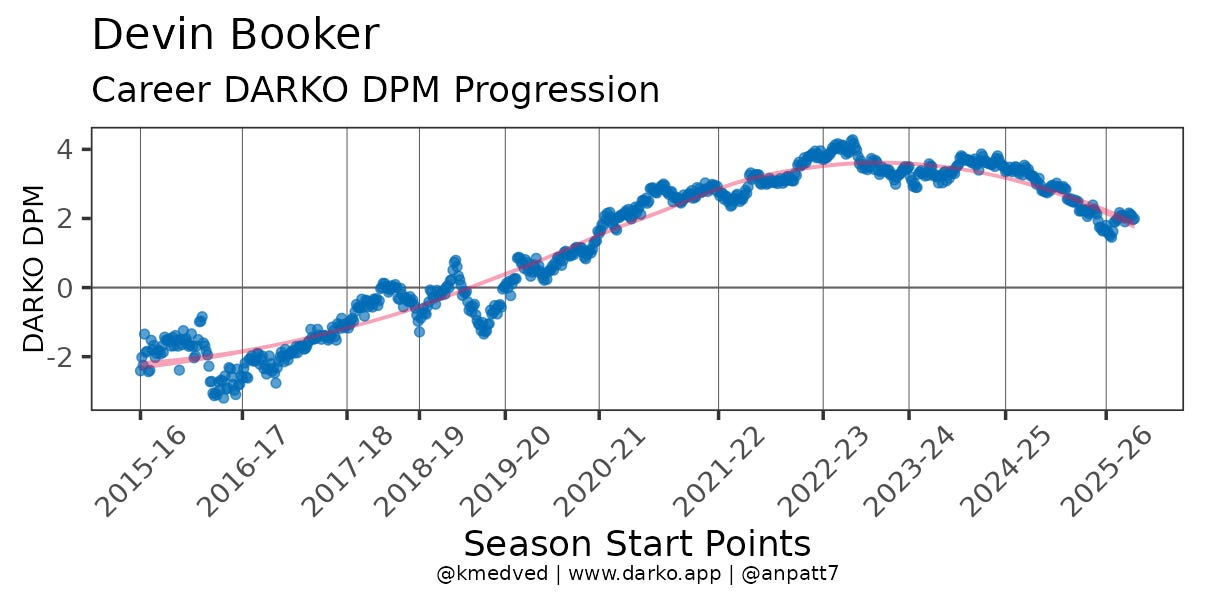
It is reasonable to think that Booker is somewhere between the 20th and 35th best player in the NBA at this moment. But eight teams have multiple players ranked higher than Booker in expected EPM, Booker’s better multi-season impact metric.
At best, Booker is the second best player on a contender and the Suns have no clear path to acquiring a “best player”. Meanwhile, Booker is paid the 9th most in the league.
Phoenix made the decision to extend Booker last summer even though he had three years remaining on his current deal. The extension will pay $145 million over two years.
Booker is currently projected to be the 3rd highest paid player in 2029-2030, behind Jayson Tatum and Shai Gilgeous-Alexander, two players who have already been the best player on a championship team and are two years younger. Booker even has a player option on that final year; although at age 33, he would only decline that as part of an agreement to add more years at a lower average number.
We just watched this story play out in Atlanta with Trey Young, who was traded for neutral value (no picks and no significant players). Memphis is having similar issues shopping Ja Morant. The 2026 summer may be the last time that the Suns could move Booker for a positive return. By 2028, they would likely need to attach a pick to get off of his contract.
Trade Hypotheticals
The Suns have been adamant that they are not parting with Devin Booker, who is trade eligible again as of January 10th, the six month anniversary of his extension. But let’s start with what they could return if they were interested.
Devin Booker For Young Players and/or Picks
Best Potential Partners: Chicago, Detroit, San Antonio
The Pistons (Harris and two of Ivey, LeVert, and Holland) and the Spurs (Barnes, Olynyk, and either Johnson or Vassell)13 could be in a better position this season if they trade for Booker, but my estimate is that they will make moves around the edges, if anything, and keep their powder dry after they see what they look like in these playoffs.
However, for Chicago, who has been stuck just under .500 for the past three seasons and are currently projected to be in the play-in again, now might be the time to make a move in one direction or another.
Having locked up Josh Giddey at a reasonable number through 2029, the next important business that the Bulls have with their current roster is Coby White’s upcoming free agency. White and Giddey have some duplicative skillsets and I expect Chicago to attempt to sign-and-trade White rather than retain him long-term.
Other than Giddey, the only players I would consider part of the Bulls’ future are Matas Buzelis, who remains on his rookie contract through 2028, and perhaps Noa Essengue, who has missed most of his rookie season with injury.
Chicago has some big expiring contracts. Nikola Vucevic could likely be traded for positive value, but Zach Collins and Kevin Huerter could not. The Bulls would also love to get off of Patrick Williams’s contract, which currently sits on their books through 2029.
The Bulls hold all seven of their first round picks plus a Portland pick that is lottery protected in 2026, 2027, and 2028 before reverting to a second rounder. They also have their own second round picks in 2028-2032.
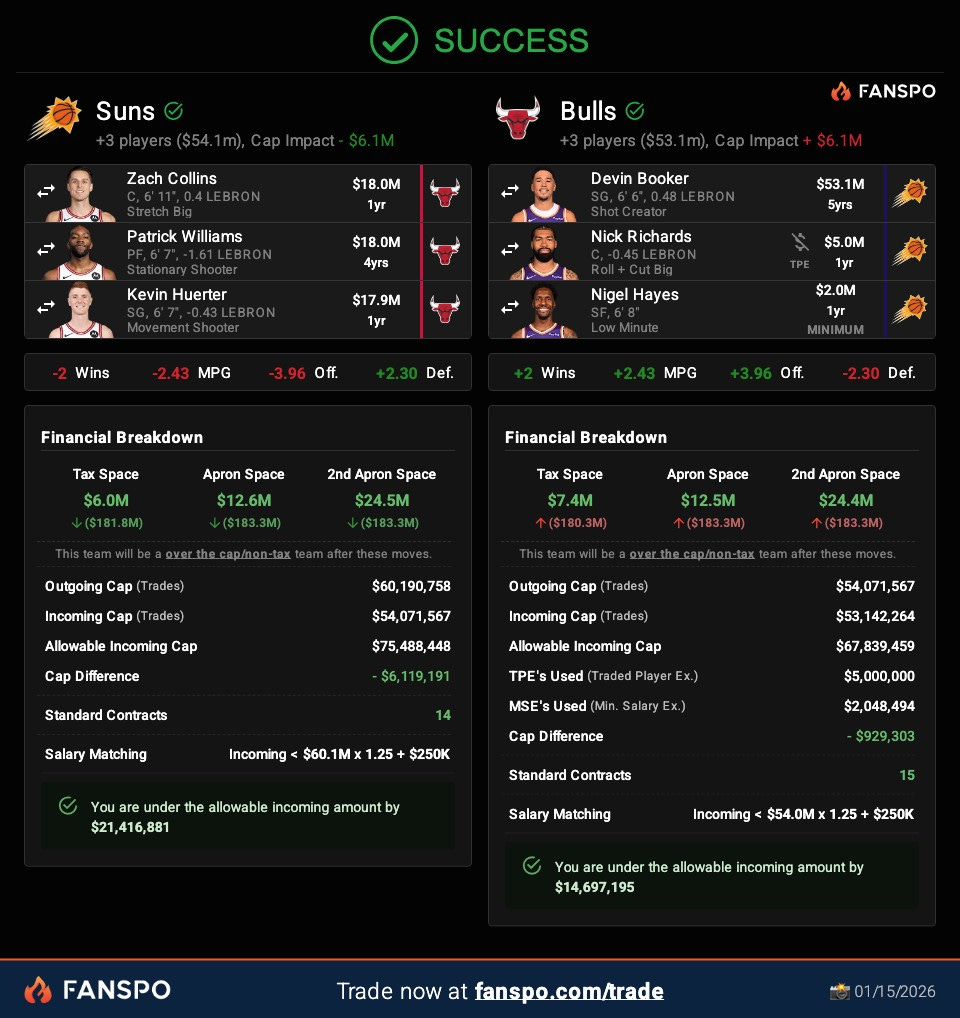
Bulls Receive: Devin Booker, Nick Richards, and Nigel Hayes-Davis.
Suns Receive: Patrick Williams, Zach Collins, Kevin Huerter, the Bulls’ 2029 first round pick, the Bulls’ 2031 first round pick, and first round pick swap rights in 2028.
Bulls Rationale: Chicago will not be bad enough to full on tank nor have they ever shown interest to in the past when they were better set up for it. Booker fits well with Giddey and Buzelis and signals that the Bulls are serious about contending soon.
They retain their 2026 first rounder with an 11.2% chance at a top-3 pick, along with the future Portland pick, their own picks in 2027 and 2033 (once this summer hits), and swap possibilities in 2030 and 2032.
If Giannis Antetokounmpo fails to sign an extension this summer, the Bucks will face the choice of moving him or potentially losing him for nothing the following summer. A sign-and-trade of Coby White in the range of the $30 million dollars that he supposedly wants, would be just enough, considering base year compensation, to be paired with the contracts of Isaac Okoro, Jalen Smith, and Tre Jones to go get the Greek Freak.
Chicago would be able to fill out their roster with the full non-taxpayer midlevel and biannual exception, along with minimums, and still not enter the tax in 2026-2027. Signing another NTMLE in 2027 would push the Bulls to the tax the following year, but they would be able to stay under the first apron.
If the Bucks played out the 2026-2027 season with Antetokounmpo, the Bulls would be perfectly set up to be a cap space team in the summer of 202714, the last year before Buzelis’s extension would take effect. With a complementary star like Devin Booker, and rising young players Giddey and Buzelis, Chicago seems like a place that Giannis would sign a long-term extension or new contract. Only an hour and a half from Milwaukee, this could be a nice fit.
Suns Rationale: When in doubt, trade with the Bulls or Kings (or Pelicans recently). Getting two unprotected picks could be a windfall. 2029 seems far away to wait, much less 2031, but that is kind of the point. Booker’s extension will have kicked in and the party may be over already in Chicago by then.
The Suns also regain some value in their 2028 pick in a couple of ways:
Currently, that pick is set to be the worst of four teams, nearly guaranteed to fall in the late first round. By adding swap rights, there is at least some chance it lands at a higher spot, which is nice because…
Phoenix will now be able to trade that 2028 pick outright, having added a 2029 pick to their inventory, thus avoiding the constraints of the Stepien rule. The same is true of their “least of three teams” pick in 2030, as they also add a 2031 pick in this deal.
There’s no question that this would be upsetting to some Suns fans, but Phoenix could lean into a much younger core group and try to develop. Plus, Jalen Green would get a clear runway to see what he could become.15 And Devin Booker gets a chance to play on a real contender in his late prime, which he definitely deserves.
An Out-of-the-Box Possible Option
Since the Suns are definitely not going to change course and trade Devin Booker just because I think they should, I’ve been toying with another possibility; however, there’s a lot of uncertainty with it.
The NBA has teased expansion for a long time, most often with Seattle and Las Vegas as the predicted locations. The CBA does not actually contain a ton of language about how expansion is handled and if the NBA were to expand, those rules would likely be re-evaluated.
However, if we went back to the last time the NBA had a two-team expansion, in 1995 with the introduction of the Grizzlies and Raptors, each existing team was able to protect up to eight players from their current rosters16, with all remaining players under contract pooled for the two new teams to pick from in an expansion draft. The Raptors selected 14 players and the Grizzlies 13, one from every existing team.
What is in the CBA?
Existing teams receive a traded player exception equal to the salary of the player they lose in the expansion draft.
Expansion teams are able to cut any of the players that they drafted before the start of the season without them counting against the cap. The player is still paid.
Aging players making 35% of the salary cap are not typically what an expansion franchise should be looking for. Not without risk, there is some opportunity here to use expansion as a pseudo-amnesty clause. If the Suns were to line up their contracts to have nine or fewer players on roster at the time of expansion and left Booker unprotected, one of the expansion teams would be forced to take him.17
If that team then cut him, he would be an unrestricted free agent, able to sign with whatever team he wants. From everything I can find, this would include the Suns.
While Phoenix would no longer hold his Bird rights, perhaps Booker would be happy to return to The Valley on a lesser deal like the midlevel, considering he would still be making the max money extension that the Suns just gave him.
Pair that with a $64 million dollar trade exception if this expansion were to occur in the summer of 2028 and all of a sudden the Suns have their path to another star.
Nick Richards to Duck the Tax
Best Potential Partners: Boston, New Orleans
Okay, we’ve played around in my fantasy world long enough so let’s get back to a boring, but much more likely reality.
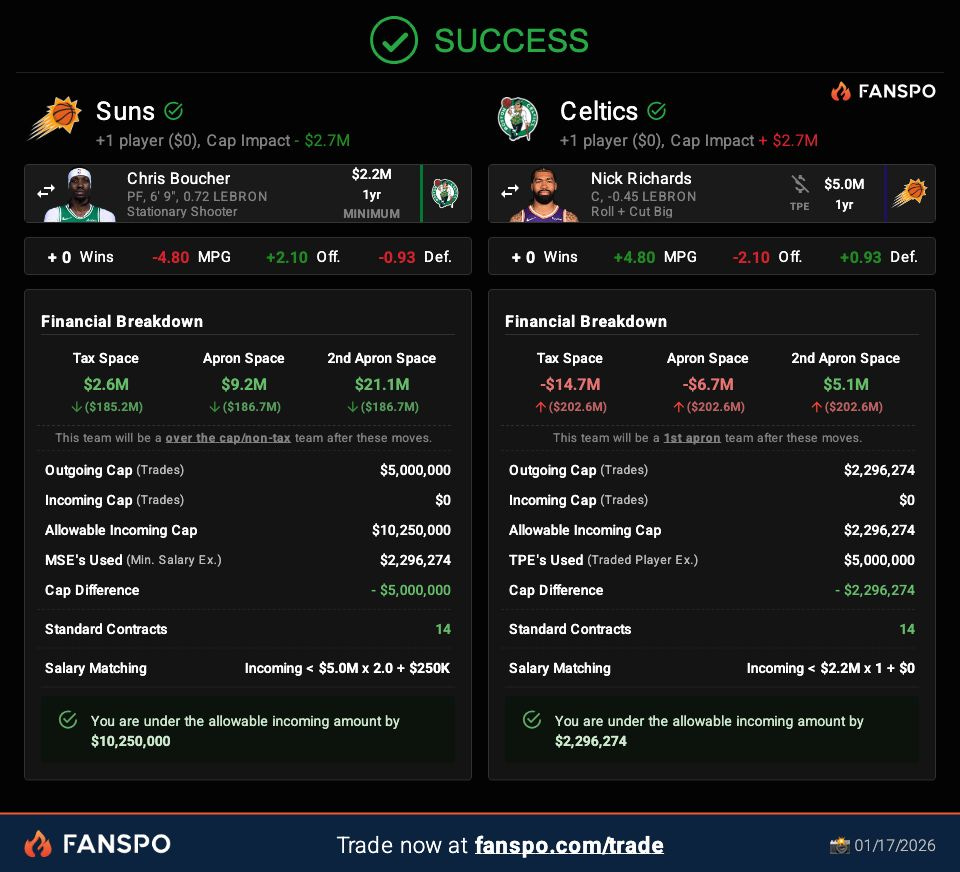
Celtics Receive: Nick Richards.18
Suns Receive: Chris Boucher.
Celtics Rationale: Luka Garza is currently the backup center for a team that might soon be the favorite to win the Eastern Conference. Having another center to try might not hurt.
Jordan Walsh and Josh Minott have emerged so Boucher has not played since November. Thoughts of trying to get under the tax this year are gone with how well Boston and, especially recently, Anfernee Simons have played.
Suns Rationale: In 50 games with Toronto last season, Boucher shot 36.3% from three on 10.8 attempts per 100 possessions. He had a 19.6% defensive rebound percentage, which would rank 20th for power forwards who have played 100 minutes this year.
Nick Richards has fallen out of the lineup and Phoenix has a more pressing need at power forward than center. The Suns should get under the tax with how close they are and this move gets them there.
Jordan Goodwin for Upside
Best Potential Partners: Cleveland, Houston, Minnesota, New York
Playoff series often require flexible rotations so I think there would be a lot of contenders interested in having Goodwin as a defensive and rebounding guard off the bench.
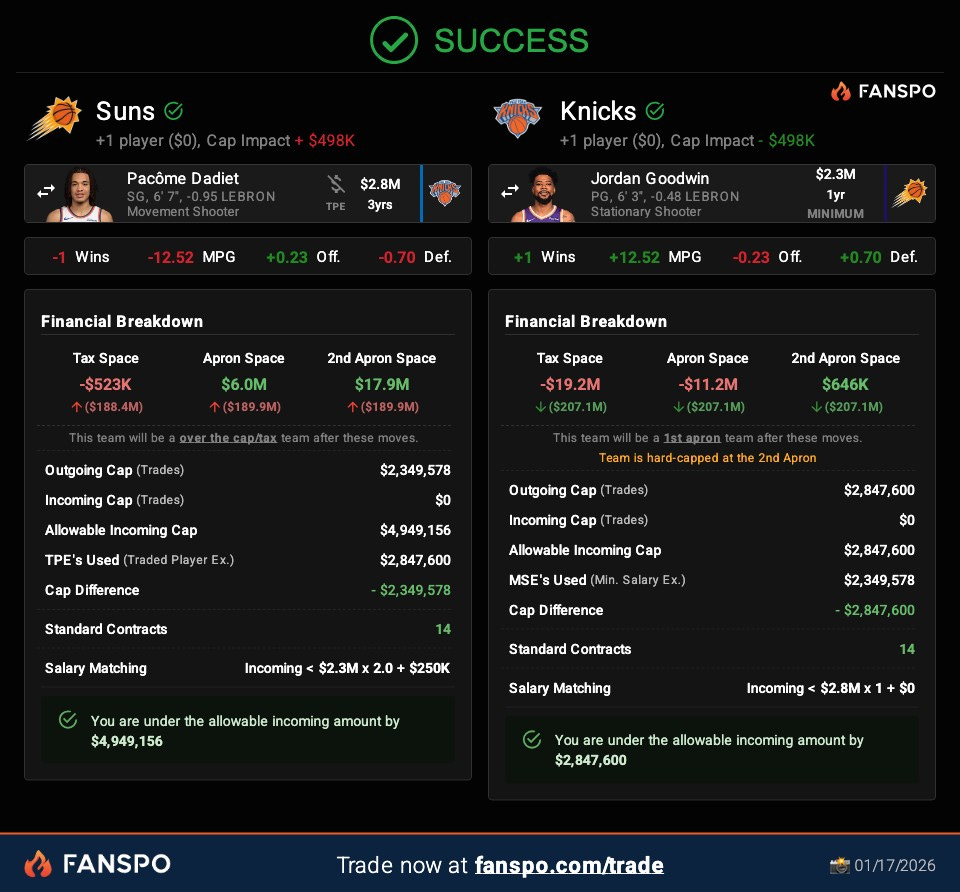
Knicks Receive: Jordan Goodwin.
Suns Receive: Pacome Dadiet. Washington’s 2027 second round pick (if Washington picks 1-8 in 2026)
Knicks Rationale: New York has plenty of guards (Brunson, McBride, Clarkson, Kolek) but not of this type. Goodwin could be a factor on a team looking to win a title.
Dadiet can’t crack the rotation and may get his fourth year option declined. For a team that flirts with the second apron, cutting a little money next year isn’t bad.
Pick-wise, best case scenario, Trey Young plays more than expected and with a little lottery luck the Knicks get Washington’s pick at #9 this year and the pick in this trade extinguishes.
Suns Rationale: Second draft guy. Give Dadiet a chance in a new environment and see what happens. What does it hurt for the Suns to have him for two years?
I’m going to bet against Washington until they prove me wrong. They tank this year and the obligation to New York becomes two second round picks. Maybe that 2027 ends up higher in the second round than you might think.
Goodwin has played the best ball of his career. At age 27, this is probably near his peak. No guarantee Phoenix could bring him back next year, nor should they try to at more than the minimum.
Sell High on Dillon Brooks
Best Potential Partners: Atlanta, Detroit, LA Lakers
As I said above, I think getting value for Dillon Brooks is a big deal. A reminder that only six months ago, Brooks was considered salary filler necessary for the Rockets to send out in order to acquire Kevin Durant.
Brooks’s play so far this season has been an outlier compared to the rest of his career as far as individual creation and shot efficiency, especially on two's away from the rim. It’s these types of opportunities, that will determine how quickly Phoenix can get back to being a real contender.
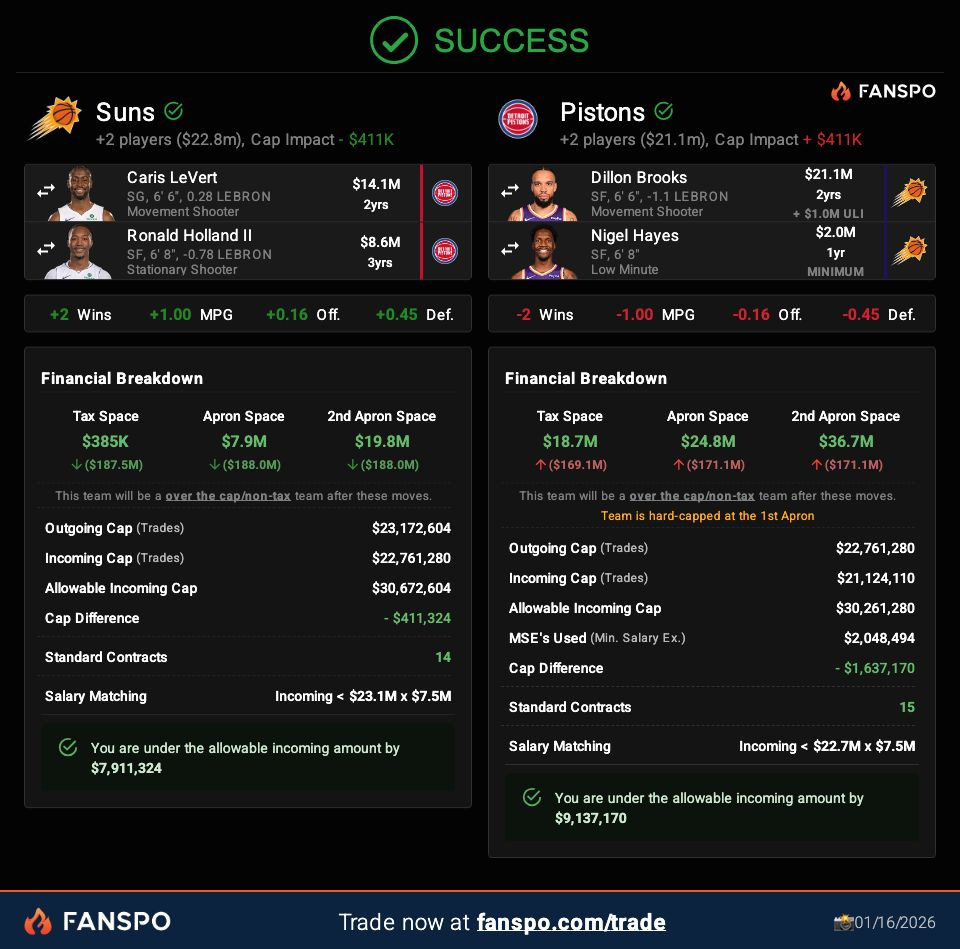
Pistons Receive: Dillon Brooks and Nigel Hayes-Davis
Suns Receive: Ron Holland, Caris LeVert, and Detroit’s 2026 First Round Pick.
Pistons Rationale: Detroit leans into their identity as a defensive terror, adding Brooks, who can flex between the two forward positions. He also adds a second side scoring option with some ability to shoot.
Holland and LeVert are playing the 7th and 8th most minutes for the Pistons but Jaden Ivey and/or Javonte Green can backfill those minutes as backend rotation guys. The pick will be late first round and Detroit is in win-now mode anyways.
Suns Rationale:
Phoenix gets below the tax with this move, picks up a young player with upside in Holland, and banks a first round pick in the upcoming draft in which they currently hold none. They likely try to flip this pick on draft night.
LeVert’s deal becomes an expiring contract next season and can be aggregated with others to make a subsequent deal if the Suns desire.
Buy! Buy! Buy!
Let’s play devil’s advocate here and look at what the Suns could do as buyers at this deadline. The play would be to flip Jalen Green or aggregate the salaries of Grayson Allen and Royce O’Neal to bring back a better player that makes up to $6.3 million more, as the Suns would be constrained by the first apron.
The problem is that Phoenix has no draft capital to attach. I see all three guys as pretty close to neutral value so you’re talking about bringing back a player that likely has issues of their own (cough, Ja, cough).
All three guys are under contract through next year and the Suns will have at least two first round picks to trade this summer, potentially a third if they find a taker for Brooks. Then, Phoenix might really be able to go hunting.
I still think that would be a rush job on a team that is not as close to contention as ownership would like to think, but I would prefer getting an expensive and really good player to making a move now for a moderately expensive and mediocre player.
2026 Offseason
If the Suns stay pat at the deadline, or only send and receive expiring contracts, here is what their cap table will look like on July 119, with Ighodaro almost definitely getting fully guaranteed (partial guarantee is why he shows in red):
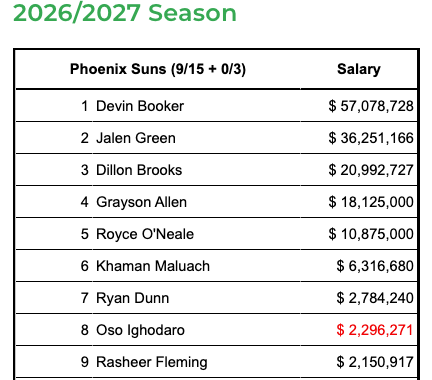
With over $23 million of dead money on their books (Beal/Little/Liddell), they will be $21.6 million from the tax line and $28.7 million from the first apron. It’s pretty safe to say that the Suns are going to blow by both of those numbers. This is just the nature of returning your five highest paid players and then wanting to re-sign two other starters.
Unless they make some moves to lower costs, Phoenix is going to be dancing with the second apron in 2026-2027. That threshold is $41.5 million away. Here are some of the second apron restrictions:
If the Suns finish the year above the second apron, their 2034 pick would be frozen. Maybe more importantly, if they went over again in either of the following two years, their 2032 pick would be moved to the end of the first round.
If they are over, they can’t use or have used the taxpayer midlevel ($6.1 million).
If they are over, they can’t aggregate or have aggregated contracts to bring back a larger contract.
While you can debate the priority of concern on these, I’m fairly confident the Suns are most concerned with the third.
If you assume that the Suns want to use the taxpayer MLE ($6.1 million) then fill out the roster with minimums (2 at $2.5 million each)20, there is about $30 million to use on Williams and Gillespie and still have a little bit of space. If it takes more than that, the Suns would need to send out enough money in any trade, to bring them back under the second apron with whoever they acquire.
Re-Signing Collin Gillespie
Gillespie spent two years in Denver on a two-way, before playing on a two-way in Phoenix last season. This year he signed for the minimum and the Suns hold his early Bird rights this summer.
With those, the Suns could offer Gillespie a four year deal, starting at 105% of the league annual salary, just under $15 million, with 8% raises. Total would be four years, $67 million.
Another team could offer the full non-taxpayer midlevel which would have a slightly (~$700k) higher first year, but be worth about $2 million less over the course of the deal due to only 5% raises. It’s also possible someone with cap space comes with a bigger offer. There may be other suitors, but Phoenix offers legitimate opportunity and things are working in The Valley.
Gillespie currently ranks 19th in EPM for guards. The 19th highest paid guard in average annual value (AAV) is Jalen Brunson at $39,137,281. The 38th is Alex Caruso at $20,274,240.
Even if the Suns gave him the max extension, his AAV would be only $17 million. I think Phoenix has to be willing to go to that, but it may be in both the team and Gillespie’s interest to do a shorter deal.
Austin Reeves got a 3+1 in a similar situation but in hindsight, would have preferred to get back on the market even quicker. This is another thing that gives the Suns an edge over other teams who would use the MLE and need three years to get him full Bird rights.
Both sides would argue to tack on an option; Gillespie with his current performance and the Suns with his limited history. The early bird exception requires two years so we could be talking a straight two year contract. If Gillespie prefers guaranteed money, maybe he’s willing to give a little back on a longer deal.
Result: 2 years, $31 million, no option ($14.9 million year one)
Mark Williams Restricted Free Agency
Williams was selected by the Charlotte Hornets with the 15th overall pick in the first round of the 2022 NBA Draft. The Suns traded for the big man, and thus hold his Bird rights.
With four years of service, Williams next contract could start at 25% of the salary cap and be for up to five years, with 8% raises. That would mean year one, around $41.5 million, and total 5 years, $240 million.
Williams is a starting-level center, but because he played only 106 of a possible 246 games in his first three years, is viewed as an injury risk and will have to concede some money in negotiations because of it. This was also likely to have been a major factor in him not agreeing to an extension last summer.
He is also a restricted free agent. The most another team could offer him up would be around $180 million over four years, but they need cap space to do it. I would rank him behind a number of other free agent centers, including, in no order, Mitchell Robinson, Jalen Duren, and Walker Kessler, the latter two also being RFA.21
That is to say, I think the Suns are in a pretty good position to negotiate here.
Williams currently ranks 19th in EPM for centers. The 19th highest paid center in average annual value (AAV) is Onyeka Okongwu at $15,495,000. Williams’s qualifying offer (QO) will be right around $14 million assuming he meets the starter criteria. I don’t think the Suns can offer much more than that to get him to accept a one year deal and essentially waive his QO no-trade.
Taking the QO is never a good thing for either side and since Phoenix gave up assets to get Williams, I’m thinking they are willing to come to a reasonable deal here. However, because Williams has a short track record due to injury, I think he will have to give up some value and/or accept a team option or non-guarantee.
Result: 3 years, $48 million, team option ($14.8 million year one)
Jordan Goodwin
Goodwin may end up being the odd man out in Phoenix. He has played well enough that multiple teams may be interested in acquiring his services for next season. However, I think most if not all will be offering the minimum. If that is the case, the Suns might look like the most attractive solution given his success this year.
In five years of NBA service, Goodwin’s career earnings total just under $5.7 million. While most competitive guys like to bet on themselves, securing multiple guaranteed years might be important to a guy that has bounced around the league.
If Phoenix is able to re-sign Gillespie and Williams at the numbers above, they would not necessarily need the veterans minimum to be at the 2-year service discount, which only applies to one year contracts.
Restricted free agency has run late into the summer for most players as of recent, so the Suns might not have a clear answer on Mark Williams for a while. But let’s say they take care of Goodwin and give him a two year minimum.
Result: 2 years, $6 million, no option ($2.9 million year one)
Taxpayer Midlevel
Only three teams used the TMLE in 2025-2026.22 Teams that use this exception basically get the cream of the crop vet minimums, but lock themselves into limited flexibility. I would only support going this route if the Suns were able to nab a difference making power forward.
Two guys at different points in their careers that I expect to be out of the Suns range but would be worth it are Kenrich Williams and Jeremy Sochan. Williams has a team option in Oklahoma City but could be a cap casualty. Meanwhile, Sochan’s time is San Antonio seems to have run its course.
Both guys would provide more rebounding and defense while getting a new opportunity. This could look like a prove-it contract, 2 years with a player option. The Suns would hope to build up their value and trade them at next year’s deadline.
If the Suns forego using the MLE, and sign a vet minimum instead, they will have another $3.5 million to spend elsewhere. They could use that towards that one-year deal for Williams if they can’t come to terms on a multi-year deal. They could also sign a 15th player at the minimum.
Result: No MLE used.
Draft
Phoenix does not hold a 2026 first round draft pick. As far as second rounders, they currently own the second most favorable of OKC, DAL and PHL (probably Philly).
With all the young talent on the team, there may not be a ton of space on the NBA roster. I’d prefer for the Suns to come to an agreement to take a player that is willing to go on a two-way and see how it goes from there. Upside is more important than if they can play immediately.
Long-Term Outlook
You’ll notice the trade deadline and free agency sections conflict. The former suggests trading anyone not tied down and the latter suggests running it back with mostly the same team. That’s pretty much the cap situation that the Suns are stuck in.
If they have dreams of aggregating the contracts of Green, Brooks, Allen, and O’Neale in some manner to bring back a star, I’m dubious. Because they are over the first apron, they will have to send out more money than they get back in any trade.
That likely means three of those four guys would have to go out if you are talking about a marquee star and then they’re right back to where they were with Booker and Durant and not enough around them. If they package two guys to go get a fringe all-star, they’re probably still not good enough at the top.
It’s not my money but history shows that owners do not like spending year after year for non-contenders. Suns owner Mat Ishbia has indicated that is fine with him, but even more so than the aprons, the 2023 CBA made the repeater tax a beefed-up deterrent to continued spending.
The Suns are too expensive for guys that would be great bench players on a championship roster, all but Brooks under contract through 2028. While this year has been exciting and fun, I worry it will actually set the Suns even farther back in the long run if they try to double down on what they currently have.
Assuming Booker stays, I’d like to see a 2027-2028 roster with Gillespie, Booker, Dunn, Fleming, Williams, Ighodaro, and Maluach in the rotation. Jalen Green is the wild card. If he gets back healthy and pops in the next year plus, that would be a huge boon. Otherwise, the Suns should be targeting additional guards and wings.
Anyone else currently on the roster should be on the trade block, trying to bring back expiring deals to get costs down, along with picks. Do that enough times, and good things can happen.
Appendix
Credit: Cleaning The Glass.
I’d like Oso Ighodaro to be able to play some at the four in two big lineups, but after playing 46% of his minutes there last year, it’s down to 6% this year, per basketball reference.
I’m adopting this term from Nate Duncan in reference to Voldemort splitting his soul into multiple pieces. The Suns have previously traded swaps, then sent out swaps of their swaps, diluting the value of the picks until they will almost assuredly end up in the late first round.
Frozen for at least the next year after finishing the 2024-2025 season above the second apron.
2026 and 2032 are also the lesser of two picks due to a swap.
Teams may not be without a first round pick in two consecutive future years.
The thought of Phoenix once again having two first round draft picks, 2027 and 2033, available to trade this summer makes me queasy.
There were no picks involved in either of the Oladipo/Sabonis deals.
Players that were drafted highly but underwhelmed, perhaps due to circumstance. Aaron Nesmith is the example de jour, after not being able to break into the Celtics rotation.
He is also somehow 9th in rebounding, 9th in assists, and 2nd in turnovers.
Nigel Hayes-Davis goes out to clear a roster spot in both of these. Picks incoming to Phoenix.
Also of note, the Suns get under the tax line this year and create a $5 million traded player exception to use next season.
Teams with eight or fewer players under contract had to leave at least one unprotected.
Again, depending on if those are still the rules at this time.
Via their Kristaps Porzingis traded player exception (TPE).
Credit: Yossi Gozlan, CapSheets.com
This gets them to the required minimum 14 rostered players. A team can have up to 15.
Also, Isaiah Hartenstein if the Thunder choose to cut costs.
D'Angelo Russell in Dallas, Al Horford in Golden State, and Guerschon Yabusele in New York
Awesome post man! As a Suns fan it's hard to see how Bradley Beal's contract hurt the team. Not wanting to part ways with many current players but Nick Richards would give us the most value I think
they’re so fun! 2nd in steals and 5th offensive boards.
guess dillon brooks is just great at creating a winning culture