


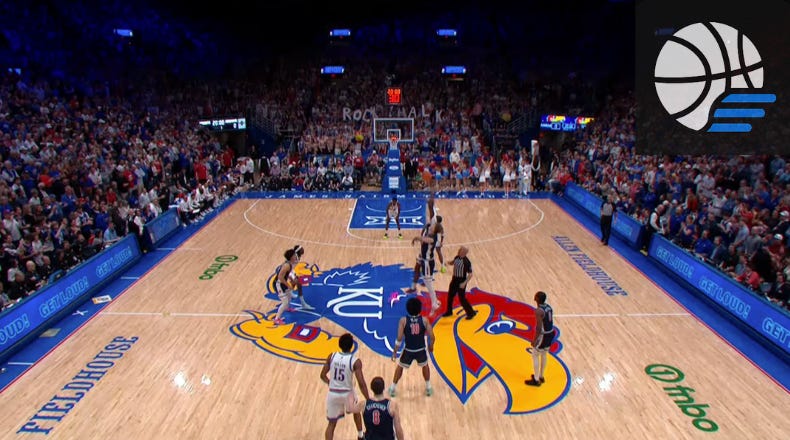
Arizona lost its first game of the season this Monday in Allen Fieldhouse. As usual, the discourse has ranged from “this is a good thing for Arizona” to “they have been exposed”. The schedule only gets tougher from here with five more ranked opponents leading into postseason play.
Concerns
Arizona held a 55-44 lead with 17:02 remaining versus Kansas. At that point KenPom estimated a win probability of 89.2%.
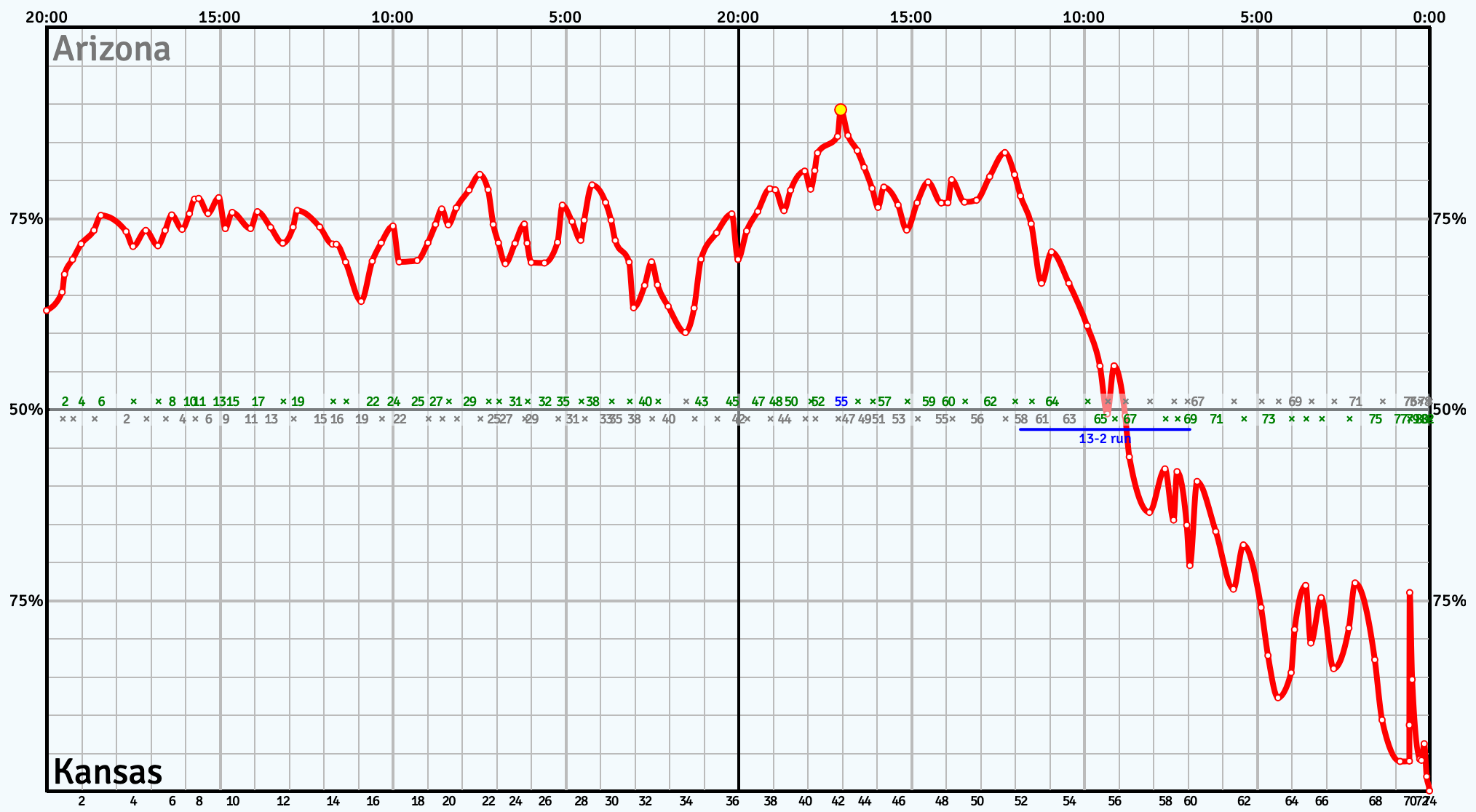
One might think that rating was an underestimate given that the Cats are one of the most consistent teams in the country.1 However, this was not the first time this year that the Wildcats struggled to maintain a second half lead.
After holding 75% win probabilities against Florida, UCLA, and Connecticut, Arizona was forced to come from behind to win each of those games. They also nearly gave up a game recently in Provo where they held a 99.7% win probability with just over a minute to go.
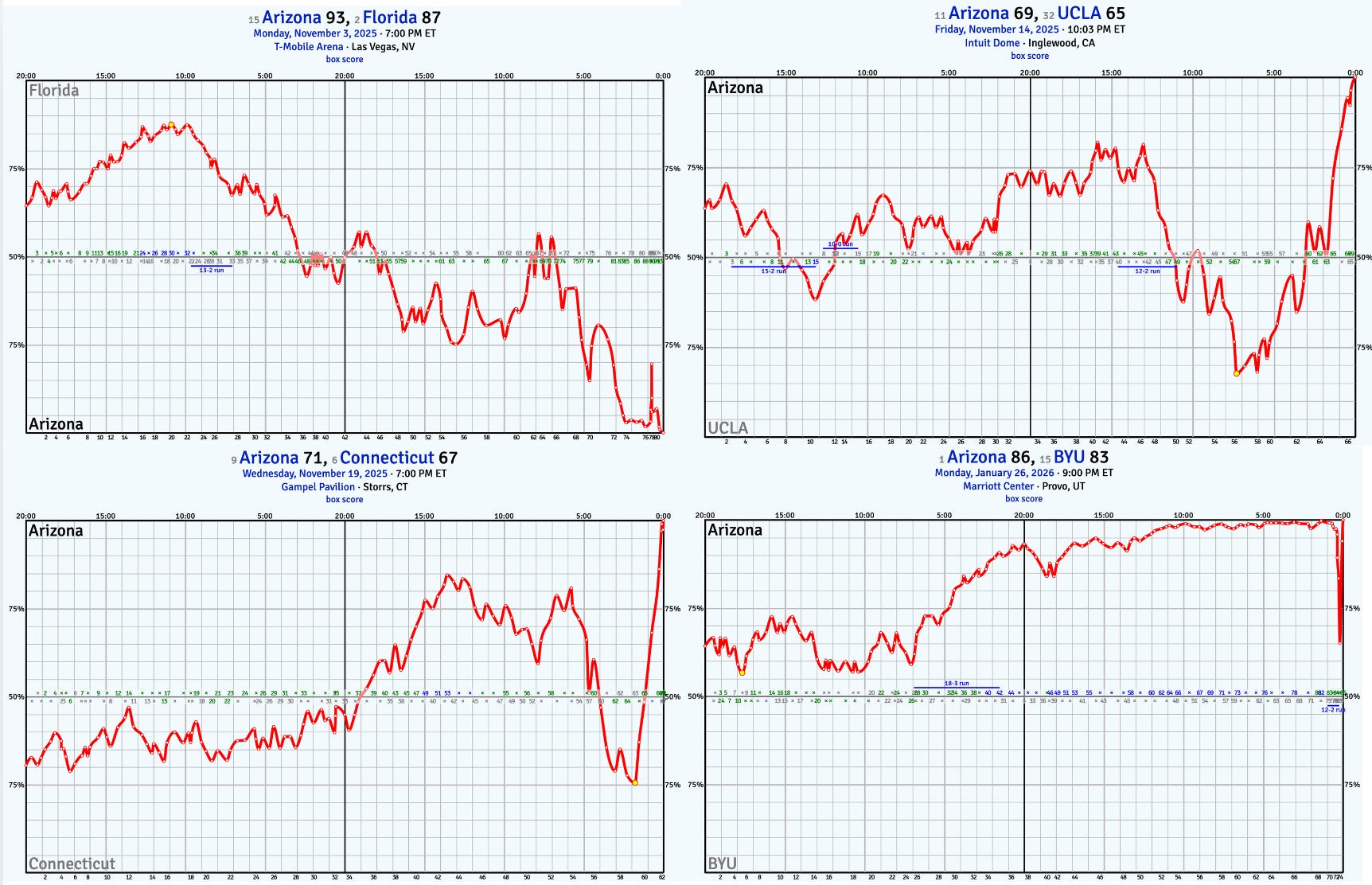
If the Wildcats beat teams with great defense and an offense built to punish teams in the paint, why have they not been able to rely on those things to put away their best opponents? It’s certainly a question worthy of more analysis for Coach Lloyd and staff.
For this article, let’s take the opportunity to review the opposite side, since we have had so few opportunities to do so. How do the Cats play when they are down late?
Late in games, it is well understood that teams that are losing must play the “foul game”, which is preferable to letting the clock run out. I will however refer to this 2017 article from Zach Lowe discussing The Basketball Tournament’s implementation of the Elam ending, in which he quotes Elam’s research finding that of 397 televised NBA games since 2014 in which the losing team had played the “foul game”, they had won a total of zero.
They are rare but not impossible, as Arizona fans know from last season’s contest against Iowa State where Joshua Jefferson was fouled and missed one of two free throws preceding Caleb Love’s tying shot from beyond half-court. Arizona eventually prevailed in overtime.
Against Connecticut, the Huskies never led by more than two points (at 3:02 and 2:16). The first deficit was answered by a Koa Peat stick-back of his own miss and the second deficit by a single made Peat free throw, a defensive stop, and then a stick-back by Mo Krivas. The Cats never relinquished the lead again.
There was never a need for Arizona to adjust its offensive strategy against Connecticut as they were never more than a single possession down. However, once a team is down three or more with few possessions left, a new factor becomes much more significant, variance.
Abandon all hope, ye who enter here: there be math ahead.
Here’s an overly simplified example. A team trails by 4 with a minute to go. They can choose between:
Strategy X which has an expected value (EV) of +1 with a variance of 3
Strategy Y with an EV of -1 and a variance of 10
In the long run, the former will incur to a two points better outcome on average.2 So, which would you choose?
In this toy example, Strategy X will result in a win 4.2% of the time while Strategy Y will result in a win 5.7% of the time.3 Variance is the friend of the trailing team.
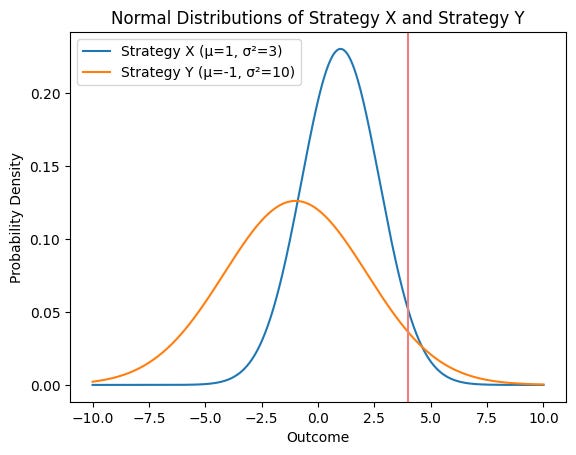
And this is something I have been surprised to not hear more about the last couple of days. What’s one of the most obvious ways to increase variance? Shoot threes instead of twos, something the Wildcats just do not do.
A quick aside: win probabilities (WP) are notoriously difficult to calculate. Think of all factors that would need to be included: time, score, possession, foul counts, timeouts remaining, challenges remaining, possession arrow, personnel for both teams, etc. Essentially everything that defines the state of the game.4
But that doesn’t mean they are useless.5 Kenpom does not expose its WP model and the best college basketball WP calculator I found from Bart Torvik is, by his own admission, crappy. A bespoke semi-accurate WP model6 would be a huge advantage for any program and I hope Arizona uses one.
For this discussion, I will be using the inpredictable NBA WP calculator as it is the best publicly available one I know of.
Scenario #1: 49 seconds remaining. Kansas 77 Arizona 71. UofA ball.
Following a Melvin Council Jr. bucket, Coach Lloyd took his third timeout of the game. Arizona’s win probability at this moment was 1.5%. Here is Arizona’s next possession (sorry for the TV glitch).
This possession is slow to develop with a quarter of the remaining game time elapsing.
Of Arizona’s eight rotation players, the two with the greatest 3 point attempt rates are Anthony Dell’Orso and Dwayne Aristode, neither of whom are on the floor coming out of the timeout.
Here are the win probabilities at the end of a possession with 37 seconds left:
Jaden Bradley has shot 46.6% (27/58) on the season on two-point jumpers outside the paint.7 I have written previously about my dislike for two point shots away from the rim, specifically related to this Wildcat team’s increased usage of them against quality opponents.
I’m right with Coach Lloyd, who said he wants “paint twos and free throws,” but my guess would be that he also generally opposes these midrange shots, especially in this scenario.
Strategy X (midrange jumper): 0.466 x 2.0% + (1-.466) x 0.2% = 1.04% WP
— Consider breakeven three point percentage as variable p
Strategy Y (three pointer): p x 4.9% + (1-p) x 0.2% = 1.04% WP
— p = 0.179
If Arizona could have shot a three pointer on this possession with at least an 18% chance of going in, they would have been better off than the shot they got.
That’s without even accounting for the fact that they would have had nearly 30% more opportunities for offensive rebounds which would knock that breakeven point down even further. I also think they could have gotten a three pointer off much quicker.
Scenario #2: 31 seconds remaining. Kansas 79 Arizona 76. UofA ball.
After the Bradley jumper, Ivan Kharchenkov made a great defensive play to force a turnover and Arizona ran what I called “high cut double” in my baseline-out-of-bounds video, and what Arizona signals as “elbow-two” for a Burries three-pointer.
The Wildcats purposely fouled Council who made both free throws (10.2% WP), setting up the classic three vs quick-two decision. Here’s how that played out:
Arizona made no offensive subs during the Council free throws and still had two non-shooters on the floor.
The possession was again slow to develop. Burries field goal attempt ended at 0:18, meaning the Wildcats used 42% of the remaining time before attempting a two-point field goal.
Here are the win probabilities at the end of a possession with 18 seconds left:
It is harder to say what the EV would be for Burries on this take than the Bradley jumper above. Part of the value in the quick-two strategy is that the defense does not want to foul and may give up an easy layup. That was not the case here, but I think it is inarguable that a shooting foul would have been a good result for the Wildcats on that drive.
Burries is a 78.8% FT shooter and the chance he makes both is 62.1%. I am ignoring if he makes 1 of 2 but I am also assuming he gets fouled 100% of the time (with no and-one). I could complicate this further but I would still be making a lot of guesses on percentages.
Overall, I am very comfortable saying that 1.242 points is an upper bound on the expected value of that drive, and I believe that in reality, it is lower. But let’s use that as our input.
Strategy X (take to basket): .621 x 18.3% + (1-.621) x 2.9% = 12.5% WP
— Consider breakeven three point percentage as variable p
Strategy Y (three pointer): p x 38.1% + (1-p) x 2.9% = 12.5% WP
— p = 0.272
This is closer than the first situation, but I still think Arizona could have found a 27% three-point attempt, and found one much quicker than this drive. I will again say that breakeven number is even lower in reality due to more offensive rebound opportunity and the fact that we used an upper bound for the drive EV.
Scenario #3: 16 seconds remaining. Kansas 80 Arizona 76. UofA ball.
Council split these free throws and Kharchenkov grabbed the defensive rebound (3.2% WP). This time he pushed the ball quickly to the basket and dished to Krivas for an 8-foot push shot.
Here are the win probabilities at the end of a possession with 10 seconds left:
The shot that Krivas ends up with is about as good as you can hope for. But our analysis is based on the moment Kharchenkov chooses not to pull up for three and to instead drive inside the arc. Just for fun, let’s say at that moment he has an 80% chance of scoring, which is unreasonably high.
Strategy X (take to basket): 0.8 x 5.0% + (1-0.8) x 0.3% = 4.1% WP
— Consider breakeven three point percentage as variable p
Strategy Y (three pointer): p x 14.3% + (1-p) x 0.3% = 4.5% WP
— p = 0.269
And again, a 27% chance at three would have still been a better choice, with all the other caveats mentioned above.
Scenario #4: 10 seconds remaining. Kansas 80 Arizona 78. KU ball.
No more math. Back to straight film breakdown. Arizona took their final timeout after the made basket to set up their pressing defense. Here’s what followed:
I think there are two decisions to be made and communicated in the huddle:
Are we switching everything or are we staying with our man?
Are we fouling immediately or are we trying for a steal then fouling if another pass is made?8
After watching this clip multiple times, I cannot answer either question.
Arizona made one sub here, Tobe Awaka replacing Mo Krivas. Understandably, the Cats did not want Krivas chasing his man around and/or switching onto a guard, although I find it hard to believe Aristode wouldn’t have been even more suited to the task than Awaka. I would have also been intrigued to see Krivas on the ball if the plan was to foul immediately on an inbounds.
Awaka and Bradley’s men come together and the way Awaka covers towards the ball tells me he has no intention of switching. Kharchenkov’s man sets a screen that he does not switch. Meanwhile, Burries leans on the screen and his man gets ten feet of separation.
It’s worth mentioning that there is no additional punishment in college basketball for fouling before the inbounds. In the NBA such a foul would result in one free throw and retention of possession. You would expect players to be totally locked to their man, playing physical, holding jerseys. We’ve seen this by opponents trying to come back vs Arizona.
Peat leaves his man immediately on the pass but with Bradley and Awaka both up the floor, neither is close enough to take away the pass back to the inbounder and the chase is on.
In the end, it probably didn’t make a difference to give that foul with 0:05 instead of 0:10. Tre White made both free throws and iced the game. But that’s what is almost always to be expected when playing the foul game without much variance.
Rotations
One of the toughest things to evaluate analytically is lineup combinations. As stated before, this type of analysis suffers from small sample size. However, the Wildcats have kept a fairly consistent rotation this season and have been fortunate to mostly avoid injuries9.
The same five guys have started every game and those guys have started the second half together in 22 games. Kharchenkov missed most of the Norfolk State game after an ankle roll and Jaden Bradley came off the bench in the second half versus Denver.
Arizona has a fairly clean separation of players in their rotation: three guards (Bradley, Burries, Dell’Orso), two small forwards (Kharchenkov, Aristode), and three posts (Peat, Krivas, Awaka).
Arizona has played 1594 possessions with some combination of these eight guys (i.e., non-garbage time).10
Guards
0 possessions with 0 of 3.
10 possessions with 1 of 3. (4 JB only, 5 BB only, 1 ADO only)
1472 possessions with 2 of 3 (341 no JB, 386 no BB, 745 no ADO)
112 possessions with 3 of 3
Small Forwards
67 possessions with 0 of 2.
1427 possessions with 1 of 2. (964 IK only, 463 DA only)
101 possessions with 2 of 2.
Posts
0 possessions with 0 of 3.
137 possessions with 1 of 3. (17 KP only, 42 MK only, 78 TA only)
1458 possessions with 2 of 3 (291 no KP, 480 no MK, 686 no TA)
1 possession with 3 of 311
Arizona plays a lineup of two guards, one small forward, and two posts in 87% of possessions (1381/1594).
Substitution Patterns
Because of the mostly clear separation in positional groupings, substitutions have predominantly stayed intra-position, especially at the beginning of each half.
Guards
Guards have fully rotated (e.g., Dell’Orso subs for Bradley, Bradley for Burries, then Burries for Dell’Orso) to start the first half in 16 of 24 games. Four more of those games saw a three guard lineup briefly before Kharchenkov replaced Dell’Orso.
Guards have fully rotated to start the second half in 12 of 24 games, with most exceptions occurring due to large leads.
In the earlier part of the season, Burries was more often the first guard subbed out, but as the season has gone on, Bradley is more often coming out first.
Small Forwards
Small forwards have fully rotated (i.e., Aristode subs for Kharchenkov, then Kharchenkov for Aristode) to start the first half in 18 of 24 games.
Small forwards have fully rotated to start the second half in 13 of 24 games.
Posts
Posts have fully rotated (e.g., Awaka subs for Krivas, Krivas for Peat, then Peat for Awaka) to start the first half in 16 of 24 games.
Posts have fully rotated to start the second half in 8 of 24 games.
Krivas has been more likely to sub out first than Peat.
Lineup Combinations
It should surprise no one that the most commonly used 5-man lineup is the starting five, which has played 453 possessions together (28.4% of non-garbage time).
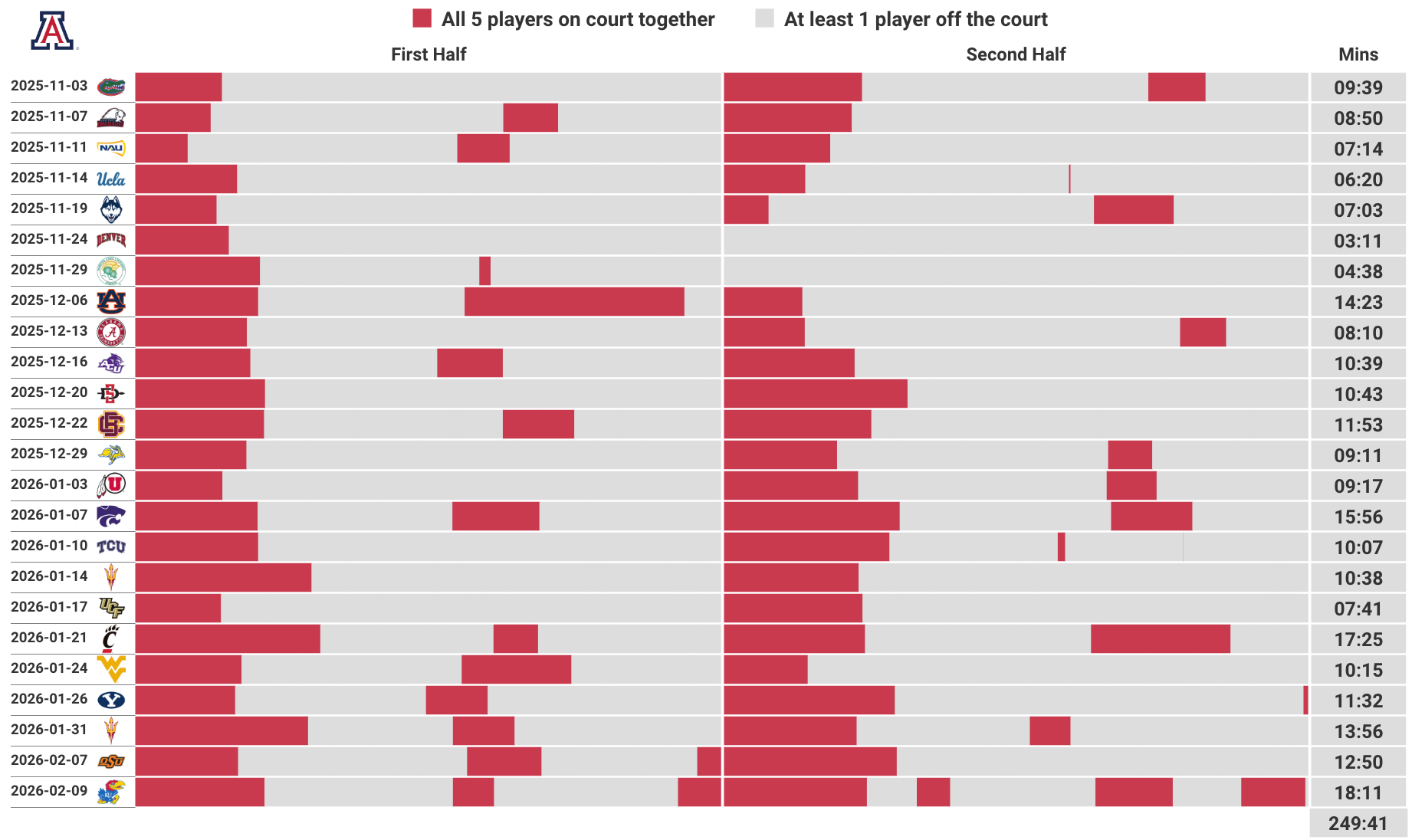
Furthermore, the most common 3-man combos are the ten possible combinations of the starters.12 However, because of the consistency of the substitution patterns, the next most common 3-man combination includes no starters.
The combination of Dell’Orso, Aristode, and Awaka has played 401 possessions together (25.1% of non-garbage time). Another way to say this would be that Arizona plays over a quarter of its non-garbage time possessions with only two starters on the floor.
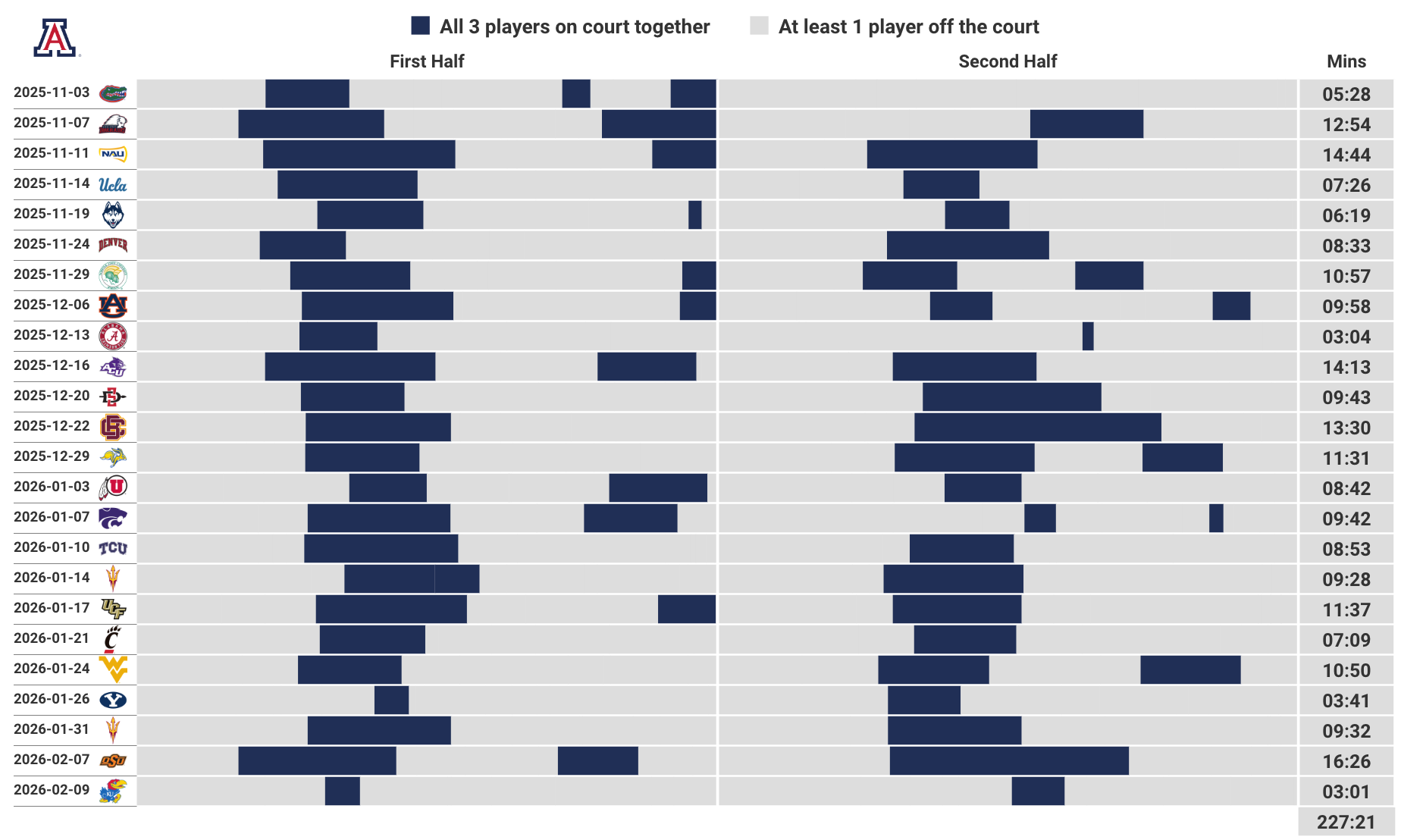
I started looking at these combinations to evaluate Dwayne Aristode, who is a nice complimentary piece right now, but not a creator yet, and was initially surprised to see that he has only played 23 possessions this year slotted in at small forward with the two starting guards and two starting posts.
Dell’Orso has more time amongst the starters due to the three guard lineups, but totals only 128 possessions along one starting guard, Kharchenkov, Peat, and Krivas. Awaka has the most shared floor time with four starters, 195 possessions.
Predictions Going Forward
If you look at the two charts above, the BYU game and especially the Kansas game included a lot less of the three subs together and more of the starters. That partially just has to do with total minutes played.
With Dell’Orso’s minutes trending more similar to Aristode’s, predominately so Bradley and Burries can spend more time on the floor, I wonder if there is opportunity to stagger ADO and DA more.
The current pattern has been to sub at all three positions between 16 and 14 minutes on the clock. The posts almost always start their rest here but the guards sometimes delay, which I think makes more sense if they each will only get one break.
If Aristode but not Dell’Orso entered around 16, the Cats could bring Kharchenkov back with Dell’Orso around 12. Bradley and Burries would take their rest from 12 to 6 before Aristode spotted Kharchenkov once again from 6 to 4 so he is fresh for the close.
Such a pattern would elevate the two starting guards to 34 minutes and Kharchenkov to 28 minutes, while Aristode and Dell’Orso would each get 12 minutes per game. Of course, this would only be a guide that could be adjusted depending on game conditions, especially if there was a reason to play the three guards and/or Kharchenkov at the four for awhile.
As far as the posts, their stints have been shorter, more matchup dependent, and often altered due to the foul situation. I wouldn’t suggest trying to time those up with any of the other rotations. It’s best for all three to be able to play hard, get a rest, and go again.
However, the numbers bear out that the Cats are best with Krivas on the floor, especially defensively. If Krivas can only go 24 minutes, then that’s what it is. But if there is a way to push those numbers to the high 20’s, I think it would be in the Wildcats favor.

Krivas, who is shooting 80% from the free throw line, compared to Awaka (65%) and Peat (61%), has not closed many games this year. The Cats game at Kansas was the first since early games against Florida, UCLA, and UCONN where he played the majority of the last four minutes.13
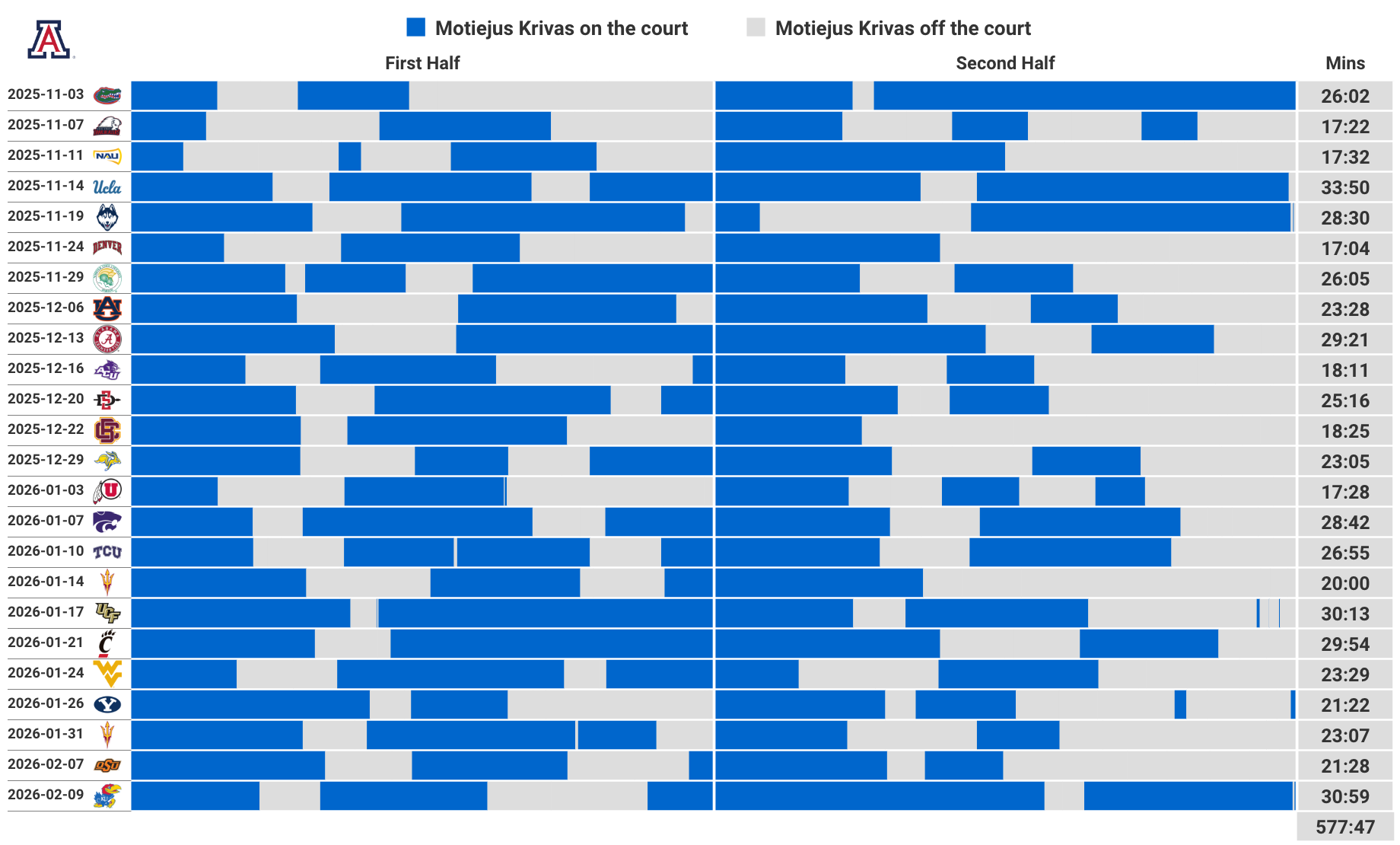
I’ll be looking to see if Coach Lloyd and staff adjust the second half rotations so he is ready to close against the gauntlet of opponents Arizona has remaining.
Challenges
Coach Lloyd and staff remain perfect on the year, now 5-0 on challenges and 1-0 on appeal for flagrant foul, after successful challenges versus Oklahoma State and Kansas.
A couple of things of note:
These were Arizona’s first challenges since December 20th vs San Diego State
These were the two earliest times in the game that Arizona has risked a timeout for challenge or appeal.
Related to the challenge vs Kansas: I’ve voiced my disappointment in the NCAA omitting fouls from their challenge process and I mentioned specifically the “foul proximate to the out-of-bounds violation” in a previous article. Here’s how the NBA rule is worded in Rule 14, Section III(b) :
If an instant replay review of an out-of-bounds violation is triggered by a Challenge, the Replay Center Official will review the video to evaluate whether the out-of-bounds violation was correctly called.
The Replay Center Official (and, with respect to Section III (b) (7) below, the on-court crew chief) may also review the video to determine only the following other matters:…
7) Whether a foul proximate to the out-of-bounds violation should have been called.
Well that doesn’t exist in college basketball. If you think Brayden Burries fouled Elmarko Jackson, there is nothing the referees can do about it if they didn’t call it live. And they can’t let Kansas keep the ball if it touched Jackson last.
This time, it may have worked in the Wildcats favor but I remain nervous where this case could arise in a more pivotal moment.
Next Game: Home vs Texas Tech on Saturday, February 14th, 4:30PM MST.
As ranked at EvanMiya.com.
God save our net rating.
Using normal distributions for this example.
This is much easier to do in sports with discrete rather than continuous events, such as football, where the Coach of the Year, made a horrible decision in the Super Bowl.
One of my favorite quotes: “All models are wrong, but some are useful.” - George E. P. Box
Likely some form of logistic regression machine learning model.
The D1 average is 36.4% so Bradley is elite and still doesn’t make half of these shots.
Worth mentioning is that two possessions previously, referee Doug Sirmons had immediately called a foul on Koa Peat when he went to trap with Jaden Bradley. That might make me lean a little more towards foul immediately, since a hard trap would have less value.
Knock on wood.
All counts from CBBAnalytics.
5 choose 3 = 10
Yes, most of these were blowouts so he didn’t need to be out there.